Husband: "Sireomeoni is the correct expression and polite"
Dispute story goes viral... National Institute of Korean Language says "same level"
A story has been shared about a woman who had a major marital fight after saving her husband's mother in her phone contacts as 'Simeo-nim' (mother-in-law) instead of 'Simeoni' (mother-in-law). The issue arose from saving the contact as ‘Simeoni’ rather than ‘Simeo-nim’.
On the 12th, a woman named A, who is in her third month of newlywed life, posted her concern on the online community Nate Pann, drawing attention.
A said, "While my husband was handing me his phone, I saw a call from my mother-in-law."
Then her husband suddenly got angry at A, asking if she had saved the contact as 'Simeoni' instead of 'Simeo-nim.'
 A story has been shared about a woman who had a big fight with her husband after saving her husband's mother as 'Si-eomeoni' (mother-in-law) in her phone contacts.
 [Photo source=Pixabay]
Because of this, A said, "We had a big fight and are currently in our first cold war since marriage." A's husband insisted that 'Simeo-nim' is the correct and polite expression. He also questioned A, saying, "Wouldn't you feel bad if I saved my mother-in-law as 'Jangmo' (mother-in-law) instead of 'Jangmo-nim'?"
A asked, "How can 'Simeoni' and 'Jangmo' be the same? Isn't 'nim' an honorific suffix for mother?" But her husband kept insisting, "No, from my perspective, 'Simeoni' and 'Jangmo' are the same."
Not understanding her husband, A said, "It feels bad to be made out as rude just because of a difference in thinking. Even if you say it's a difference in opinion, it just looks like you're being unreasonable. If it bothers you that much, then change it to the same 'Jangmo'." She did not back down.
Three days later, her husband sent a message saying, "Can't you understand me? If it makes me feel bad by my standards, isn't it something you can understand and change? Am I the only one who has to understand?" But A asked netizens, "Is it right for me to understand my husband? I still don't get it."
Netizens who read the story responded in unison that they could not understand A’s husband, with comments like "Jangmo and Simo are the same," "If your mother-in-law’s phone has you saved as daughter-in-law, tell her to change it," and "Change Simeo-nim to match Jangmo-nim."
According to the National Institute of the Korean Language, both 'Eomeoni' and 'Eomeonim' can be used
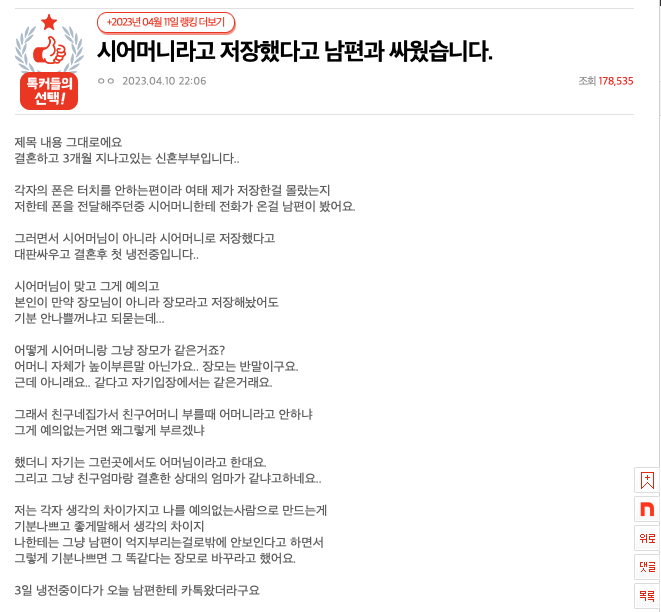 On the 10th, a woman named A, who has been newly married for three months, shared her concerns on the online community Nate Pann. [Photo source=Nate Pann]
Is the expression 'Eomeoni' really a lowered form of 'Eomeonim,' which caused controversy in the previous story? According to the 'Standard Language Etiquette' published by the National Institute of the Korean Language in 2011, both 'Simeo-nim' and 'Simeoni' can be used as expressions of the same level.
The National Institute of the Korean Language explained, "Both 'Eomeonim' and 'Eomeoni' can be used to address the mother-in-law. Traditionally, the honorific 'Eomeonim' was used for the mother-in-law, but in reality, many people address her as 'Eomeoni,' so this has been accepted."
They further stated, "The affectionate term 'Eomeoni' does not violate etiquette."
For the mother-in-law herself, both 'Eomeonim' and 'Eomeoni' can be used without violating language etiquette. However, it is recommended to address her as 'Eomeonim' when speaking to the husband, the husband's peers, or their spouses. For the wife's family or others, all forms?'Simeo-nim,' 'Simeoni,' and 'Eomeonim'?can be used.
© The Asia Business Daily(www.asiae.co.kr). All rights reserved.


















