Samyang Foods Reviews Legal Response Centered on Legal Team Over Similarity in Packaging and Design with Buldak Bokkeummyeon
The Buldak Bokkeummyeon series launched by Samyang Foods is gaining popularity worldwide, including in the United States, Europe, and Russia. Amid this, Japan's Nissin Foods, the world’s first company to develop instant ramen, has released copycat products imitating Samyang Foods' Buldak Bokkeummyeon series, sparking controversy both domestically and internationally.
Recently, online communities and social networking services (SNS) have pointed out that products from Japan’s Nissin, the world’s first instant ramen company, have packaging similar to Samyang Foods' Buldak Bokkeummyeon products.
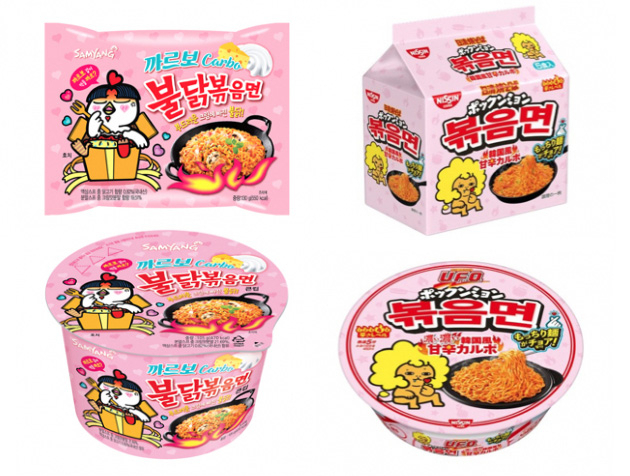 Recently, online communities and social networking services (SNS) have raised concerns that a product from Japan's Nissin, the world's first instant noodle company, has packaging similar to that of Samyang Foods' Buldak Bokkeum Myun.
 [Photo by Samyang Foods, Nissin]
According to industry sources on the 11th, Nissin released bagged ramen products such as 'Nissin Yakisoba Bokkeummyeon Korean-style Amakara (甘辛·sweet and spicy) Carbo 5-pack' (hereafter Nissin Carbo) and cup ramen products like 'Nissin Yakisoba U.F.O Bokkeummyeon Rich Korean-style Amakara Carbo' (hereafter Nissin Carbo Cup Ramen).
Samyang’s Carbo Buldak features a spicy sauce combined with cheese to create a smooth carbonara flavor. Nissin also describes its new product as having “the umami of gochujang and cheese.” The packaging is similar as well. Nissin applied a light pink color to the ramen packaging, similar to Samyang’s Carbo Buldak. Both products feature a cute character on the left side. On the right side, both have images of the cooked product. Nissin also printed “볶음면” (bokkeummyeon) in Korean or emphasized “Korean-style” in the center of the packaging.
Some netizens have pointed out that such similar designs, including the color and Korean text, could confuse consumers.
Samyang Foods established its local sales subsidiary Samyang Japan in 2019 to officially start its business in Japan. Since March 2020, beginning with the Buldak Bokkeummyeon series, it has continuously expanded its product lineup. Recently, it launched products like Yakisoba Buldak Bokkeummyeon tailored to local trends to actively target the market. Sales in 2022 reached 2.1 billion yen (approximately 20.8 billion KRW), a 26.9% increase compared to the previous year.
Regarding Nissin’s products, Samyang Foods stated that its legal team has reviewed possible legal actions but noted difficulties in responding solely based on trademark rights since the product names differ.
An official said, “We are actively exploring various measures related to unfair competition prevention. We hold the trademark rights for Buldak Bokkeummyeon (in both Korean and Japanese) in Japan. Since Samyang Foods’ Buldak Bokkeummyeon has high recognition in Japan, we plan to conduct marketing activities emphasizing originality.”
Korea Requested Technology from Japan, the 'Ramen Powerhouse,' in the 1960s
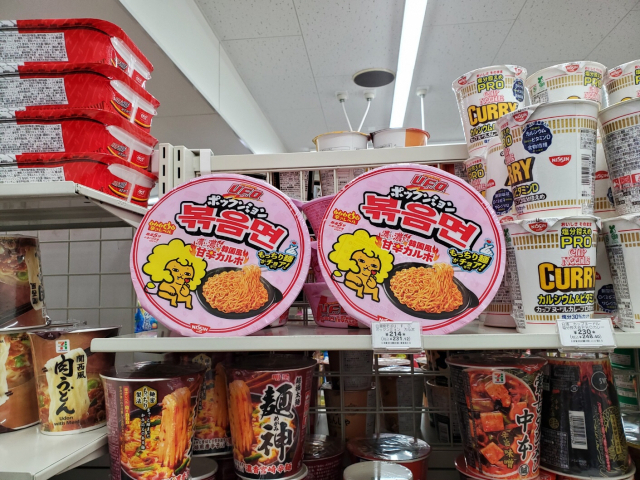 Nissin applied a light pink color similar to Samyang's Carbo Buldak on the ramen packaging. Both products feature a cute character on the left side.
 [Photo by Samyang Foods]
Meanwhile, Nissin’s blatant release of copycat products has brought renewed attention to the past relationship between the two companies.
In the 1960s, Samyang requested technology transfer from Nissin to develop domestic ramen but was refused. At that time, Myojo Foods, a rival company of Nissin, provided the technology free of charge, leading to the birth of Korea’s first instant ramen, “Chicken Ramen,” in 1963.
The fact that Samyang, which once lacked even ramen development technology, is now being imitated by Japan’s leading ramen company Nissin is seen as an example of how the status of domestic companies has changed over the past 60 years.
© The Asia Business Daily(www.asiae.co.kr). All rights reserved.
![Clutching a Stolen Dior Bag, Saying "I Hate Being Poor but Real"... The Grotesque Con of a "Human Knockoff" [Slate]](https://cwcontent.asiae.co.kr/asiaresize/183/2026021902243444107_1771435474.jpg)

















