The northern region of China has been engulfed in a "sandstorm" caused by yellow dust originating from Mongolia. In some areas, the springtime pollen dispersal has compounded the situation, resulting in the worst air quality conditions.
On the 10th, the China National Desertification Monitoring Center announced that the Mongolian yellow dust struck parts of the Inner Mongolia Autonomous Region and is moving southeast along air currents. Consequently, the National Meteorological Center issued a blue alert for sandstorms across 12 northern provinces of China. China's yellow dust warnings are divided into four levels: blue, yellow, orange, and red, with red indicating the most severe pollution.
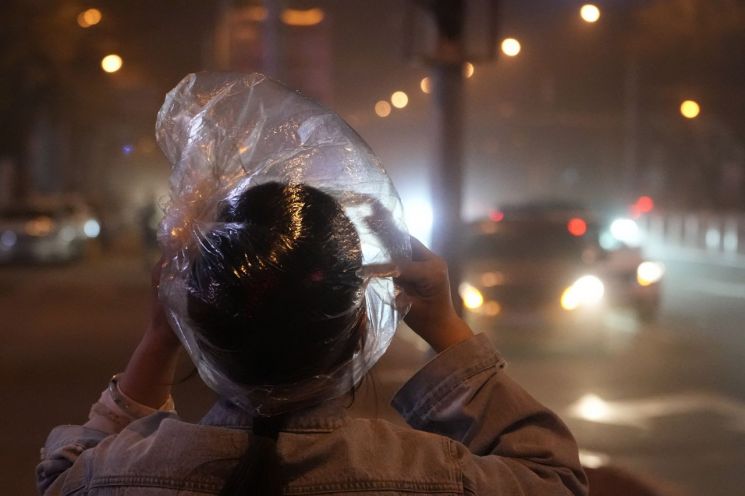
According to the center, the sandstorm is expected to hit regions including southern and eastern Xinjiang, the Qinghai Basin, western and northern Gansu Province, Ningxia, central-northern Shanxi Province, Inner Mongolia, Hebei and Shandong Provinces, Beijing, Tianjin, northern Henan Province, southwestern Heilongjiang Province, western Jilin Province, and central-western Liaoning Province.
The Beijing Meteorological Bureau raised the alert level to yellow starting that night and recommended the closure of major outdoor recreational facilities. In some areas, strong sand winds are expected to continue until late night on the 11th. As of 7:45 AM on the 11th (local time), Beijing's air pollution index soared to the maximum measurable value of 500. The city is also experiencing widespread pollen dispersal, resembling heavy snowfall, making it difficult to walk outdoors without a mask.
Meteorologist Zhang Mingying told the Global Times, "This past winter and spring have seen less rain and snow than usual, leading to severe drought," adding, "More dust is being emitted from desert areas." She further predicted, "By late April or early May, as the weather warms and rainfall increases, dust generation will gradually ease." According to the Disaster Management Department and other authorities, China experienced six sandstorm events in the first quarter of this year alone, with four occurring in March.
© The Asia Business Daily(www.asiae.co.kr). All rights reserved.

















