Seongnam Seoul National University Hospital Professor Kim Jeong-hoon’s Research Team
AI Trained on 20,000 Household Noises... 86% Accuracy
"Core Technology Usable for Sleep Tech"
A technology that allows easy detection of sleep apnea at home using a smartphone has been developed by domestic researchers.
Professor Kim Jeong-hoon’s team from the Department of Otorhinolaryngology at Bundang Seoul National University Hospital (co-corresponding author Dr. Kim Dae-woo from A-Sleep) announced on the 11th that they have developed a technology that can detect sleep apnea in real time even in home environments with various noises by utilizing a smartphone.
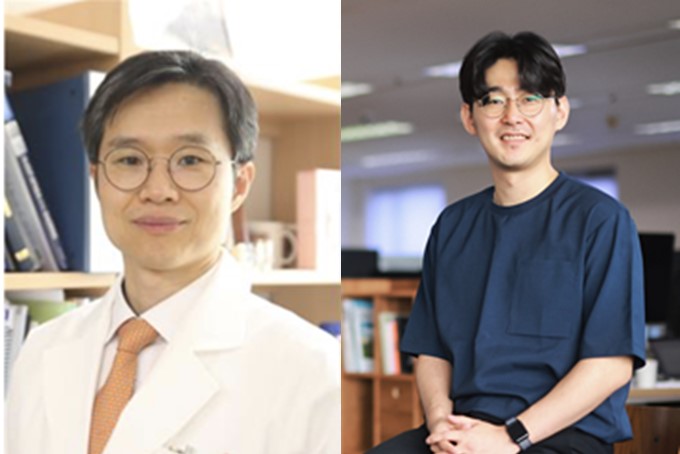 Professor Kim Jeong-hoon, Department of Otorhinolaryngology, Bundang Seoul National University Hospital (left), Dr. Kim Dae-woo, A-Sleep.
 [Photo by Bundang Seoul National University Hospital]
Sleep apnea is a disorder in which breathing repeatedly stops during sleep, disrupting the normal sleep cycle that alternates between REM sleep and various stages of NREM sleep, significantly reducing sleep quality. Patients with sleep apnea experience persistent fatigue despite sufficient sleep time, along with headaches and decreased concentration, leading to a reduced quality of life. If left untreated for a long time, it greatly increases the risk of cardiovascular and cerebrovascular diseases, cognitive impairment (dementia), and other conditions.
To increase the diagnosis rate of sleep apnea, the research team previously developed and announced a smartphone-based diagnostic technology last year that can complement and replace polysomnography, which is conducted in hospitals with various attached devices. Recently, they have advanced this technology to a level capable of real-time sleep apnea diagnosis.
For accurate real-time diagnosis, the research team utilized an artificial intelligence (AI) model trained on over 1,000 breathing sound data obtained from polysomnography and more than 20,000 noise data including household appliance noises such as air conditioners and external vehicle noises. As a result, the accuracy reached approximately 86% even in sleep environments with various everyday noises.
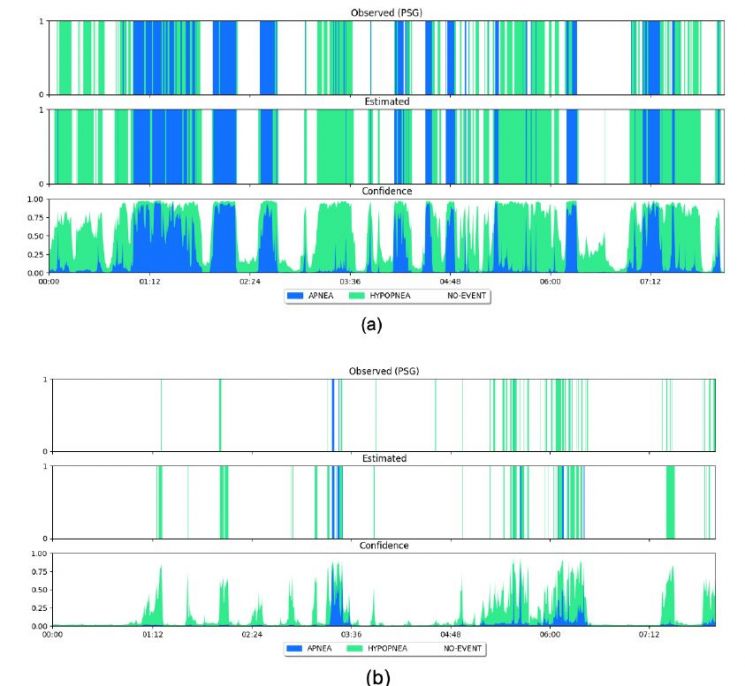 The results of sleep apnea revealed through polysomnography and the comparison with the research team's AI model show high accuracy in both severe (above) and mild cases. [Data provided by Bundang Seoul National University Hospital]
Existing sleep apnea diagnostic devices approved by the U.S. Food and Drug Administration (FDA) can only diagnose after a full night’s sleep. The newly developed technology can detect sleep apnea immediately when it occurs, which the research team explained is a significant foundational technology that could lead to the development of bedding products that correct sleeping posture in real time to reduce apnea during sleep.
Professor Kim said, "The 22,500 home environment noises used in this study cover almost all noises that can occur at home," adding, "Unlike hospital environments, this technology can detect sleep apnea in real time even in homes with various noises, making it an important foundational technology in the future 'Sleep-tech' field."
The research results were recently published in the international journal in the advanced healthcare field, Journal of Medical Internet Research. The research team has applied and distributed this technology through the free application 'Sleep Routine' to help the general public with self-diagnosis of sleep apnea and lifestyle habit correction.
© The Asia Business Daily(www.asiae.co.kr). All rights reserved.


















