LG Energy Solution's Q1 'Earnings Surprise'
AMPC Immediately Reflected in Q1
SK On and Hanwha Solutions Starting US Production
Expected to Receive Substantial Subsidy Benefits
Domestic battery and solar energy companies can profit simply by manufacturing in the United States. Massive subsidy provisions designed to attract next-generation industry manufacturing facilities to the U.S. began to take full effect starting from the first quarter of this year.
LG Energy Solution recorded an "earnings surprise" in the first quarter of this year. Initially, the securities industry estimated LG Energy Solution would post an operating profit of around 480 billion KRW, but it far exceeded expectations with an operating profit of 633.2 billion KRW. For the first quarter alone, this is higher than Samsung Electronics' 600 billion KRW.
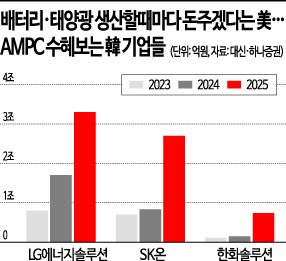
The reason behind the results surpassing market estimates lies in the "Advanced Manufacturing Production Credit (AMPC)" clause within the U.S. Inflation Reduction Act (IRA). LG Energy Solution officially stated that it reflected 100.3 billion KRW of advanced manufacturing production tax credits in its first-quarter operating profit. LG Energy Solution is expected to receive subsidies worth 800 billion KRW this year, 1.7 trillion KRW next year, and 3.3 trillion KRW in 2025 (Daishin Securities).
AMPC is a key provision within the IRA that encourages relocating eco-friendly energy-related manufacturing facilities to the U.S. Starting this year, battery modules produced and sold within the U.S. receive a subsidy of $45 (approximately 59,400 KRW) per kWh. Solar modules receive $70 (approximately 92,400 KRW) per kW. Even after deducting product sales revenue, the subsidy benefits that domestic battery and solar companies will earn are expected to reach tens of trillions of KRW. Notably, these subsidies are likely to be provided through a "direct pay" method, which directly pays the amount rather than reducing part of the tax at the time of sale.
However, the detailed AMPC guidelines have not yet been disclosed. There is a possibility of fine-tuning the payment format, criteria, and amount limits. The details are expected to be finalized after June this year. The tax credit rate will gradually decrease after 2030 and will be eliminated by 2033.
SK On (a battery subsidiary of SK Innovation) and Hanwha Solutions (Q CELLS division), which have started production in the U.S., are also expected to enjoy substantial subsidy benefits. SK On is expected to receive 700 billion KRW this year, 830 billion KRW in 2024, and 2.7 trillion KRW in 2025. Especially since SK On is currently operating at a loss, the AMPC benefits could accelerate its turnaround to profitability. Industry insiders currently expect SK On to turn profitable in the second half of next year. Samsung SDI is also expected to benefit from AMPC starting in 2025 when it begins operating its U.S. factory.
Hanwha Q CELLS, which is building a solar module factory in Georgia, U.S., with an investment of 3.1 trillion KRW, is also a beneficiary. Hanwha Q CELLS is projected to receive subsidies of 110 billion KRW this year, 150 billion KRW next year, and 740 billion KRW in 2025.
AMPC provides tax benefits not only for finished products in next-generation industries but also across the entire value chain. For electrode active materials, which are key raw materials for battery cathodes and anodes, 10% of production costs incurred in the U.S. are eligible for tax credits. Whether other components and materials such as separators, electrolytes, and copper foil will be included in AMPC is expected to be clarified through the detailed guidelines. Polysilicon producers, a basic material for solar energy, can receive $3 per kg, and wafer producers can receive $12 per square meter in benefits.
© The Asia Business Daily(www.asiae.co.kr). All rights reserved.
![Clutching a Stolen Dior Bag, Saying "I Hate Being Poor but Real"... The Grotesque Con of a "Human Knockoff" [Slate]](https://cwcontent.asiae.co.kr/asiaresize/183/2026021902243444107_1771435474.jpg)















