National Assembly to Hold Full Committee Meeting for Four Days Starting the 10th
"Timely Election System Reform" Consensus Between Ruling and Opposition Parties
Key Issues: Introduction of Large Multi-member Districts and Expansion of Proportional Representation
With one year remaining until the general election for National Assembly members scheduled for April next year, the National Assembly has convened the 'Plenary Committee (Jeonwonwi)' to gather the consensus of all 300 members on the direction of electoral system reform. The Plenary Committee will hold a total of four discussions by the 13th to reach an agreement on the electoral system reform.
On the first day of the Plenary Committee, lawmakers from both ruling and opposition parties agreed on the need to revise the current electoral system, but showed differences of opinion regarding the direction of reform, particularly on the introduction of a large multi-member district system and the expansion of proportional representation.
Previously, the Special Committee on Political Reform (Jeonggae Teukwi) submitted reform proposals to the Plenary Committee, including ▲a mixed urban-rural large multi-member district system + regional parallel proportional representation ▲single-member district system + regional semi-linked proportional representation ▲open-list large multi-member district system + national parallel proportional representation. The Special Committee approved these proposals based on maintaining the total number of National Assembly members at 300. However, with Kim Gi-hyeon, leader of the People Power Party, recently mentioning a 'reduction in the number of members,' finding common ground is expected to be difficult.
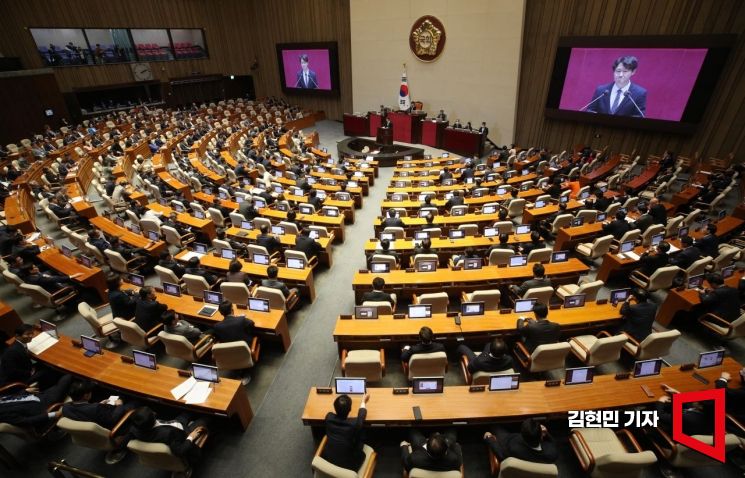 The full committee of the National Assembly convened for four days starting on the 10th at the National Assembly in Yeouido, Seoul, to discuss the election system reform plan (amendment to the Public Official Election Act) to be applied in next year's general election, with ruling and opposition party members engaging in heated debates. This is the first time in 20 years that the full committee has been held since the discussion on the 'Iraq War Dispatch Extension Agreement' in 2003. Photo by Kim Hyun-min kimhyun81@
Democratic Party lawmaker Lee Tan-hee, who made the first remarks that day, described the current domestic political situation as a "state of nationwide unrepresentation, a state of political disappearance." Lee, who has long advocated for electoral district reform through a 'large multi-member district system' to broaden voter choice, pointed out, "Among the 300 National Assembly members, there is no one who represents my position," and criticized, "In a structure of reflexive benefits (where winning is achieved by preventing votes for the opponent), our politics does not focus on protecting the lives of the people." He raised his voice, saying, "It ends with mocking, questioning, and insulting others, filing lawsuits and complaints, submitting arrest consent motions, and demonizing opponents. There is no competition of alternatives." Lee emphasized the necessity of electoral reform, stating, "As long as the single-member district system, where only the first place survives, is combined with regionalism, our politics cannot move forward even a step."
Following him, People Power Party lawmaker Choi Hyung-doo said, "The extreme discrepancy between the people's votes and the National Assembly seats is unprecedented in the world," adding, "The core issue is that extreme distortion occurred in the metropolitan area." Choi, who is also the ruling party secretary of the bipartisan political reform lawmakers' group, has advocated for a mixed urban-rural large multi-member district system that introduces large multi-member districts in the metropolitan area while maintaining single-member districts in other regions. On this day, Choi said, "The vote share in the metropolitan area was 12 percentage points, but this gap resulted in a seat difference of 103 seats for the first party and 17 seats for the second party, a sixfold difference. No country with developed democracy has ever had such a sixfold gap between seat numbers and party vote shares." He added, "Ahead of next year's general election, when electoral district delimitation is done, the metropolitan area may exceed 130 seats, while non-metropolitan areas may fall below 120 seats."
Besides Choi, other People Power Party lawmakers participating in the discussion also leaned toward the mixed urban-rural large multi-member district system. Lawmaker Lee Yong-ho of the People Power Party said, "We started this Plenary Committee discussion because we have experienced the harms and side effects of the current single-member district system and semi-linked proportional representation," adding, "Political distrust is deepening amid the two-party monopoly confrontation, and I believe that simply introducing a large multi-member district system can promote a culture of compromise politics." He further suggested, "It is worth trying to introduce a mixed urban-rural electoral district system where cities with populations of 500,000 adopt large multi-member districts, and rural areas maintain single-member districts."
Opinions were also exchanged regarding the expansion of proportional representation. Kim Young-bae, Democratic Party lawmaker and opposition secretary of the bipartisan political reform group, advocated for expanding proportional representation. Kim, who proposed regional proportional representation under the single-member district system, initially suggested that the ratio between constituency seats and proportional representation seats should be 2:1 (220 seats to 110 seats) to sufficiently achieve proportionality, thus proposing an expansion of proportional representation. During this process, an increase in the total number of National Assembly members was also mentioned, but it was scrapped due to opposition from the People Power Party. On this day, Kim emphasized, "At least 60 proportional representation seats must be secured."
Kim stated, "The current system, which is mainly based on single-member districts, cannot prevent a large number of wasted votes," and proposed, "On the premise of expanding proportional representation, we should switch to regional proportional representation." He also added that the system allowing dual candidacy?running simultaneously in constituency and proportional representation?should be permitted to break regionalism.
The Justice Party, which argues for expanding proportional representation to secure diversity, pointed out the harms of the current winner-takes-all single-member district system and emphasized that electoral reform should be carried out as a way to break the two-party system. Justice Party lawmaker Shim Sang-jung said, "Without improving the winner-takes-all electoral system, the growth of a third political force is impossible," and pointed out, "Because a single vote can determine the outcome, nearly half of the votes are wasted in every election." She also questioned, "In the 21st general election, voters in their 20s and 30s accounted for 31.4%, but the number of young lawmakers is only 13, just 4.3%. Meanwhile, there are 46 lawmakers with legal backgrounds. Can the politicization of the judiciary and the judicialization of politics, where political issues are frequently taken to courts and the Constitutional Court, be unrelated to this?"
Shim said, "The core of this electoral reform should be to increase the number of proportional representation seats and ensure that the number of seats converges as much as possible to party support rates," adding, "If it can lead to a multi-party cooperative politics that can boldly face national challenges and global crises, and if various parties with diverse solutions can enter the National Assembly more, it does not have to be the Justice Party. The Justice Party believes that a party-list proportional representation system that reflects 100% of the people's political will is best, but if proportionality and representativeness improve compared to the current system, we will keep all options open and consider any system."
Following the first discussion, where 28 lawmakers spoke?including 15 from the Democratic Party, 11 from the People Power Party, and 2 from non-negotiating groups?28 lawmakers are scheduled to speak on the 11th, 24 on the 12th, and 20 on the final day, the 13th.
© The Asia Business Daily(www.asiae.co.kr). All rights reserved.
![From Bar Hostess to Organ Seller to High Society... The Grotesque Con of a "Human Counterfeit" [Slate]](https://cwcontent.asiae.co.kr/asiaresize/183/2026021902243444107_1771435474.jpg)
















