Polls Show Dominance of Regime Check Theory
Ruling Party Faces Challenges Blocking Prosecutor Parachute Theory
Opposition Lee Jae-myung's Judicial Risks Pose Unexpected Obstacles
With the general election a year away, the ruling and opposition parties have entered a fierce battle for control of the political landscape. The People Power Party (PPP), aiming to secure a majority for the stability of the Yoon Seok-yeol administration, and the opposition Democratic Party, which insists on having enough power to check the government, have already begun their high-stakes contest. The PPP faces the challenge of President Yoon Seok-yeol's low approval ratings, while the Democratic Party must resolve the judicial risks surrounding its leader Lee Jae-myung. Concerns are rising that the intense partisan conflicts seen in the 21st National Assembly will become even more severe over the next year.
According to a regular public opinion poll released on the 10th by Realmeter (commissioned by Media Tribune and conducted via ARS automated response from March 3 to 7, surveying 2,504 adults nationwide aged 18 and over), party support was measured at 45.9% for the Democratic Party, 37% for the People Power Party, and 3.7% for the Justice Party. Earlier, a Gallup poll conducted from April 4 to 36 (interview method by telephone surveyors with 1,000 adults nationwide aged 18 and over) showed that 50% believed more opposition party members should be elected to check the government, while 36% supported electing more ruling party members to support the government.
The overall public sentiment appears to favor the theory of regime judgment over regime stability. However, even looking at the last general election, it is clear that current public opinion trends have limitations in predicting election outcomes. For example, in the Gallup poll conducted on February 13, 2020, two months before the election, the regime judgment theory stood at 45%, closely contesting the regime stability theory at 43%, yet the ruling party won by a landslide, demonstrating how volatile public opinion can be.
Above all, the political sphere has yet to fully escape the shadow of the last presidential election. President Yoon Seok-yeol, the winner of the presidential race, is struggling with low approval ratings despite being early in his term, acting more as a stumbling block than a boost for his party’s support. Meanwhile, Lee Jae-myung, leader of the Democratic Party and the presidential election loser, revealed internal party divisions during the vote on the arrest consent bill. Furthermore, Lee’s judicial risks are considered the biggest risk for the opposition in the upcoming general election.
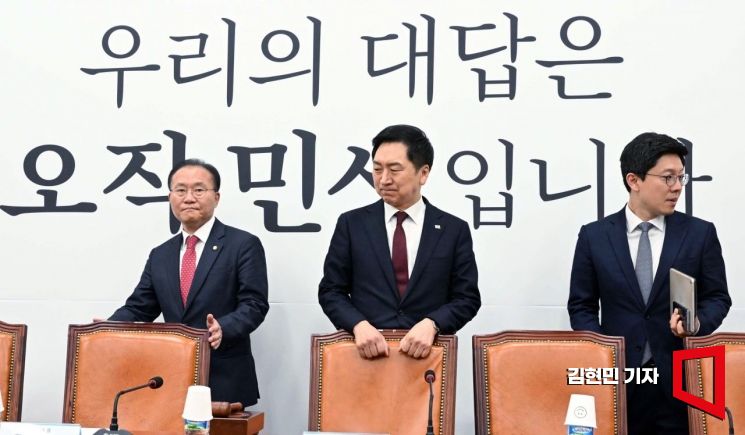 Kim Ki-hyun, leader of the People Power Party, and Yoon Jae-ok, floor leader, along with other party leadership, are attending the Supreme Council meeting held at the National Assembly in Yeouido, Seoul on the 10th. Photo by Kim Hyun-min kimhyun81@
On the ruling party side, with one year left until the general election, Kim Ki-hyun, leader of the People Power Party, is promoting the regime stability theory and aiming for a majority of seats. Regarding concerns that next year’s election will be dominated by pro-Yoon (pro-Yoon Seok-yeol) factions, Kim dismissed rumors about parachuting prosecutors as “urban legends” and announced a bottom-up nomination policy. There is widespread speculation in political circles that many candidates with close ties to President Yoon and backgrounds in prosecution will be nominated in next year’s election. In this context, Kim stated at the PPP Supreme Council meeting, “I clearly declare that rumors circulating about prosecutor nominations in next year’s general election are baseless. It is impossible and will not happen that a large number of candidates from a specific profession will be nominated, and as party leader, I will not tolerate it.” Kim added, “There will be no discrimination based on factions during the nomination process, and no unjust artificial replacement of candidates causing unfair losses. We will strictly adhere to the bottom-up nomination principle as stipulated by party rules and thoroughly supervise a fair and transparent nomination system.”
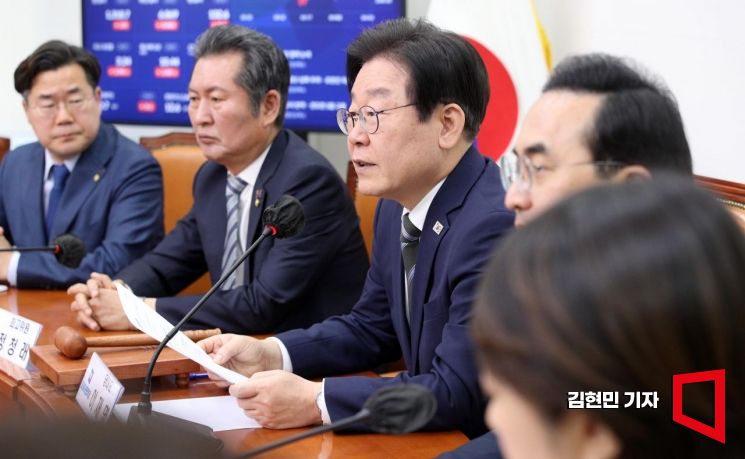 Lee Jae-myung, leader of the Democratic Party of Korea, is speaking at the Supreme Council meeting held at the National Assembly in Yeouido, Seoul on the 10th. Photo by Kim Hyun-min kimhyun81@
The Democratic Party is focusing its efforts on highlighting the government’s failures and promoting the regime judgment theory. At the Democratic Party Supreme Council meeting, Lee said, “The general election is exactly one year away. It is time for the sovereign people of the Republic of Korea to evaluate whether their proxy politicians and political groups have done well or poorly and decide whether to entrust them again. Approval ratings are like ripples on a river, and the true will of the people lies in the flow. We will humbly respect the people’s will and diligently and continuously carry out the fundamental work that politics must do.”
However, within the party, there is concern over whether Lee will serve as the Democratic Party’s figurehead in next year’s election. Democratic Party lawmaker Park Jae-ho said on YTN Radio’s “News King Park Ji-hoon” program, “If Lee loses the general election, his political career will be over. He will make various wise decisions to win the election.” He added, “If it is advantageous to proceed as is, they will continue, but if the burden of saving the party and ongoing trials is too great, a wise decision may be made.” This suggests that options such as an orderly retreat or stepping down before the election are on the table.
Meanwhile, on the same day, Democratic Party lawmaker Oh Young-hwan announced he would not run in next year’s general election, exactly one year before the vote. Oh said, “It is time to reflect on whether the National Assembly has faithfully fulfilled its role as a melting pot to resolve social conflicts.”
For detailed information related to the polls, please refer to the Central Election Poll Deliberation Commission website.
© The Asia Business Daily(www.asiae.co.kr). All rights reserved.


















