As the banking crisis that erupted simultaneously in the United States and Europe has passed its peak, commercial real estate is emerging as a new flashpoint for the spread of the crisis. With the scale of commercial real estate loans maturing within the next two years reaching 2,000 trillion won, there are forecasts that the crisis will inevitably spread to the financial sector.
According to Bloomberg News on the 9th (local time), the amount of U.S. commercial real estate loans that must be repaid by the end of 2025 is estimated to be about $1.5 trillion (approximately 2,000 trillion won).
James Egan and other Morgan Stanley analysts pointed out in a memo last week that refinancing risk is emerging as the biggest issue for real estate owners, ranging from office buildings to stores and warehouses. Morgan Stanley warned, "The maturity wall is right in front of us," adding that "related risks such as loan defaults and early repayment demands are also increasing."
In particular, concerns are growing as regional banks, which have relatively weaker financial structures, have high exposure to commercial real estate loan risks. According to Morgan Stanley Capital International, the proportion of commercial real estate loans by regional banks surged by about 10 percentage points from 17% in 2017 to 27% last year. This means that 30% of loans by regional banks, excluding the top 25 large U.S. banks, are commercial real estate loans.
The commercial real estate market has not escaped a downward trend over the past two to three years due to the spread of remote work amid the COVID-19 pandemic. Moreover, with concerns over a deepening recession, the vacancy rate of commercial real estate has soared to the highest level since the 2008 global financial crisis, making further price declines inevitable. Wall Street investment banks, including Morgan Stanley, estimate that commercial real estate prices could fall by up to 40% from their peak, increasing the risk of defaults.
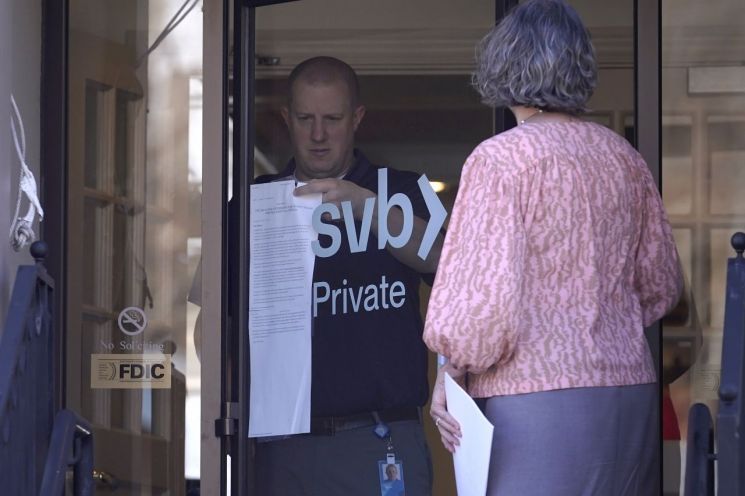 On the 27th of last month (local time), an employee at the Wellesley branch of Silicon Valley Bank (SVB) in Massachusetts, USA, is removing a notice attached to a glass door. Seventeen days after SVB filed for bankruptcy following a bank run on the 10th of last month, it was acquired by First Citizens, a U.S. regional bank based in North Carolina. From that day, 17 SVB branches across the United States have been renamed and operate as First Citizens branches.
The worst-case scenario is the insolvency of regional banks due to the deterioration of commercial real estate loans. As concerns about the soundness of banks with large commercial real estate loans grow, bank runs (massive deposit withdrawals) could accelerate, and as a result, banks may demand repayment of commercial real estate loans, which could worsen the commercial real estate market situation, creating a vicious cycle.
The recently bankrupt U.S. Silicon Valley Bank (SVB) also had an overwhelmingly high proportion of commercial real estate loans. Bloomberg pointed out that the regional bank risks triggered by the bankruptcies of SVB and other regional banks last month are transferring to risks in the U.S. commercial real estate market, dampening investment sentiment.
The Wall Street Journal (WSJ) also warned that the high-intensity tightening that rapidly unfolded since last year has exposed cracks in the financial system, and the risk could shift to another pillar of the economy, with commercial real estate potentially becoming the next target.
However, there are also assessments that the commercial real estate crisis will be smaller compared to past crises such as the 2008 financial crisis. The Peterson Institute for International Economics (PIIE), a Washington think tank, predicted that while the deterioration of banks' commercial real estate assets could surface, worsening the asset quality of financial firms with high real estate financing exposure, a severe threat on the scale of the 2008 financial crisis is unlikely to occur.
© The Asia Business Daily(www.asiae.co.kr). All rights reserved.

















