Despite Absence of Regional Hegemony Party Candidates,
Democratic and People’s Parties Fail to Be Chosen as Alternatives
Progressive Party Secures Number 4 for Next Year’s General Election by Entering the National Assembly
The April 5 by-elections once again confirmed the deep-seated cold sentiments between regions. The People Power Party and the Democratic Party of Korea hoped for a turnaround in the Jeonju-eul National Assembly by-election and the Changnyeong County governor by-election, but they received a dismal report card. The Progressive Party succeeded in re-entering the National Assembly after eight years, securing the number 4 ballot position for next year's general election.
According to the Central Election Commission on the 6th, Kang Seong-hee, the Progressive Party candidate, was elected with 39.1% of the vote in the Jeonju-eul by-election held the previous day. The Jeonju-eul by-election was held following the removal of former Democratic Party lawmaker Lee Sang-jik due to violations of the Public Official Election Act. The Democratic Party, which had been strong in this area, decided not to field a candidate as part of responsible politics. However, Im Jeong-yeop, who left the Democratic Party, ran as an independent and lost with 32.1% (14,288 votes).
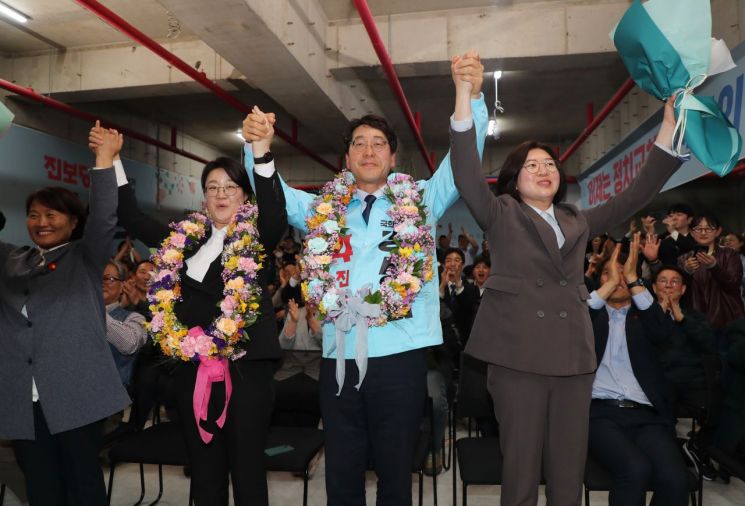
With Kang’s election, the Progressive Party re-entered the National Assembly after eight years. The Progressive Party, the successor to the Unified Progressive Party which was dissolved as an unconstitutional party during the Park Geun-hye administration, was re-established as the Minjung Party in 2017 and renamed the Progressive Party in 2020. In last year’s local elections, the party performed well, winning the Ulsan Dong-gu mayoral seat with Kim Jong-hoon, as well as three metropolitan council seats and 17 local council seats, outperforming the Justice Party, the third-largest party in the National Assembly, which won two metropolitan and seven local council seats. Kang is a former labor union official who worked for 18 years at Hyundai Motor’s Jeonju plant and recently served as secretary-general of the Jeonbuk branch of the National Courier Union.
Kim Kyung-min, the People Power Party candidate, received only 8.0% (3,561 votes), placing fifth behind Ahn Hae-uk (10.1%) and Kim Ho-seo (9.2%). The People Power Party, which sought to target the Honam region by not fielding a candidate, only confirmed the high barriers there.
The Changnyeong County governor election showed a similar pattern. The by-election was held following the tragic suicide of former Changnyeong County governor Kim Bu-young, who was on trial for violating the Public Official Election Act. The People Power Party also decided not to field a candidate, citing responsible politics. Since five out of six independent candidates were former People Power Party members, there was speculation about a possible upset by the Democratic Party candidate. However, the election results saw Sung Nak-in, an independent candidate formerly of the People Power Party, win with 24.2% of the vote. Democratic Party candidate Sung Ki-ok received 10.8%, placing fifth among seven candidates.
Although the dominant parties in Yeongnam and Honam regions did not field candidates, the reflected benefits did not go to the opposition. Factors such as low interest, low voter turnout, and voting during rain highlighted the opinions of politically engaged voters, but regardless of the regional dominant party candidates, rejection of the opposing party influenced the vote. Kim Bong-shin, CEO of Metavoice, commented on the election results, saying, "It confirmed the emotional partisan alignment that has continued since the previous government," and added, "It showed that the emotional partisanship between the democratization (progressive) camp and the conservative camp has completely solidified into a political divide, confirming the strong feelings of hatred toward the opposition."
However, possibilities for change were also observed in metropolitan and local council elections. In the Ulsan Nam-gu district, Democratic Party candidate Choi Deok-jong was elected with 50.6% of the vote. In the metropolitan council election, Democratic Party candidate Woo Seo-young placed second with 24.3%, which was regarded as a strong performance both inside and outside the party. Despite being a conservative stronghold, the Democratic Party’s strong showing demonstrates that individual politicians’ efforts at the grassroots level can influence election outcomes.
© The Asia Business Daily(www.asiae.co.kr). All rights reserved.
![Clutching a Stolen Dior Bag, Saying "I Hate Being Poor but Real"... The Grotesque Con of a "Human Knockoff" [Slate]](https://cwcontent.asiae.co.kr/asiaresize/183/2026021902243444107_1771435474.jpg)











