Energy Crisis and Climate Change Response
Realizing Economical Energy Supply
Korea Hydro & Nuclear Power (hereinafter KHNP) held an event on the 5th at the Gori Nuclear Power Headquarters in Gijang-gun, Busan, pledging to safely promote the continued operation of Gori Unit 2.
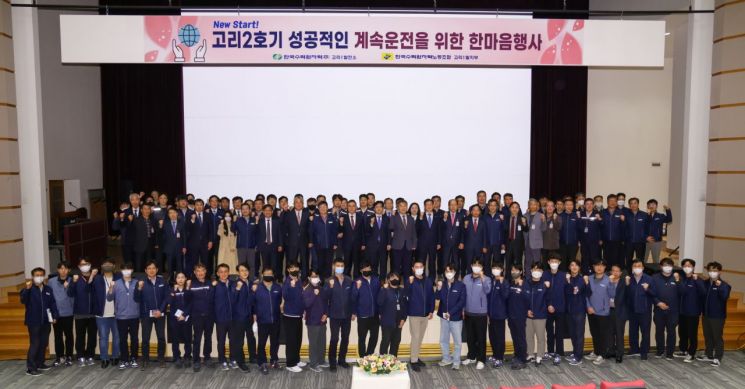 On the 5th, Korea Hydro & Nuclear Power held a commitment event to promote the continued operation of Kori Unit 2 at the Kori Nuclear Power Headquarters.
At the event attended by Hwang Ju-ho, President of KHNP, Cheon Young-gil, Director of the Energy Policy Office at the Ministry of Trade, Industry and Energy, and representatives from partner companies, a commemorative video of Gori Unit 2 was screened, followed by a resolution ceremony to pledge the successful promotion of continued operation.
Gori Unit 2, the second nuclear power plant in South Korea, began construction on May 26, 1977, and started commercial operation on August 10, 1983. The reactor is scheduled to be shut down on the night of the 8th when its operating license expires. Over the past 40 years, Gori Unit 2 has generated approximately 195.5 billion kWh, an amount sufficient to supply all citizens of Busan for more than nine years.
As of 2021, Busan's annual electricity purchase volume was about 21 billion kWh (Korea Electric Power Corporation Monthly Electricity Statistics Report).
KHNP applied for an operating change permit for the continued operation of Gori Unit 2 to the regulatory authority on the 30th of last month. Prior to this, in April of last year, it submitted a safety evaluation report for continued operation and completed the collection of residents' opinions on the draft environmental impact assessment for radiation related to continued operation in December of the same year.
KHNP aims to respond as quickly as possible during the review process and plans to restart the reactor by June 2025, assuming safety is secured.
Hwang Ju-ho, President of KHNP, stated, "Continued operation is the best way to reduce national energy costs, contribute to carbon neutrality, and realize a stable energy supply. Since the continued operation project of Gori Unit 2 is the first step toward the continued operation of 10 nuclear reactors, let us prioritize safety and carry it out perfectly."
Cheon Young-gil, Director of the Energy Policy Office at the Ministry of Trade, Industry and Energy, said, "The continued operation of existing nuclear power plants with verified safety reduces the enormous costs and time required for new construction and secures immediately usable carbon-free power sources." He urged all to do their best in responding to safety reviews and improving facilities for the prompt restart.
Since 1997, Gori Unit 2 has improved plant safety and performance through investments totaling 324.8 billion KRW.
Among these, 179.2 billion KRW was invested in 77 safety enhancement facility improvements reflecting the latest safety standards, such as post-Fukushima measures, and 145.6 billion KRW was invested in 122 other facility operation improvements. Additional facility investments worth 175.8 billion KRW are planned for continued operation, including the incorporation of safety enhancement measures.
Globally, among 252 nuclear reactors whose operating licenses have expired, 92% (233 reactors as of December 2022) have implemented continued operation, making it a widely proven technology in terms of safety.
In particular, continued operation is recognized as a key measure for achieving carbon neutrality amid the climate crisis, and the government has included the continued operation of 10 nuclear reactors whose operating licenses will expire within the next seven years in the 10th Basic Plan for Electricity Supply and Demand.
Accordingly, the continued operation of Gori Unit 2, the first of the 10 reactors to continue operation, is considered highly significant not only for KHNP but also for national energy policy and industry.
Furthermore, since facility investments related to continued operation are expected to proceed, it is anticipated to contribute to revitalizing the nuclear power industry.
Moreover, according to a recent analysis by the Korea Energy Economics Institute, if Gori Unit 2 begins continued operation, the resumption of power generation and substitution for LNG power generation will result in an average electricity bill reduction of 0.67 KRW per kWh, which translates to an annual electricity bill reduction of about 7,000 KRW per capita.
© The Asia Business Daily(www.asiae.co.kr). All rights reserved.

















