Decrease in Japan's radioactive material inspections... Detection rate increases
Cesium 137 half-life 30 years "Lethal to humans"
As Japan prepares to discharge contaminated water from Fukushima, concerns are growing as analyses show an increase in the detection rate of radioactive substances in Japanese agricultural and marine products.
On the 5th, the Citizens' Radiation Monitoring Center and the Korea Federation for Environmental Movements released the "2022 Analysis Report on Radioactive Contamination of Japanese Agricultural, Marine, and Livestock Products."
The report analyzed the results of radioactive cesium (Cs-134, Cs-137) detection tests conducted by Japan's Ministry of Health, Labour and Welfare on a total of 36,155 agricultural, marine, and livestock food samples last year. Cesium-137 has a half-life (the period during which radiation levels reduce by half) of 30 years and can have fatal effects on the human body if absorbed through food.
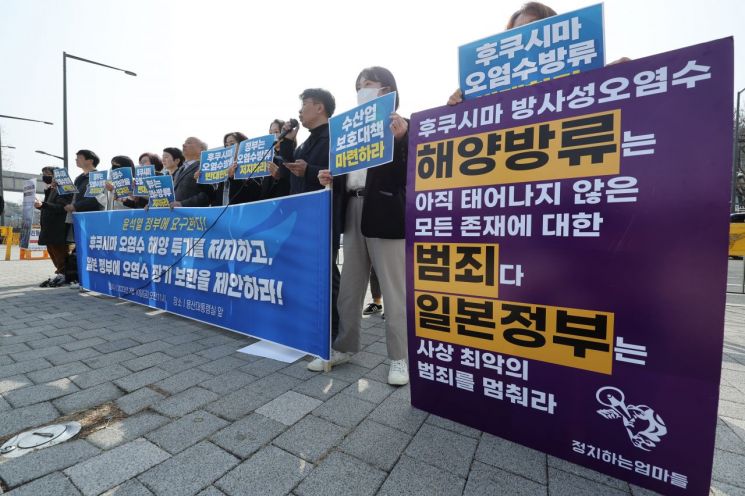 Citizens' groups including the Joint Action to Stop Japan's Radioactive Contaminated Water Discharge and the Korea-Japan Historical Justice and Peace Action held a press conference on the morning of the 10th near the Yongsan Presidential Office in Seoul, urging the Yoon Seok-yeol administration to demand the Japanese government to store Fukushima's radioactive contaminated water long-term. Photo by Yonhap News Agency
According to the report, while the number of radioactive substance inspections on Japanese food has been decreasing annually, the detection rate is on the rise. By category, cesium was detected in 3% of marine products, 21.1% of agricultural products, 2.6% of livestock products, 29.0% of wild game, 6.3% of processed foods, and 0.3% of dairy products.
The item with the highest cesium detection was the Neungi mushroom, measuring 1500 Bq/kg. Other wild mushrooms also showed high cesium detection amounts and rates, with pine mushrooms at 290 Bq/kg and other mushroom varieties at 230 Bq/kg. The domestic standard for cesium in food is 100 Bq/kg.
In marine products, 170 Bq/kg of cesium was detected in mountain trout. Cesium was also found in species such as Korean bullhead, mountain trout, carp, brown trout, and eel. Agricultural products also showed severe radioactive contamination, with 770 Bq/kg in gobi (Angelica tree shoots), 370 Bq/kg in durup (Aralia elata shoots), 300 Bq/kg in durup fruit, and 270 Bq/kg in bamboo shoots.
The organizations stated, "Although the Japanese government claims that cesium contamination in seawater fish due to Fukushima contaminated water has stabilized, the situation remains serious," adding, "It is impossible to judge the safety of Japanese food solely based on the Ministry of Health, Labour and Welfare's radioactive substance test results."
Criticism was also raised regarding flaws in the radioactive inspection data provided by the Ministry of Health, Labour and Welfare, including survey design, sample analysis, and procedures. The organizations said, "Detailed and simplified food inspections are mixed, and even the criteria for selecting food inspection samples are not provided," emphasizing, "This proves that the Japanese government's claim of scientifically and safely managing radioactive contaminated food is nothing but empty rhetoric."
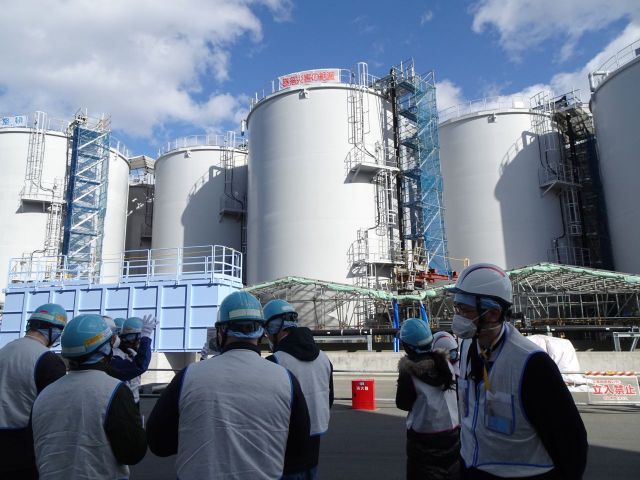 Tokyo Electric Power Company officials explained the contaminated water storage tanks to foreign journalists at the Fukushima Daiichi Nuclear Power Plant on the 2nd. Photo by Yonhap News Agency
Meanwhile, the Japanese government plans to discharge diluted contaminated water?diluted to one-fortieth?over approximately 30 years, starting as early as April. However, it is facing concerns from neighboring countries due to a lack of transparent disclosure of information related to the contaminated water. Even within Japan, there is no consensus on the discharge plan; according to a survey by the Japan Atomic Energy Culture Foundation on the 4th, 51.9% of respondents said that "the discharge of contaminated water does not have the understanding of the public," accounting for more than half.
In the political sphere, voices are calling for the government to actively address the contaminated water discharge issue, as it is directly linked to the import of Fukushima agricultural and marine products. Previously, the WTO (World Trade Organization) ruled in April 2019 that South Korea's ban on imports of Fukushima seafood was justified due to pollution issues in Japan's marine environment and potential impacts on seafood. There are concerns that tolerating the discharge of contaminated water could weaken the rationale for seafood import restrictions.
© The Asia Business Daily(www.asiae.co.kr). All rights reserved.


















