Gwangmyeong Station Desiang, 220 Million KRW Increase in Two Months
Cheolsan Jugong Reconstruction, 250 Million KRW Increase in Three Months
10,000 Households Supplied This Year... "Concerns Over House Price Decline Remain"
Following Sejong, the Gwangmyeong real estate market in Gyeonggi Province, which experienced the second-largest drop in housing prices nationwide, is seeing a series of 'rebound transactions.' Recently, actual transaction prices around Gwangmyeong Station and Gwangmyeong New Town have been recorded higher than previous deals, cautiously spreading the perception that housing prices have hit bottom. However, concerns about further price declines remain as more than 10,000 housing units are scheduled for supply in Gwangmyeong this year.
According to the Ministry of Land, Infrastructure and Transport's real transaction price disclosure system on the 6th, an 84.86㎡ (exclusive area) unit in YU Planet Taeyoung Desiang in Iljik-dong, Gwangmyeong, changed hands for 1.14 billion KRW on the 9th of last month. This apartment was sold at a low of 910 million KRW in January when Gwangmyeong housing prices were plummeting, meaning it rose by 220 million KRW in just two months.
Similarly, an 84.85㎡ unit in Gwangmyeong Station Central Xi was contracted for sale at 1.06 billion KRW on the 23rd of last month, up 110 million KRW compared to the previous transaction price of 950 million KRW in January.
Rebound transactions are also emerging in areas undergoing redevelopment and reconstruction, such as Gwangmyeong-dong and Cheolsan-dong. A 121.26㎡ unit in Cheolsan Jugong Complex 13, which recently passed the reconstruction safety inspection, was traded for 1.2 billion KRW in March, 250 million KRW higher than the previous sale price of 950 million KRW in December last year.
Although recent transaction prices are still far below the peak prices seen during the real estate boom, the clear upward trend compared to previous transactions is interpreted as a sign of market recovery. A representative from a real estate agency near Gwangmyeong Station explained, "As actual transaction prices have risen above previous deals, homeowners are raising their asking prices, engaging in a cautious standoff," adding, "Although prices are still much lower than the peak, quick-sale properties are disappearing, and transactions are gradually picking up."
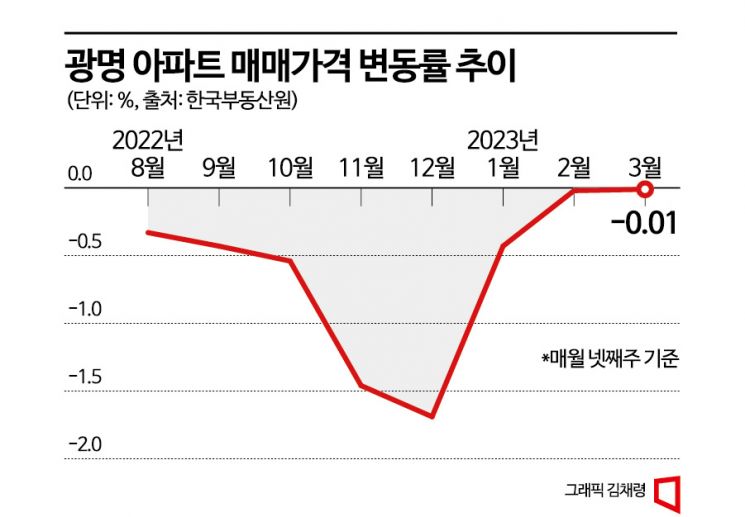
In fact, the changing atmosphere in the Gwangmyeong real estate market is also reflected in the Korea Real Estate Board's housing price statistics. In the fourth week of March, the apartment price change rate in Gwangmyeong was -0.01%, close to stable. This was the lowest decline rate in eight months since the fourth week of May last year (-0.01%). Compared to the Gyeonggi Province average decline rate of -0.24%, the drop is much narrower.
Gwangmyeong borders Seoul's Guro-gu and Geumcheon-gu districts and is considered a 'quasi-Seoul' area in the real estate market. Its proximity to Seoul makes it highly desirable for residence. Additionally, the overlapping benefits of the Sinansan Line, the metropolitan area express railway (GTX) Line B, and large-scale reconstruction and redevelopment projects caused apartment prices to soar during the previous real estate boom. Due to the large price increase, the impact of the real estate downturn was also significant, with Gwangmyeong (-15.41%) experiencing the second-largest decline nationwide after Sejong (-16.74%) last year. However, following the lifting of regulatory measures under the 1.3 real estate policy and the perception that prices have bottomed out, buying interest is gathering, bringing signs of market recovery.
However, it remains uncertain whether the warming of the Gwangmyeong real estate market will be sustained despite the 'supply bomb.' According to Real Estate R114, 13,626 housing units are scheduled for supply in Gwangmyeong this year. Among the total planned supply of 84,250 units in Gyeonggi Province, Gwangmyeong is the only area with over 10,000 units planned.
This month, 'Gwangmyeong Xi The Sharp Forena,' located in Gwangmyeong New Town District 1, will be launched for sale. Out of a total of 3,585 units, 776 are allocated for general sale. Additionally, Gwangmyeong Central I-Park (1,957 units) in District 4, Vermontro Gwangmyeong (3,344 units) in District 2, District 5 (2,878 units), and reconstruction projects for Cheolsan Jugong Complex 10 and 11 (1,490 units) are also scheduled for sale.
A real estate industry insider said, "Gwangmyeong's proximity to Seoul and transportation improvements to Seoul have caused housing prices to rise, and if the Seoul real estate market improves, Gwangmyeong tends to follow suit," adding, "However, as the saying goes, 'there is no business in front of supply,' the possibility of price declines due to the supply bomb remains."
© The Asia Business Daily(www.asiae.co.kr). All rights reserved.


















