On the 5th, Party and Government Meeting on Pediatric, Emergency, and Non-Face-to-Face Medical Care Held
Consensus Reached That Non-Face-to-Face Medical Services Should Not Be Suspended
The People Power Party and the government have decided to expand the number of severe emergency medical centers accessible within one hour from anywhere nationwide from the current 40 to 60. This is to prevent a recurrence of the so-called ‘emergency room roundabout’ incident that recently occurred in Daegu.
On the morning of the 5th, the party and government held a ‘Pediatric, Emergency, and Non-face-to-face Medical Measures’ party-government consultative meeting at the National Assembly main building and announced this decision.
Park Dae-chul, the Policy Committee Chair of the People Power Party, said at a briefing held immediately after the consultative meeting, “We see the urgent need to establish a one-stop emergency patient transport system to ensure that from the occurrence of emergency patients to transport and treatment, everything is done easily and safely. We will closely examine all related circumstances and proceed swiftly.” He added, “In particular, the party has ordered the government to promptly and strongly implement the policy tasks related to the emergency room drifting incident included in the basic emergency medical plan announced in March.” On the 19th of last month, an incident occurred in Daegu where a teenage student died in an ambulance after wandering around looking for a hospital room.
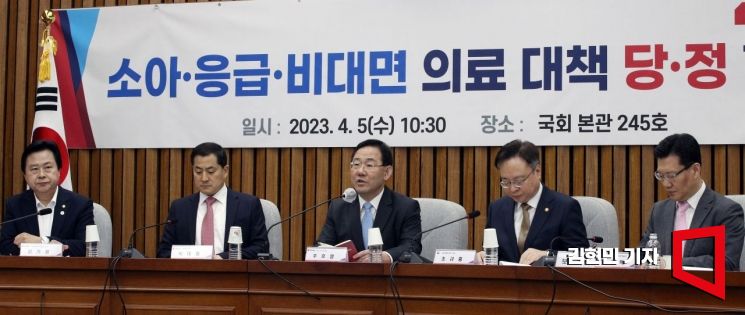 Joo Ho-young, floor leader of the People Power Party, is speaking at the party-government meeting on pediatric, emergency, and non-face-to-face medical measures held at the National Assembly in Yeouido, Seoul, on the 5th. Photo by Kim Hyun-min kimhyun81@
Chairman Park explained, “We decided to speedily promote the plan to expand severe emergency medical centers accessible within one hour nationwide from the current 40 to 60,” and “We have restructured the functions of severe emergency medical centers to enable final treatments such as surgery and hospitalization.”
The party and government also agreed on improving working conditions for medical staff by raising health insurance fees in the severe emergency field, supporting night and holiday duty pay, and guaranteeing appropriate working hours. Additionally, they plan to establish a system that can share information in real-time regarding ambulance dispatch, transport, and emergency room treatment to prevent refusal of acceptance through regular inspections.
Chairman Park said, “Since emergency medical care is an essential field requiring concentrated investment over a five-year plan, the party will actively support necessary measures such as revising the Emergency Medical Service Act, expanding emergency medical funds, and increasing budgets.”
The party and government also agreed that non-face-to-face medical treatment, which was temporarily allowed during the COVID-19 situation, should not be discontinued. Chairman Park explained, “During the three years of the COVID-19 situation, 13.79 million people received 36.61 million cases of non-face-to-face medical treatment, regaining their health, and satisfaction was also high. The party and government share the view that the improved accessibility and satisfaction of medical use through non-face-to-face treatment should not be reverted.”
Pediatric treatment was also discussed at the consultative meeting that day. Chairman Park said, “We will supplement the issues of expanding medical staff and improving the insufficient medical environment more thoroughly and proceed with close party-government coordination.” Minister Cho Kyu-hong of the Ministry of Health and Welfare, who also attended the meeting, emphasized, “The policy goal is to ensure that children receive necessary treatment when needed based on three principles: infrastructure expansion, appropriate compensation, and securing sufficient medical resources. We created measures in March under the president’s directive, and through a review team, we agreed to check the implementation system thoroughly and supplement any deficiencies.”
Attending the meeting from the party side were Policy Committee Chair Park Dae-chul, Floor Leader Joo Ho-young, and Kang Ki-yoon, the People Power Party secretary of the National Assembly Health and Welfare Committee. From the government side, Minister Cho and Lim In-taek, Director of Health and Medical Policy at the Ministry of Health and Welfare, participated.
© The Asia Business Daily(www.asiae.co.kr). All rights reserved.
![Clutching a Stolen Dior Bag, Saying "I Hate Being Poor but Real"... The Grotesque Con of a "Human Knockoff" [Slate]](https://cwcontent.asiae.co.kr/asiaresize/183/2026021902243444107_1771435474.jpg)
















