A survey revealed that more than half of the cases of trade secret leaks in domestic companies were caused by former employees of those companies.
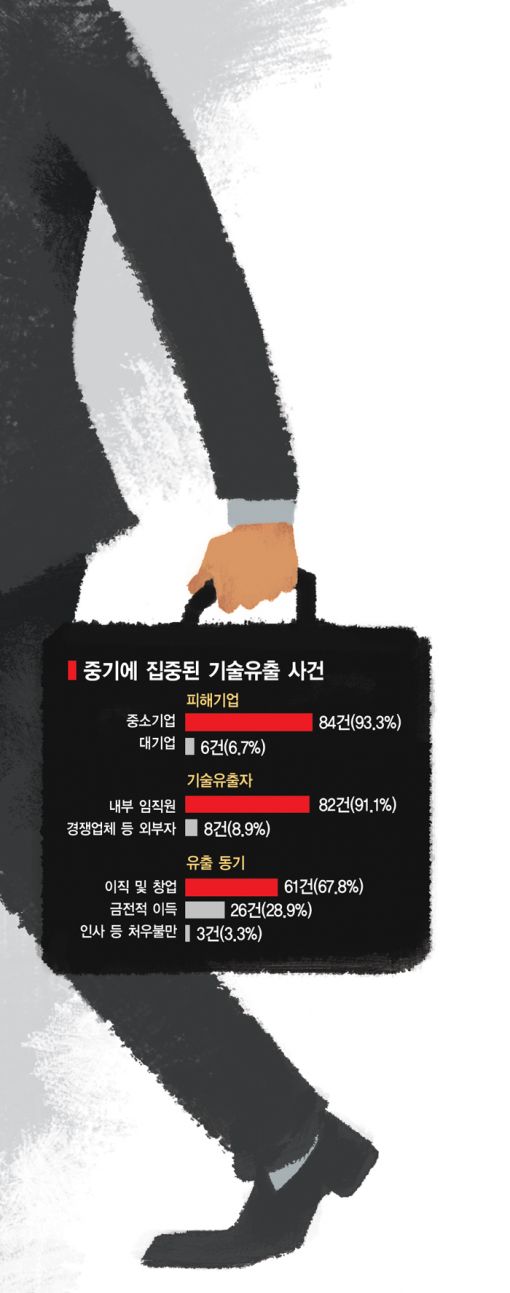 Illustration of technology leakage. Source=Asia Economy
On the 5th, the Korean Intellectual Property Office (KIPO) announced the results of the "2022 Intellectual Property Protection Status Survey," which included this information.
The survey was conducted on 8,269 domestic companies to understand the possession and damage status of trade secrets and industrial property rights, as well as awareness and experience of unfair competition acts.
According to the survey, 76.8% of domestic companies responded that they possess trade secrets, and among them, 1% experienced trade secret leakage damage in the past five years (2017?2021).
Regarding types of trade secret leaks, leaks caused by former employees accounted for the highest proportion at 51.2%, followed by current employees at 26.4%, and outsiders at 24%.
On the other hand, only 44.8% of companies responded that they made management efforts such as interviewing former employees and obtaining "Confidentiality Agreements," revealing vulnerabilities due to the absence of a former employee management system.
By industry, the food and beverage manufacturing sector, noted as "K-Food," had the highest trade secret leakage rate at 2.3%, followed by the electrical and electronics industry including semiconductors (2.1%), apparel and footwear manufacturing (2.0%), non-metallic mineral industry (1.9%), chemical industry (1.7%), other manufacturing industries (1.3%), machinery industry (1.2%), wholesale and retail trade (1.1%), and business services and telecommunications (0.7%).
The rate of domestic companies that have directly experienced or indirectly witnessed unfair competition acts in the past five years was 5.2%.
By type of act (multiple responses allowed), product form imitation accounted for the highest proportion at 2%. This was largely attributed to the recent increase in luxury brand preference and the rapid growth of non-face-to-face industries due to the COVID-19 pandemic, which highlighted online consumption behaviors.
The possession rate of industrial property rights among domestic companies was confirmed to be 22.2%, with the types of rights held (multiple responses allowed) ranked as patents at 18.2%, trademarks at 6.9%, and design rights at 4.8%.
Among domestic companies holding industrial property rights, 3.9% experienced industrial property rights infringement damage in the past five years, with trademark rights infringement being the highest at 1.7%. The relatively high incidence of trademark infringement damage is attributed to the surge in counterfeit product distribution mediated by online platforms such as SNS and open markets, which increased trademark infringement cases as well.
For example, the "Open Market Sales Suspension" cases compiled by the Korea Intellectual Property Protection Agency showed a sharp increase: 7,662 cases in 2019, 10,446 cases in 2020, 16,846 cases in 2021, and 24,687 cases last year.
Kim Si-hyung, Director of the Industrial Property Protection Cooperation Bureau at KIPO, stated, "Based on the survey results, we will actively pursue policy support and system improvements to ensure that our companies' intellectual property is thoroughly protected."
© The Asia Business Daily(www.asiae.co.kr). All rights reserved.
![Clutching a Stolen Dior Bag, Saying "I Hate Being Poor but Real"... The Grotesque Con of a "Human Knockoff" [Slate]](https://cwcontent.asiae.co.kr/asiaresize/183/2026021902243444107_1771435474.jpg)















