The first ozone advisory was issued last month in Chungnam. This was about a month earlier than in 2021, when the only April ozone advisory was issued since the ozone alert system was introduced and implemented in 2004.
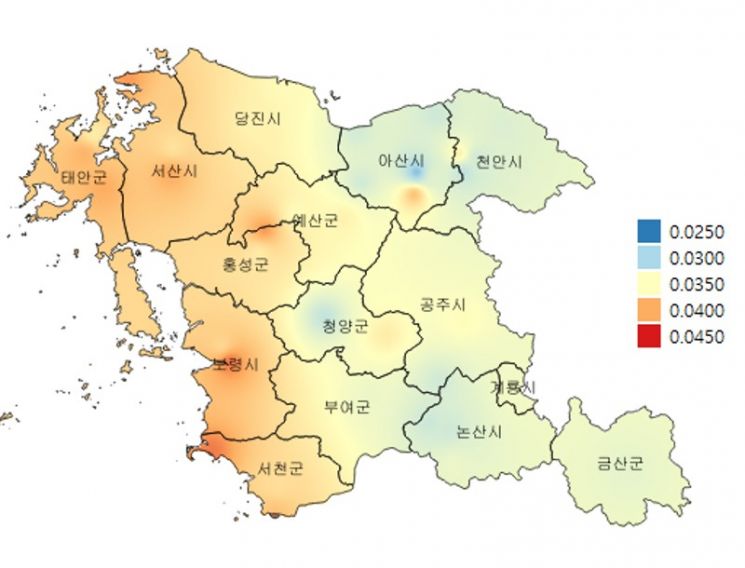 Last year's average ozone concentration data in the Chungnam region. Provided by Chungnam Provincial Institute of Health and Environment.
According to the Chungnam Provincial Institute of Health and Environment on the 5th, ozone advisories were issued in Chungnam starting from April 22 in Seosan, Dangjin, and Taean, followed by Cheonan on the 31st, and again in Seosan and Taean on the 1st of this month.
Considering that the ozone alert system is usually in effect from April 15 to October 15, when high concentrations of ozone occur, the institute explained that the first alert was issued relatively early.
Chungnam has also shown a trend of increasing ozone concentrations every year from 2021 to 2022 during the April to October period.
Ozone is a substance that is not directly emitted but is formed in the atmosphere through photochemical reactions when nitrogen oxides (NOx) and volatile organic compounds (VOCs) in the air meet strong sunlight.
High concentrations of ozone mainly occur in spring and summer under weather conditions where clear skies persist, temperatures rise, and winds are weak, acting in complex ways with the atmospheric environment.
As ozone concentration increases, its irritant and oxidative properties intensify, causing damage to the airways and lungs, irritation to sensory organs, and can inhibit plant growth by causing tissue destruction.
Exposure to ozone at a concentration of 0.1 ppm for 30 minutes can cause eye irritation and headaches, and exposure to 0.3 ppm for 5 minutes increases respiratory volume.
Ozone alerts are issued to prevent such ozone-related damage. The alert levels are divided into advisory (0.12 ppm or higher), warning (0.3 ppm or higher), and severe warning (0.5 ppm or higher).
The institute operates 39 air quality monitoring stations across 15 cities and counties to implement the ozone alert system, issuing alerts based on the highest concentration measured in each city or county.
Kim Ok, director of the institute, said, “According to the Korea Meteorological Administration, temperatures this year are expected to be higher than average with similar precipitation levels, increasing the likelihood of high ozone concentrations. When an advisory is issued, we urge respiratory patients, the elderly, and children to refrain from outdoor activities.”
© The Asia Business Daily(www.asiae.co.kr). All rights reserved.

















