The 232nd Ministerial Meeting on External Economic Affairs
Deputy Prime Minister and Minister of Economy and Finance Choo Kyung-ho stated on the 5th that uncertainties regarding the United States' Inflation Reduction Act (IRA) still exist.
On the same day, Deputy Prime Minister Choo held the Foreign Economic Ministers' Meeting at the Government Seoul Office and said, "Although our position has been substantially reflected in the sub-regulations of the U.S. Inflation Reduction Act (IRA), uncertainties still remain regarding conditions for receiving semiconductor subsidies, the scope of information to be submitted during the application process, and export controls on semiconductor equipment." Deputy Prime Minister Choo emphasized, "We will continue intergovernmental consultations with the relevant industries to maximize the benefits for our companies and minimize difficulties during future opinion gathering and subsidy application processes."
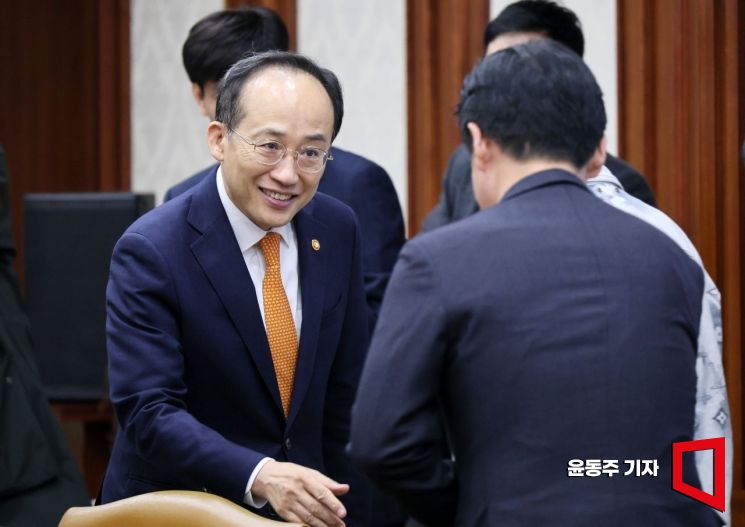 Deputy Prime Minister for Economy Choo Kyung-ho is attending the Ministerial Meeting on External Economy held at the Government Seoul Office in Jongno-gu, Seoul on the 5th. Photo by Dongju Yoon doso7@
Regarding the European Union (EU)'s Critical Raw Materials Act and Carbon Neutral Industry Act, he said, "Since the legislative process usually takes two years, we will continue consultations to ensure our position is reflected, while domestically supporting the rapid development of carbon reduction technologies."
Deputy Prime Minister Choo stated, "To expand the base of exports, we will diversify and broaden Free Trade Agreements (FTAs) by improving existing FTAs and introducing new methods. For some developing countries where concluding FTAs in the existing manner is difficult, we will newly pursue Economic Partnership Agreements (EPAs) that relax market opening levels and strengthen economic cooperation elements."
Accordingly, the government plans to start EPA negotiations with Georgia and Mongolia in the first half of this year to support our companies' entry into new markets and diversification of supply chains. Additionally, agreements currently under negotiation with Ecuador and the Gulf Cooperation Council will be focused on key issues and concluded promptly.
Regarding the Indo-Pacific Economic Framework (IPEF), launched in May last year, Deputy Prime Minister Choo said, "Active discussions are underway in the areas of trade, supply chains, clean economy, and fair economy with the goal of achieving tangible results, and the second round of negotiations was completed last month. We plan to actively participate in the negotiations to reflect our position."
He announced plans to reorganize the key economic security items selected in December 2021 in response to changes in domestic and international conditions such as the weaponization of supply chains and intensified competition in advanced fields.
He said, "We will add key items focusing on three major areas: items newly highlighted by supply chain risks, essential items for new growth and core industries, and items directly related to citizens' daily lives. Items for which management necessity has decreased due to domestic production conversion and diversification of import sources will be excluded from the key items."
They will implement item-specific tailored management by preparing contingency plans and discovering additional policy tasks. In particular, they plan to support the National Assembly's discussion process to enact the Basic Act on Economic Security Supply Chains.
© The Asia Business Daily(www.asiae.co.kr). All rights reserved.
![User Who Sold Erroneously Deposited Bitcoins to Repay Debt and Fund Entertainment... What Did the Supreme Court Decide in 2021? [Legal Issue Check]](https://cwcontent.asiae.co.kr/asiaresize/183/2026020910431234020_1770601391.png)
















