'Return of South Korea as Joint Proposer after 5 Years of "Moon Government" Absence
Resolution Adopted for 21 Consecutive Years...No Vote This Time Either
6 Detainees from South Korea...Limitations Due to Missing Nationality and Names'
The United Nations Human Rights Council adopted the 'North Korea Human Rights Resolution' condemning human rights abuses by the Kim Jong-un regime. While the South Korean government, which had withdrawn from co-sponsoring the resolution during the Moon Jae-in administration, positively rejoined the draft negotiations after five years, the resolution still leaves room for improvement as it contains vague references to victims from the South under North Korean authorities and was once again adopted without a vote.
On the 5th, Asia Economy obtained and analyzed the full text of the North Korea Human Rights Resolution through the Transitional Justice Working Group (TJWG), a human rights investigation organization. The resolution newly specifies violations of the right to information under the 'Law on the Prohibition of Reactionary Thought and Culture.' However, it still refers to North Korea's human rights abuses against South Korean prisoners of war only at the level of 'suspicions and concerns,' and it was confirmed that the six South Korean detainees held by North Korea were not even identified by nationality or name.
"Systematic Human Rights Violations"... Addition of Condemnation of the Law on the Prohibition of Reactionary Thought and Culture
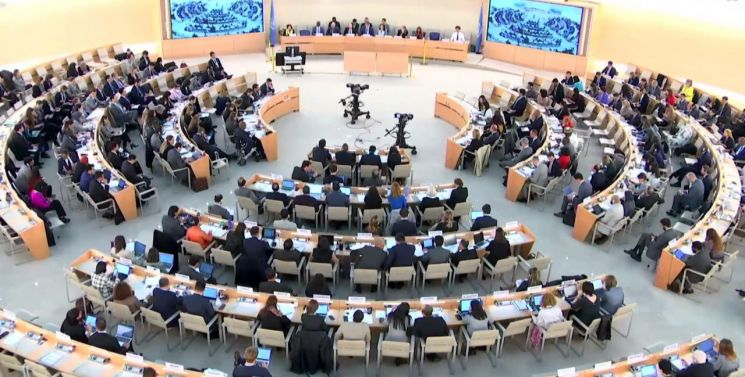 The United Nations Human Rights Council adopted the North Korean human rights resolution on the 4th (local time).
 [Photo by United Nations]
On the 4th (local time), at the 56th meeting of the 52nd session, the UN Human Rights Council adopted the North Korea Human Rights Resolution condemning systematic human rights violations occurring in North Korea. In particular, it clearly pointed out 'violations of the right to information' and added the phrase "Review laws and practices including the Law on the Prohibition of Reactionary Thought and Culture." This law, enacted in 2020 and revised in August last year, strictly prohibits all content produced outside North Korea, including South Korea, as reactionary thought and culture. However, there are criticisms that South Korea's leaflet ban law against North Korea, enacted around the same time, also infringes on the right to information and cannot be free from criticism.
The existing clause that specifies human rights abuses experienced by prisoners of war and their descendants newly includes the phrase "Attention should be paid to nationals of other member states detained in North Korea without information on their health or detention status." Additionally, the clause expressing concerns about torture, summary executions, and arbitrary detention of foreigners was supplemented with a call to "disclose all relevant information, including life status and whereabouts, to families and related agencies."
The resolution also newly includes the phrase "North Korean residents repatriated to North Korea must not be subject to any human rights violations, including enforced disappearance, arbitrary execution, torture, or unfair treatment," which is interpreted as referring to the forced repatriation of North Korean fishermen in 2019.
Furthermore, the resolution calls for the cessation of enforced disappearances, arbitrary executions, torture, and other human rights abuses against defectors deported to North Korea, urging the provision of information on their status and treatment. This is seen as a concern that if North Korea reopens its borders, which were closed after COVID-19, a large number of defectors detained in China may be forcibly repatriated. While reaffirming the 'principle of non-refoulement,' the resolution does not explicitly name 'China' as the target.
The resolution also criticizes North Korea for increasingly diverting resources that should be used to improve residents' welfare and address food shortages to nuclear and missile development. In addition, it retains calls from previous resolutions for comprehensive solutions to human rights abuses in detention facilities, forced labor, discrimination based on social class, abductions and enforced disappearances, widespread privacy surveillance, guilt-by-association systems, and public executions.
South Korean Prisoners of War and Detainees' Victim Details 'Unclear'... No Names Included
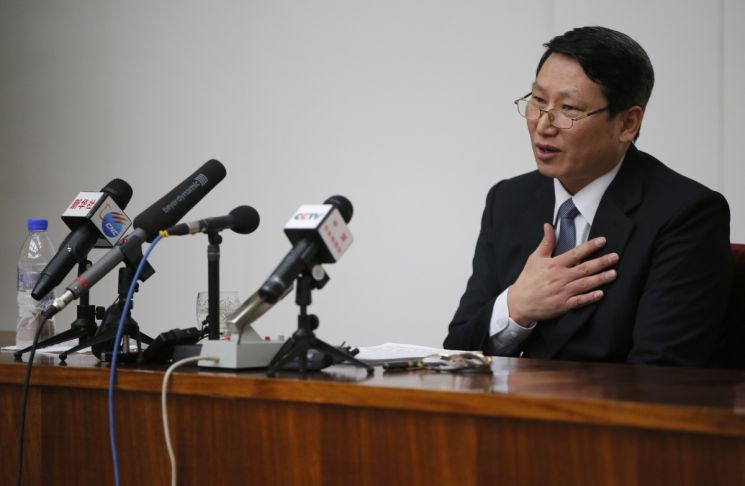 Missionary Kim Jung-wook appealing for release in a press conference format in Pyongyang in February 2014. Missionary Kim was reportedly sentenced to life labor reform after being arrested in October 2013 in the North Korea-China border area on charges of plotting to overthrow the state, but his detailed whereabouts or life status have not been confirmed for 10 years.
The North Korea Human Rights Resolution has been adopted for 21 consecutive years since it was first adopted by the UN Commission on Human Rights (the predecessor of the Human Rights Council) in 2003. Notably, although the Moon Jae-in administration withdrew from co-sponsorship from 2019 to pursue a conciliatory policy toward North Korea, the South Korean government's return to co-sponsorship in this resolution is a meaningful achievement. However, there is a limitation in that the resolution has been adopted by 'consensus' without a vote for eight consecutive years since 2016.
Immediately after the adoption of this resolution, the Ministry of Foreign Affairs stated, "We welcome the adoption of the North Korea Human Rights Resolution by consensus again this year, with 57 countries including South Korea participating as co-sponsors." However, consensus is a method of adoption when no country requests a vote and differs from unanimous approval where all cast affirmative votes. If countries neither support nor oppose, the practical implementation may lose momentum.
There are calls for the resolution to more clearly include details about victims from the South and the realities of human rights abuses, and for the annual repeated wording to be improved through a voting procedure. For example, the resolution has described human rights abuses against prisoners of war since 2021 only as 'suspicions' or 'concerns.' There are criticisms that specific condemnations such as forced labor, torture, detention, enforced disappearance, and executions should be included.
In particular, six South Korean detainees including missionary Kim Guk-gi are mentioned only as "nationals of other member states," without their nationality or names. This contrasts with the direct mention of Aung San Suu Kyi's name when condemning her detention in June 2020. Similarly, after two consecutive years of specific release demands in the resolution for Reuters journalists detained in Myanmar while covering the Rohingya persecution in 2017, their actual release was carried out in May 2019.
Scheduled for December General Assembly..."Government Must Actively Strive to Strengthen Wording"
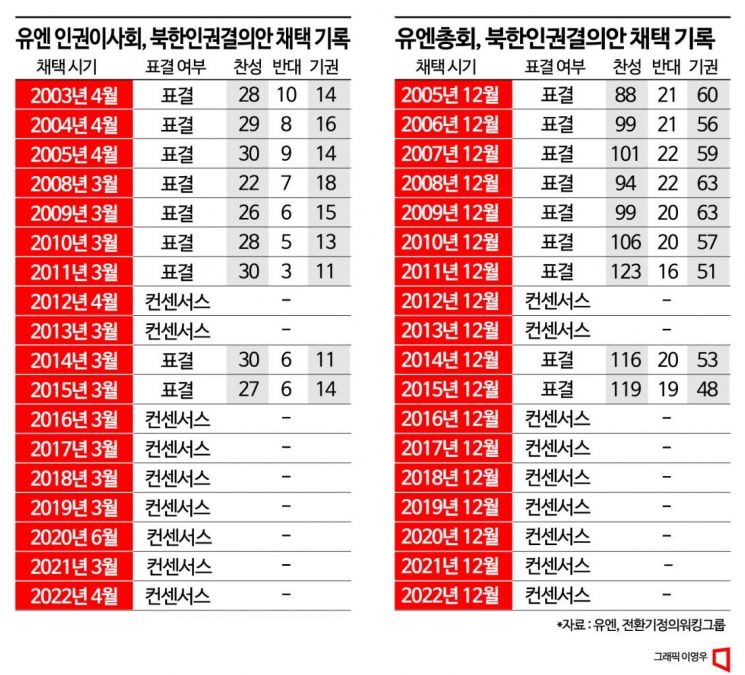
The UN has adopted the North Korea Human Rights Resolution annually at the Human Rights Council in Geneva, Switzerland, in the first half of the year, and at the General Assembly in New York, USA, in the second half. Based on usual precedents, the content of the next resolution is created through a process of supplementing previous resolutions. To strengthen and advance the wording of the North Korea Human Rights Resolution to be adopted at the UN General Assembly in December this year, diplomatic efforts by the South Korean government toward member states are required.
On the 3rd, Kim Jeong-sam, the brother of missionary Kim Jeong-uk currently detained in North Korea, along with five North Korea human rights organizations, sent a letter to President Yoon Suk-yeol requesting "strengthening the wording regarding prisoners of war and detainees in the North Korea Human Rights Resolution." They demand that the nationality and names of detainees such as Kim Guk-gi, Choi Chun-gil, Kim Jeong-uk, Kim Won-ho, and Go Hyun-cheol be clearly included, and that concerns about human rights abuses against them be specifically pointed out.
Shin Hee-seok, legal analyst at the Transitional Justice Working Group, said, "It is welcome that South Korea has returned as a co-sponsor," but added, "As Ambassador Oh Jun’s famous speech at the UN in 2014 stated, 'If North Korean residents are not just anybodies,' the government should consult human rights organizations in advance and strive to reflect their opinions in the resolution. It is also necessary to become a major co-sponsor jointly with the EU or to pursue adoption by vote instead of consensus."
Meanwhile, North Korea expressed its rejection of the resolution, calling it a "document containing political conspiracy." Han Dae-sung, North Korea’s representative to Geneva, made the absurd claim that it was "an unrealistic dream to undermine the dignity of the motherland and overthrow our society." He also targeted Western countries involved in drafting the resolution, accusing them of being "countries that have committed all kinds of human rights violations such as invasion, massacre, and racial discrimination."
© The Asia Business Daily(www.asiae.co.kr). All rights reserved.



















