The Cheonho A1-2 district in Gangdong-gu, Seoul, will be transformed into a residential complex with 780 households through redevelopment. The Seoul Metropolitan Government plans to develop this area into a residential complex that harmonizes nature, history, and culture by leveraging its proximity to the Han River and Pungnaptoseong Fortress.
On the 5th, Seoul announced the finalization of the rapid integrated planning proposal for the redevelopment of Cheonho A1-2 district. The Cheonho A1-2 district had faced development difficulties due to height restrictions around Pungnaptoseong Fortress. Seoul devised a plan that maximizes the locational advantages of being close to the Han River while harmonizing with surrounding cultural assets, gaining residents' consensus.
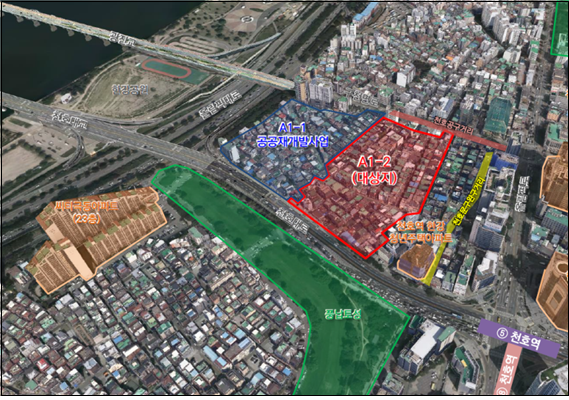
According to the finalized rapid integrated planning proposal for the redevelopment of Cheonho A1-2 district, the area will be transformed into a residential complex with up to 40 floors and 780 households that blend with the surrounding cultural heritage. Considering that about one-third of the district area is designated as a ‘historical and cultural environment preservation zone’ subject to height restrictions of 8 to 14 floors, the maximum height for areas not subject to these restrictions has been relaxed from 35 to around 40 floors. Additionally, efforts were focused on creating an integrated plan with the adjacent Cheonho A1-1 district to maximize views of the Han River.
To this end, Seoul incorporated four planning principles under the goal of creating a ‘residential complex where nature, history, and culture harmonize’: ▲ Establishing a complex embracing the Han River through integrated planning with adjacent districts ▲ Building a convenient transportation system through district-level traffic improvements ▲ Creating creative landscapes considering local characteristics ▲ Developing an open complex that shares the community with the region.
First, through integrated planning with adjacent districts, a pedestrian route connecting Cheonho Station to the Han River (Gwangjin Bridge) was established, and tower-type main buildings were staggered to maximize Han River views. Originally a single complex, the A1 district was divided into A1-1 (public redevelopment) and A1-2 (private redevelopment) during the project process. The city established a plan where public and private redevelopment coexist by comprehensively reviewing landscape, Han River views, pedestrian and traffic systems.
Second, due to the location along Cheonho-daero, a frequently congested road, district-level traffic improvement measures were prepared to resolve traffic issues arising from large-scale development. Instead of allowing direct access to Cheonho-daero from the site, the prehistoric road, which was severed under the Cheonho Bridge overpass, was refurbished to connect with Olympic-daero, establishing a circular traffic network.
Third, considering height restrictions within the historical and cultural environment preservation zone, a skyline gradually rising from Pungnaptoseong Fortress was planned, and high-rise main buildings with Han River views were planned inside the site, with the maximum height relaxed from 35 to 40 floors.
Lastly, to revitalize the area, an open complex sharing living convenience facilities was created. Community facilities centered on history and culture to preserve the long history of Pungnaptoseong Fortress and local culture were placed along public pedestrian paths and designed as facilities open to the general public, creating a space for harmony with local residents.
With the finalization of the rapid integrated planning proposal for Cheonho A1-2 district, the city expects the maintenance plan decision to be completed within the year. Due to the simplification of the rapid integrated planning process, the project period is expected to be significantly shortened by integrating reviews from the Urban Planning Committee’s delegated subcommittee and related reviews during the project implementation plan stage.
Jo Nam-jun, Director of the Seoul Metropolitan Government’s Urban Planning Bureau, said, “This planning proposal is a meaningful case that leverages the locational strengths of local resources such as the Han River and Pungnaptoseong Fortress and creates a creative landscape through integrated planning with surrounding districts. Through rapid integrated planning, we will draw a blueprint for harmonious development beyond individual districts to surrounding districts and, further, the city.”
© The Asia Business Daily(www.asiae.co.kr). All rights reserved.

![Clutching a Stolen Dior Bag, Saying "I Hate Being Poor but Real"... The Grotesque Con of a "Human Knockoff" [Slate]](https://cwcontent.asiae.co.kr/asiaresize/183/2026021902243444107_1771435474.jpg)















