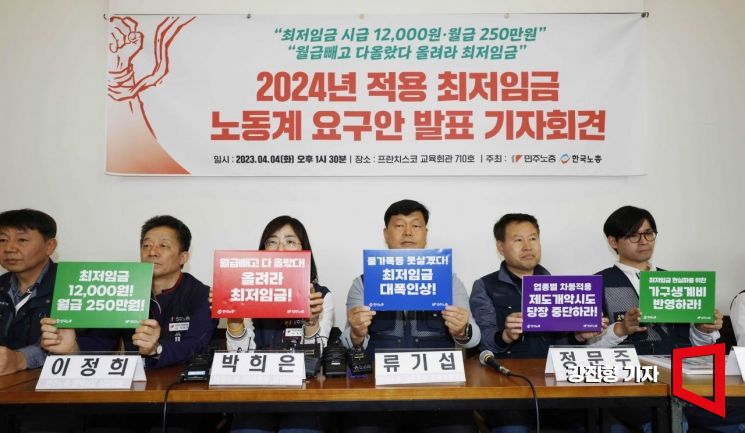
 On the 4th, union members affiliated with the two major trade unions held a press conference announcing the labor sector's demands for the 2024 minimum wage at the Francisco Education Center in Jung-gu, Seoul. Photo by Jinhyung Kang aymsdream@
As labor groups demand an hourly minimum wage of 12,000 won for next year, attention is focused on whether the minimum wage can surpass 10,000 won for the first time in history.
On the 4th, the two major labor unions, the Korean Confederation of Trade Unions (KCTU) and the Federation of Korean Trade Unions (FKTU), held a press conference at the Francisco Education Center in Jeong-dong, Jung-gu, Seoul, to announce their minimum wage demands for 2024.
The amount requested by the two major unions is 12,000 won per hour, which corresponds to a monthly salary of 2,508,000 won (based on 209 hours). This is 24.7% higher than this year's minimum wage of 9,620 won per hour (monthly salary of 2,010,580 won).
The two unions emphasized, "We strongly demand a substantial increase in the minimum wage to overcome the decline in real wages during the worst inflation period and to alleviate the deepening polarization and inequality system," adding, "With gas, electricity, and transportation fares rising one after another, the perceived inflation experienced by ordinary people has become a price bomb threatening the livelihoods of working-class citizens."
Along with the minimum wage demand, the labor groups also presented seven demands: ▲ reflecting household living expenses in the minimum wage determination criteria ▲ abolishing differentiated application by business type ▲ strengthening the responsibility of contractors ▲ government payment of the minimum wage difference ▲ establishing measures to expand application to platform workers and other workers currently excluded from minimum wage coverage ▲ restoring the scope of inclusion and deeming ordinary wages ▲ abolishing the exclusion of disabled persons and others from minimum wage application.
The two major unions stated, "For two consecutive years, the minimum wage has been determined based on the calculation method reflecting inflation rate, economic growth rate, and employment growth rate as proposed by the public interest commissioners," and emphasized, "This calculation method lacks clear legal grounds and ignores the role of the Minimum Wage Commission."
They added, "If such criteria are applied without filtering again this year, the fundamental purpose of the Minimum Wage Commission as a social dialogue body will collapse," and pointed out, "Deliberations should proceed in accordance with the original purpose of the minimum wage system, which is to stabilize workers' livelihoods."
The first plenary meeting of the Minimum Wage Commission is scheduled for the 18th. The commission consists of 27 members: 9 employer representatives, 9 public interest commissioners, and 9 worker representatives. Since the positions of worker and employer representatives are always sharply opposed, the minimum wage is usually decided through mediation by the public interest commissioners who hold the casting vote.
The current minimum wage is 9,620 won, and if the minimum wage increase rate for next year exceeds 3.95%, it will surpass 10,000 won. Given the significant concerns about inflation and economic recession this year as well, fierce disputes between labor and management over the minimum wage level are expected.
In particular, heated debates are anticipated regarding the 'differentiated application by industry' during this year's discussions.
The business community argues that the minimum wage should be applied differently by industry due to significant differences in business conditions and regional economic situations, but labor groups maintain their opposition, citing concerns such as the stigmatization effect on low-wage industries.
© The Asia Business Daily(www.asiae.co.kr). All rights reserved.
![Clutching a Stolen Dior Bag, Saying "I Hate Being Poor but Real"... The Grotesque Con of a "Human Knockoff" [Slate]](https://cwcontent.asiae.co.kr/asiaresize/183/2026021902243444107_1771435474.jpg)












