Seoul City is completely overhauling the ‘Yeoksekwon Youth Housing’ program. Private rental fees will be reduced to 75-85% of the surrounding market price, and management fees will also be lowered. Additionally, the project area will be expanded beyond just the areas near subway stations to include main roads accessible by public transportation such as buses. The city plans to supply a total of 120,000 youth safety housing units within Seoul by 2030.
On the 4th, Seoul City held a press briefing at City Hall and announced the ‘Youth Safety Housing Promotion Plan,’ which includes the details of the ‘Yeoksekwon Youth Housing’ project overhaul. Launched in 2017, ‘Yeoksekwon Youth Housing’ is housing aimed at stabilizing the residence of young people without homes, located within 350 meters of subway stations, and allowing residents to live for up to 10 years at rents lower than market prices.
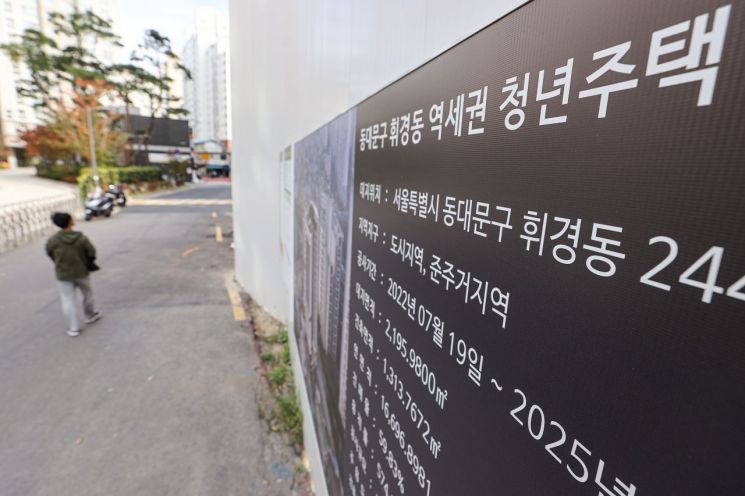 A new youth housing construction site near a station in Hwikyung-dong, Dongdaemun-gu, Seoul.
 [Photo by Yonhap News]
Currently, about 12,000 units are occupied within Seoul, and 45,000 units have been supplied. The original goal was to supply 65,000 units by 2026, but an additional 55,000 units will be added to reach a total of 120,000 units by 2030.
This plan includes lowering rent and management fees. Previously, private rental units in Yeoksekwon Youth Housing were supplied at 85-95% of the surrounding market price, but through the overhaul, they will be supplied at 75-85%, a 10 percentage point reduction. After the market price is announced, the plan will also undergo review by the ‘Youth Housing Operation Advisory Committee,’ which collects opinions.
For public rental units, the deposit selection range will be expanded from 20 million to 30 million KRW to 5 million to 30 million KRW. Private rentals will introduce jeonse (lump-sum deposit lease) in addition to deposit-based monthly rent, and interest-free deposit support will increase from a maximum of 45 million KRW to up to 60 million KRW.
Management fees will also be reduced by about 10 percentage points. To achieve this, 30-40% of idle parking spaces within buildings will be opened for paid use, and income generated from operating tenant-shared spaces will be used to offset the reduced management fee burden. Furthermore, the previous policy that only allowed residents with livelihood vehicles to use parking lots will be changed to permit vehicle use if parking fees are paid. The city analyzed that charging for 40% of parking spaces could reduce management fees by 12,000 KRW per household.
The project target areas for Youth Safety Housing will also be expanded. Previously, the Yeoksekwon standard was within 350 meters of urban railway platforms, but this will be adjusted to within 250 meters. The city stated that the project target areas will not be limited to ‘Yeoksekwon’ but will be expanded to main roads accessible by buses and other public transportation. The development standard will be within 50 meters from the road boundary, and the zoning will principally be ‘quasi-residential areas.’ Ordinance revisions are planned for May.
The city explained that main roads have sufficient infrastructure such as public and convenience facilities and public parking lots, have low floor area ratios, and many old buildings, making them suitable for youth housing supply and development potential. For main roads that are already well developed, some allowance will be made to upgrade zoning to ‘commercial areas,’ and Yeoksekwon areas will be allowed up to 350 meters depending on surrounding development conditions. Han Byung-yong, Director of Seoul City Housing Policy Office, explained, “Although project sites have not yet been finalized, the area occupied by main roads is larger in the Northeast area (21 km) and Southwest area (17 km) than other regions, so it is expected that many youth housing units will be supplied in those areas.”
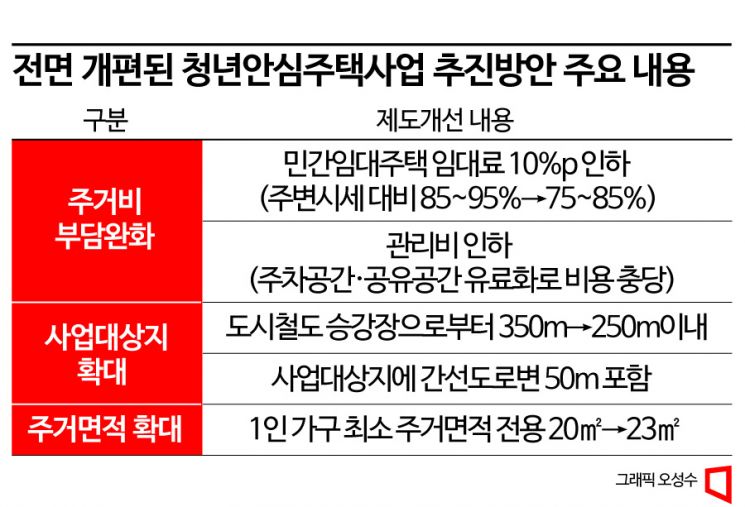
The residential area per household will also increase. Previously, the minimum residential area for single-person households was 20㎡ (exclusive area), but this will be expanded to 23㎡. Additionally, standardized specifications and quality criteria will be presented for built-in appliances, which varied by developer, to ensure uniform products are installed.
Moreover, the city plans to operate a ‘Youth Safety Housing Support Center’ to ensure young people have sufficient information. The center, currently located near Jangji Station in Songpa-gu, will be relocated near Samgakji Station in Yongsan-gu, providing services from move-in information to application and move-out. The recruitment of residents will also increase from twice a year to three times a year.
In addition, from the early stages of the Youth Safety Housing project, local districts will participate in the ‘Integrated Deliberation Committee’ to directly convey opinions from local governments and residents. To support developers facing difficulties due to recent construction cost and interest rate increases, construction loan interest support will be raised from 1.5% to 2% for this year only. Particularly, the ‘pre-review procedure,’ in which the city and local governments previously confirmed project requirements in advance, will be abolished to shorten project periods and reduce developer burdens.
Han Byung-yong, Director of Seoul City Housing Policy Office, said, “We will spare no effort to improve and support the project to supply Youth Safety Housing where young people can live comfortably and for a long time without worrying about housing.”
© The Asia Business Daily(www.asiae.co.kr). All rights reserved.
![Clutching a Stolen Dior Bag, Saying "I Hate Being Poor but Real"... The Grotesque Con of a "Human Knockoff" [Slate]](https://cwcontent.asiae.co.kr/asiaresize/183/2026021902243444107_1771435474.jpg)

















