Opposition Repeatedly Plays 'Impeachment·State Audit' Card
Government and Ruling Party Oppose Every Opposition Legislation
Experts Say "Frame Competition Has Already Begun"
The National Assembly, one year ahead of the 22nd general election, has been engulfed in a vortex of 'extreme politics.' Terms like 'impeachment,' 'state audit,' and 'special investigation' are pouring out, and expressions such as 'unilateral' and 'forceful' have become commonplace. Both ruling and opposition parties have solidified their internal bases by rallying their hardline supporters, resulting in the disappearance of the fundamental political principle of cooperation. The confrontation is expected to worsen as President Yoon Seok-yeol exercised his first veto power on the 'Grain Management Act Amendment.'
According to the National Assembly's legislative information system on the 5th, the resolution titled 'Withdrawal of the Yoon Seok-yeol Government's humiliating and anti-historical "Forced Mobilization Solution" and urging apology and compensation from the Japanese government and companies' was submitted as an agenda item for the plenary session. The resolution, which passed the Foreign Affairs and Unification Committee on the 13th of last month, described the government's 'third-party compensation plan' regarding Japan's forced labor as "a surrender declaration bowing to the perpetrator Japan by the victim Korea, marking the worst diplomatic disaster in history, akin to a national humiliation." It called for ▲ withdrawal of the forced mobilization solution ▲ diplomatic efforts by the government to elicit compensation and direct apologies from Japanese companies ▲ acknowledgment, apology, and compensation from the Japanese government for past wrongdoings.
Additionally, bills such as the Medical Service Act amendment, which cancels licenses for doctors sentenced to imprisonment or higher, and the Nurse Act, directly submitted by the Democratic Party, were also presented to the plenary session. The Democratic Party is also preparing to directly submit other contentious bills, including the so-called Yellow Envelope Act, which expands the scope of labor union strikes. With President Yoon Seok-yeol reviewing and approving the request for reconsideration of the Grain Management Act Amendment at the Cabinet meeting held the previous day, the Democratic Party's legislative dominance is expected to intensify.
Minority Government Structure... Predictable Confrontation of Strengths
Since the launch of the Yoon Seok-yeol administration, the Democratic Party has already submitted two motions of dismissal to the National Assembly (Foreign Minister Park Jin and Minister of the Interior and Safety Lee Sang-min). The opposition party alone processed the impeachment motion against Minister Lee. The impeachment trial for Minister Lee is currently preparing for arguments at the Constitutional Court. Additionally, impeachment discussions continue regarding Prime Minister Han Seung-soo and Minister of Justice Han Dong-hoon. For example, the Democratic Party recently harshly criticized Prime Minister Han's statement on the Grain Management Act Amendment as "content announced by a thug," escalating confrontations at every turn.
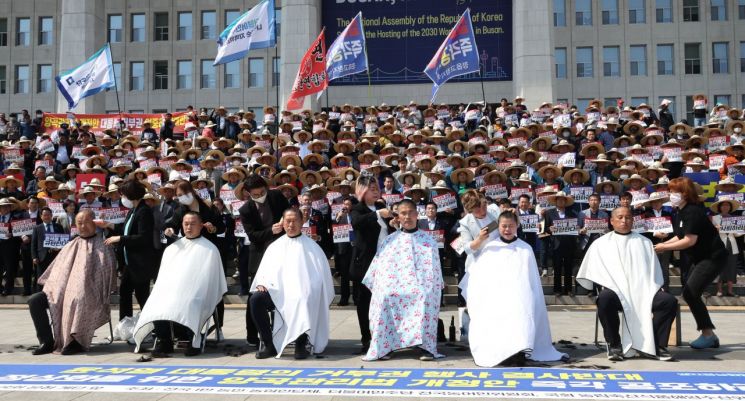
Moreover, the party is overusing state audits and hearing cards. The Democratic Party is pushing for a state audit related to the Korea-Japan summit last month, which has drawn opposition not only from the ruling party but also from the presidential office, calling it an "unprecedented demand." Furthermore, the National Assembly's Education Committee held a hearing on lawyer Jeong Soon-shin, who was appointed but fell through as head of the National Investigation Headquarters. The clashes over the Grain Management Act Amendment between the ruling and opposition parties have revived 'relay head-shaving' protests, along with condemnation rallies and outdoor demonstrations.
This intense confrontation is analyzed to have worsened due to the political landscape shift to a minority government last year and the competition for clarity as both parties rally their support bases ahead of next year's general election. A Democratic Party insider said, "As the general election approaches and the term of the floor leadership ends, it seems they are increasingly confronting each other in a 'strong vs. strong vs. strong' pattern," adding, "Lawmakers appear to take a strong stance unconditionally when it concerns their constituencies."
"Tense Atmosphere to Continue Until Next Year's General Election"
Experts predict that the tense atmosphere will intensify until the general election as both parties lack the will to cooperate. Professor Park Sang-byeong of Inha University Graduate School of Policy said, "Until next year's general election, the ruling and opposition parties will have no choice but to continue extreme struggles," explaining, "President Yoon has little desire to listen to the opposition's claims and run the government accordingly, nor is the environment conducive to that." He added, "Conversely, the Democratic Party under Representative Lee has no intention of cooperating with the Yoon administration to achieve results," and "Regardless of whether the president exercises veto power, the opposition is doing its best to fulfill its role."
Political commentator Lee Jong-hoon also diagnosed that a 'frame' competition between the two parties has begun. He said, "Both parties are framing the narrative as either working for the people's livelihood or neglecting it to boost their approval ratings," explaining, "In the case of the Grain Management Act, the president knew he would exercise veto power but pushed for forceful passage." He predicted, "Such issues will continue to arise in the future."
© The Asia Business Daily(www.asiae.co.kr). All rights reserved.

















