US NASA Announces Crew List for Artemis 2 Launching in November Next Year
For the first time in history, a woman and a Black person will participate in a lunar orbit test flight. Asian representation is absent.
On the 3rd (local time), the United States National Aeronautics and Space Administration (NASA) and the Canadian Space Agency (CSA) announced the list of four Artemis II astronauts?three Americans and one Canadian?at the Johnson Space Center in Houston, Texas. They will board Artemis II, scheduled for launch in November next year. They will not orbit or land on the Moon. Instead, over ten days, they will leave Earth's orbit, enter a lunar transfer orbit, approach the lunar surface to about 14,270 km, pass by the Moon reaching approximately 13,000 km, and then return to Earth. This project is a test flight conducted ahead of the manned lunar landing (Artemis III) planned after 2025.
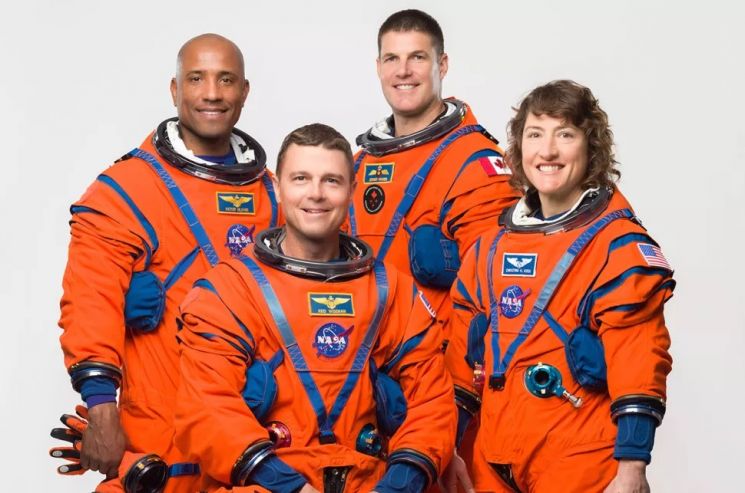 The National Aeronautics and Space Administration (NASA) announced on the 3rd (local time) the four astronauts who will participate in the Artemis 2 crewed lunar flyby mission. Photo by NASA
Previously, NASA successfully tested the performance of the rocket and manned capsule by launching the unmanned Artemis I in December last year, flying a similar route and returning. The main objectives of Artemis II's launch are to verify the performance and stability of NASA's super heavy-lift rocket launch vehicle (SLS) and to test the life support, navigation, and communication equipment of the manned space capsule 'Orion spacecraft' mounted on its upper stage. This mission marks the first lunar exploration in over 50 years since the Apollo program of the 1960s and 1970s.
NASA Administrator Bill Nelson said, "(The selected astronauts) represent the thousands of people tirelessly working to take us to the stars," adding, "Each has their own life story, but they embody our motto 'E pluribus unum' (Out of many, one), and we are opening a new era of exploration for the Artemis generation, the new generation of space navigators and dreamers."
The commander is Reid Wiseman (47), a veteran who spent six months on the International Space Station (ISS) from May to November 2014 and conducted 13 hours of spacewalks. He served as NASA's Chief of the Astronaut Office from December 2020 to November last year. Pilot Victor Glover (46) will be the first Black person to visit the Moon. Christina H. Koch (44), participating as a mission specialist, will be the first woman to orbit the Moon. Another mission specialist, Jeremy Hansen (47) from Canada, will be the first non-American to visit the Moon. Canada is an active partner in space development cooperation with the United States. In particular, Canada has been actively involved in the Artemis project, including providing the robotic arm 'Canadarm 3' to be attached to the lunar orbit space station 'Lunar Gateway.' Unfortunately, Asian representation is excluded this time. Korean-American doctor Johnny Kim (38) was a candidate but was not selected.
The Artemis II launch will follow a 'hybrid free return trajectory,' where the Orion manned spacecraft, mounted on the SLS, will leave Earth's orbit, travel near the Moon, and then return. The Orion spacecraft will use a service module produced by the European Space Agency (ESA) to leave Earth's orbit, head toward the lunar transfer orbit, pass the Moon, and return along a path captured by Earth's gravity.
Prior to this, the Orion spacecraft's piloting skills will be enhanced using the Interim Cryogenic Propulsion Stage (ICPS) installed on the upper stage of the SLS. Training will also be conducted for life support, communication, and navigation system operations within the Orion spacecraft. Before them, 24 Earthlings visited the Moon, starting with Frank Borman, Jim Lovell, and William Anders, who orbited the Moon aboard Apollo 8 in 1968, through to Apollo 17 in 1972. NASA plans to launch Artemis III for lunar landing exploration after 2025 if Artemis II's lunar orbit mission succeeds. Artemis III will land in the Moon's permanently shadowed regions near the south pole to investigate the presence of underground water. NASA's ShadowCam, attached to South Korea's first lunar orbiter Danuri, which arrived at the Moon in December last year, is tasked with mapping for this mission.
Vanessa Wyche, director of NASA's Johnson Space Center, said, "The astronauts selected this time will conduct exploration representing the interests of all humanity, realizing the highest form of humanism," adding, "This mission will expand humanity's deep space exploration and provide new opportunities for scientific discovery, commercial, industrial, academic partnerships, and the Artemis generation."
© The Asia Business Daily(www.asiae.co.kr). All rights reserved.

















