② Samsung Electronics and SK Hynix Expected to Post Deficits of Around 4 Trillion Won
Micron's Poor Performance as a Real Deficit Barometer
Deficit Forecast for Second Consecutive Quarter
Due to accumulating inventory and falling product prices, semiconductor companies' performance in the first quarter of this year is expected to be the 'worst ever.' The securities industry estimates that Samsung Electronics and SK Hynix will each incur losses exceeding 4 trillion won. There is also a possibility that the deficit in the second quarter could be even larger than in the first quarter. Considering the potential earnings shock in the first quarter and further semiconductor price declines, analyses suggest that the possibility of even greater losses remains open.
On the 3rd, financial information firm FnGuide forecasted Samsung Electronics' first-quarter sales and operating profit for this year at 64.3841 trillion won and 1.1781 trillion won, respectively. This represents a decrease of more than 80% compared to the operating profit forecast of 5.9254 trillion won compiled just three months ago in early January. Compared to the first quarter of last year (14.1214 trillion won) and the previous quarter (4.3061 trillion won), it plunged by 72.6% and 91.7%, respectively. This is because the DS (semiconductor) division is expected to incur losses around the 4 trillion won mark.
SK Hynix is expected to record first-quarter sales of 4.9757 trillion won and an operating loss of 3.4776 trillion won. This means the operating loss, which was 1.8984 trillion won in the previous quarter, will double. SK Hynix is also expected to possibly incur operating losses in the 4 trillion won range.
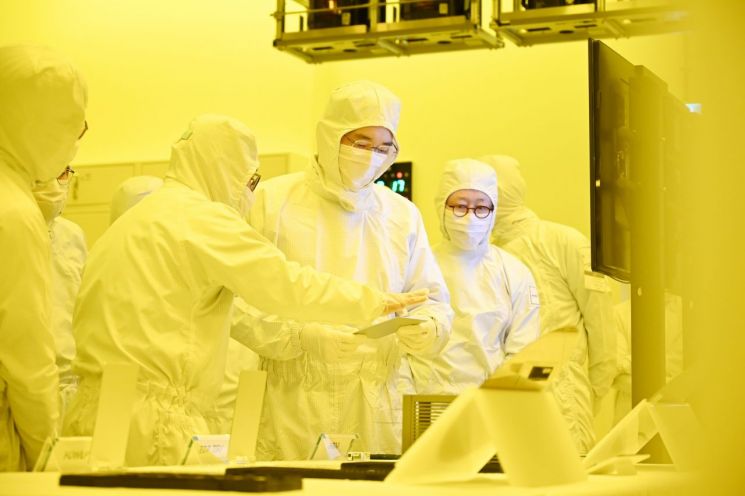
The poor performance of the two companies is attributed to the traditional seasonal off-season, increased inventory burdens, and a significant decline in exports. The Bank of Korea announced in February that semiconductor exports amounted to only 5.96 billion dollars, a 42.5% decrease compared to a year earlier. Looking at data released by the Korea International Trade Association, semiconductors accounted for only 12.8% of cumulative exports up to the 20th of this year. This is the first time since 2016 that the share of semiconductor exports in total exports has fallen below 15%.
The global memory semiconductor market size has shrunk by more than 60% over three quarters due to the sharp drop in semiconductor prices and decreased demand. The market size, which reached 43.7 billion dollars (56.7663 trillion won) in the second quarter of 2022, shrank to 31.9 billion dollars and 22.6 billion dollars in the third and fourth quarters of the same year, respectively, and further contracted to 16.8 billion dollars (21.8232 trillion won) in the first quarter of this year.
The question is whether the semiconductor industry can pass its bottom in the first half of this year. First, Micron, the third-largest memory semiconductor company, is expected to continue its losses for two consecutive quarters following the previous quarter. In its earnings announcement in December last year, Micron provided second-quarter sales guidance of around 3.8 billion dollars, which is a 51% decrease compared to the second quarter of last year. Earlier, during its first-quarter earnings announcement, Micron reported a net loss of 1.53 billion dollars and announced a 10% workforce reduction.
Choi Yoo-jun, a researcher at Shinhan Investment Corp., explained, "Micron's performance generally acts as an event that allows us to preview domestic semiconductor earnings. It is necessary to gauge domestic companies' performance through the earnings announcement of the third-largest memory company and seek information on the possibility of industry recovery in the second half."
The securities industry analyzed that if the second-quarter exports and semiconductor exports pass the bottom, the possibility of passing the earnings bottom is also likely to be linked. The semiconductor export growth rate is approaching an empirical bottom, and price declines may gradually slow due to supply adjustments. Expectations for semiconductor industry improvement are expected to grow due to the end of U.S. monetary tightening and China's reopening (resumption of economic activities).
Park Yoo-ak, a researcher at Kiwoom Securities, said, "Due to improved demand and price stabilization of NAND memory in the second quarter of this year, a slight improvement is expected, followed by a full-fledged rebound starting in the third quarter with DRAM demand recovery and price stabilization."
Kim Kwang-jin, a researcher at Hanwha Investment & Securities, forecasted, "Memory shipments are expected to fall short of the existing guidance due to the stronger-than-expected inventory reduction trend among major customers throughout the quarter. DRAM is expected to decline by 13%, NAND by 12%, and prices are expected to drop sharply by 20%." He diagnosed, "Semiconductor division earnings, which will be the direct trigger for stock price rebounds, are expected to gradually improve starting in the second quarter."
© The Asia Business Daily(www.asiae.co.kr). All rights reserved.
![Clutching a Stolen Dior Bag, Saying "I Hate Being Poor but Real"... The Grotesque Con of a "Human Knockoff" [Slate]](https://cwcontent.asiae.co.kr/asiaresize/183/2026021902243444107_1771435474.jpg)

















