Korea Employers Federation, Comparison of Last Year's Minimum Wage Underpayment Rates Domestically and Internationally
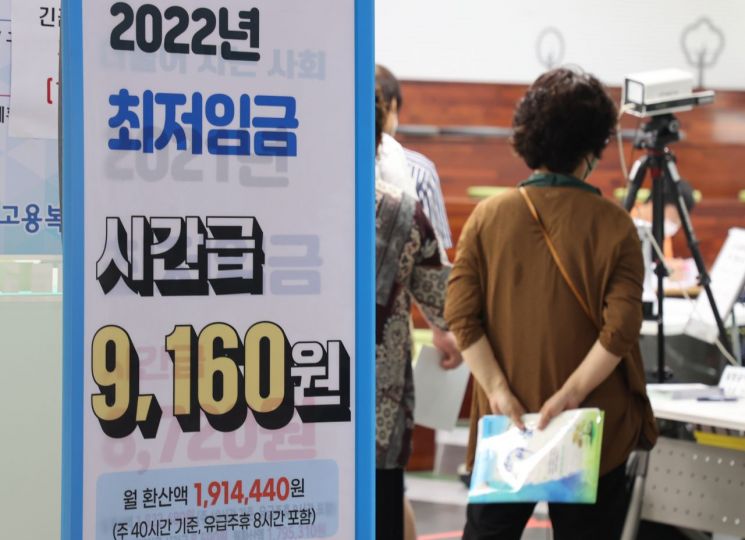
Last year, the rate of workers earning below the minimum wage decreased to 12.7% compared to the previous year. However, it still remains considerably high within the Organisation for Economic Co-operation and Development (OECD). The minimum wage underpayment rate refers to the proportion of wage workers who earn less than the statutory minimum wage of 9,160 KRW per hour (as of 2022). This rate tends to increase primarily when the minimum wage rises too quickly for the market to absorb.
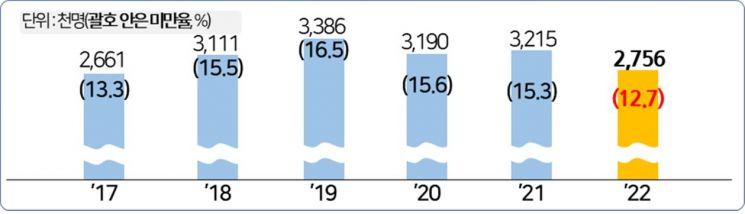
The Korea Employers Federation (KEF) analyzed raw data from Statistics Korea and released a domestic and international comparison of the minimum wage underpayment rate on the 2nd. According to the data, 2,756,000 workers in the Korean labor market earned less than the statutory minimum wage of 9,160 KRW per hour last year.
Previously, the number of workers earning below the minimum wage was around 577,000 in 2001, but it steadily increased to over 3.38 million in 2019. The underpayment rate also reached its highest level at 16.5% in 2019. Since the following year, the rate has slightly decreased, marking the lowest level since 2015 (11.4%). KEF evaluated this trend by stating, "Although there is a decreasing trend, the rate remains high, indicating a significant gap still exists between Korea’s minimum wage system and the realities of the market."
KEF analyzed that the main reason for the high underpayment rate is the steep increase in the minimum wage over recent years. This means the rise has been too rapid for employers to accept. Korea’s minimum wage has increased by about 41.6% over the past five years, which is up to 5.6 times higher than the major seven countries (G7) with which Korea directly competes.
Besides the speed of increase, the absolute level of the minimum wage itself was also pointed out as high. According to KEF’s analysis of OECD and country-specific data, Korea’s minimum wage last year was 62.2% of the median wage. The median wage refers to the middle level when all wage workers are ranked.
This figure ranks eighth highest among the 30 OECD countries with minimum wage systems. Compared to G7 countries, it is estimated to be the highest. Countries with higher rates than Korea include Colombia, T?rkiye, Costa Rica, Chile, New Zealand, Portugal, and Mexico, none of which are direct competitors of Korea.
By industry, the underpayment rate was high in agriculture, forestry, and fisheries at 36.6%, and in accommodation and food services at 31.2%. It was relatively low in professional, scientific, and technical services at 2.8%. By company size, businesses with fewer than five employees had a high underpayment rate of 29.6%.
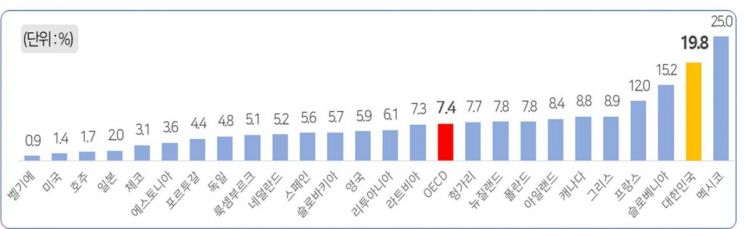
According to OECD’s direct survey data on the ‘proportion of workers earning below the minimum wage,’ Korea ranked second highest among 25 OECD countries at 19.8%, following Mexico at 25.0%. This is 2.7 times higher than the average rate of 7.4%.
Hahm Sang-woo, head of KEF, said, "Recently, Korea’s minimum wage has risen significantly higher than in advanced countries, resulting in underpayment rates exceeding 30% in some industries, showing that the labor market cannot sustain this. To improve the acceptability of the minimum wage, it is necessary to stabilize the minimum wage for a considerable period and apply differentiated minimum wages according to industries, considering the severe disparities in business environments."
© The Asia Business Daily(www.asiae.co.kr). All rights reserved.



















