South Korea's exports have declined for six consecutive months, resulting in a trade deficit that has persisted for 13 consecutive months as of last month. The export recovery is delayed due to a more than 30% plunge in semiconductor exports, a key export item.
According to the "March 2023 Export-Import Trends" released by the Ministry of Trade, Industry and Energy on the 1st, export value (customs clearance provisional figure) was $55.12 billion, down 13.6% year-on-year, while imports were $59.7 billion, down 6.4%. During this period, the number of working days was 24, one day more than the same period last year (23 days). Considering the number of working days, the average daily export value was $2.3 billion, down 17.2%. Exports have decreased for six consecutive months from October last year to this month. Although total imports decreased, the decline in exports was greater, resulting in a trade deficit of $4.62 billion last month.
The cumulative export value for this year is $151.62 billion, down 12.6% compared to the same period last year, and imports are $174.021 billion, down 2.2%. Accordingly, the annual trade balance for this year recorded a deficit of $22.41 billion. This means that the trade deficit has continued for 13 consecutive months from March last year to last month. In just three months this year, the trade deficit has nearly reached half of last year's total trade deficit (-$47.2 billion).
The government cited the prolonged trade deficit mainly due to a decline in exports caused by sluggish semiconductor exports and still high levels of energy imports. Energy import value recently averaged $14.5 billion per month, $4.8 billion higher than the 10-year average ($9.6 billion) from 2013 to 2022. The prolonged decline in semiconductor exports, a key export item, is also a problem. Last month, semiconductor exports fell by 34.5% year-on-year, shrinking for eight consecutive months since August last year (-7.8%). The sharp drop in semiconductor exports is due to the prolonged weakness in product prices of memory semiconductors such as DRAM and NAND, which have a large export share. Additionally, the sharp decline in exports of intermediate goods such as displays (-41.6%), petrochemicals (-25.1%), and steel (-10.7%) also contributed to the export slump.
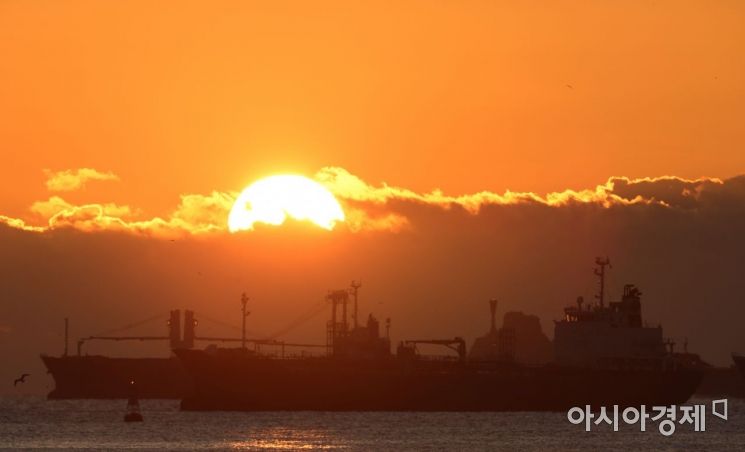 At dawn, the sun rises over a large container ship waiting to load export cargo near Busan Port.
Busan ? Photo by Yoon Dong-joo doso7@
The trade balance with China, the largest trading partner, continuing a deficit for 10 consecutive months, is also a burden. Last month, exports to China decreased by 33.4% year-on-year. Although China has been actively reopening its economy since the end of last year, the recent effects have somewhat stalled. According to China's National Bureau of Statistics, the manufacturing Purchasing Managers' Index (PMI) for March was 51.9, slightly down from 52.6 in the previous month. The manufacturing PMI by the National Bureau of Statistics is a leading indicator compiled by surveying over 700 manufacturing purchasing managers nationwide on five indicators: new orders, production, shipments, inventories, and employment. A PMI above 50 indicates that manufacturers expect economic expansion, while below 50 indicates contraction. Since early this year, as the spread of COVID-19 has slowed and consumption began to recover, the manufacturing PMI surpassed the baseline of 50 for two consecutive months in January and February; however, it is still considered premature to conclude that the economy has entered a stable recovery phase.
The government plans to promote export drives along with improving energy efficiency to improve the trade deficit. It will concentrate export support budgets in the first half of the year and promote export commercialization for small and medium-sized enterprises (SMEs) and mid-sized companies. Furthermore, it plans to strengthen support such as discovering promising items to ensure that the cooperative atmosphere between Korea and Japan leads to export expansion. The Ministry of Trade, Industry and Energy stated, "To manage energy imports, it is necessary to realize energy pricing to promote a transition to a high-efficiency energy structure," adding, "We will promote energy efficiency innovation and the establishment of a saving culture by strengthening incentives for investment in efficient equipment."
© The Asia Business Daily(www.asiae.co.kr). All rights reserved.
!["The Woman Who Threw Herself into the Water Clutching a Stolen Dior Bag"...A Grotesque Success Story That Shakes the Korean Psyche [Slate]](https://cwcontent.asiae.co.kr/asiaresize/183/2026021902243444107_1771435474.jpg)
















