Over the weekend, the wildfire risk index is expected to remain at a ‘high’ level in most regions nationwide, requiring public attention and caution to prevent wildfires.
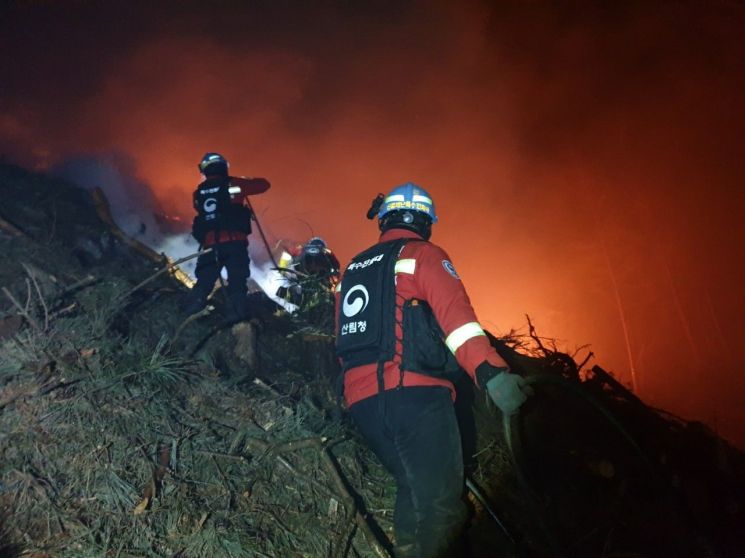 A forest fire recently broke out in Mangyong-ri, Woldeung-myeon, Suncheon-si, Jeollanam-do, and the Korea Forest Service's special wildfire suppression team is conducting firefighting operations. Provided by the Korea Forest Service [Image source=Yonhap News]
On the 1st, the National Institute of Forest Science predicted that the wildfire risk index will stay at the ‘high’ level from that day until just before rainfall on the 4th.
The wildfire risk index (based on 100) is divided into four levels: low (below 51), somewhat high (51?65), high (66?85), and very high (above 85).
As the wildfire risk index approaches the highest level, a burning wildfire warning has been issued for Gangwon, and a burning wildfire advisory has been issued for most regions nationwide, including parts of Seoul, Daegu, Gwangju, Daejeon, Ulsan, Sejong, Gyeonggi, Gangwon, Chungbuk, Chungnam, Jeonbuk, Jeonnam, Gyeongbuk, and Gyeongnam.
The increase in the wildfire risk index is influenced by low precipitation. According to the Korea Meteorological Administration, the recent one-month precipitation is only 51.7% of the average.
As of the 27th of last month, the one-month precipitation by region (average) was recorded as follows: Seoul and Gyeonggi 7.7 (34.3) mm, Gangwon 14.0 (35.0) mm, Chungbuk 21.4 (43.5) mm, Chungnam 14.8 (43.6) mm, Jeonbuk 29.9 (51.7) mm, Jeonnam 38.0 (75.1) mm, Gyeongbuk 32.5 (46.1) mm, and Gyeongnam 38.0 (73.6) mm.
Based on this, the precipitation in the central region is only 34.5% of the average, while the southern region’s precipitation is 64.2% of the average.
Meanwhile, daytime temperatures in most regions nationwide are expected to exceed 20 degrees Celsius until the 4th, creating a hot and dry weather condition that increases the likelihood of wildfires more than usual.
In particular, from the 1st to the 2nd (weekend), the weather is expected to be distinctly spring-like and warmer than usual, leading to increased outdoor activities such as hiking and outings, so the National Institute of Forest Science emphasizes the need for special caution against wildfires.
Earlier, from January 1st to the 31st of last month (as of 1 PM), a total of 365 wildfires occurred nationwide, which is more than 145 cases above the usual number (240 cases). Among these, 150 wildfires occurred from February 25th to March 11th, and 76 wildfires from March 14th to 22nd.
Ahn Hee-young, head of the Forest Disaster Prediction and Analysis Center at the National Institute of Forest Science, said, “Until the rain arrives on the 4th, the hot and dry weather will continue, and the wildfire risk index is expected to remain at a high level. We urge people to refrain from handling fire sources such as burning, smoking, and cooking near forest-adjacent areas.”
© The Asia Business Daily(www.asiae.co.kr). All rights reserved.

















