On the first day of the general strike by the Gyeongnam School Irregular Workers Solidarity on the 31st, the Gyeongnam Office of Education announced that most academic operations are running normally.
The provincial Office of Education stated, “In response to the general strike notice by the School Irregular Workers Solidarity, measures were prepared for schools at all levels, cafeterias, after-school care rooms, after-school classes, and special classes, and it appears that there is no major disruption.”
The Gyeongnam School Irregular Workers Solidarity held a general strike rally in front of the provincial Office of Education on the same day after collective wage negotiations failed to reach an agreement.
They demanded ▲ collective wage negotiations ▲ formation of a labor-management consultative body to reform the wage system ▲ application of welfare allowances on the same standards as regular workers ▲ measures to prevent lung cancer in school cafeterias and lowering of placement standards.
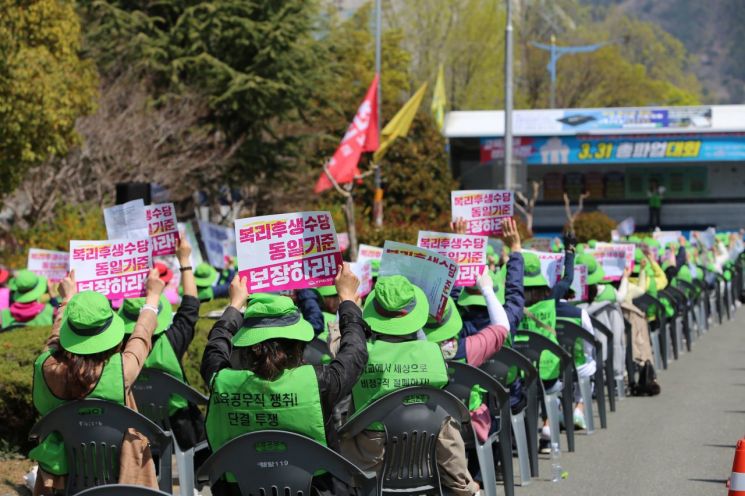 The Gyeongnam School Irregular Workers' Solidarity is holding a general strike rally on the road in front of the Gyeongnam Office of Education.
 [Photo by Lee Seryeong]
The Gyeongnam School Irregular Workers Solidarity is composed of three unions: the National Education Public Officials Headquarters, the National Women’s Labor Union, and the National School Irregular Workers Union Gyeongnam branch.
They argued, “While prices have risen by 7%, public officials’ wages were increased by only 1.7% of the base salary like civil servants,” and “the current wage system only widens the wage gap with regular workers.”
They added, “The core of this wage demand is to receive holiday bonuses at 120% of the base salary, but since even that is difficult, we submitted a revised proposal for 100% of the base salary, yet the management has not responded.”
The Solidarity urged, “When working, even indefinite contract workers are called regular workers and referred to as part of the education family, but in wage negotiations, they are treated as irregular workers and discriminated against compared to regular workers. We ask to be treated according to the amount of work and experience so that we can feel rewarded.”
According to the provincial Office of Education on the day, 19.9% of the 12,653 education public officials at 1,026 public and private schools in the province participated in the strike.
School meals were operated normally, and among them, five schools adjusted their academic schedules to conduct experiential learning and did not use the cafeterias.
Among 517 elementary after-school care classrooms, 106 schools participated in the strike, and among 956 after-school care workers, 193 participated, with three classrooms not operating.
Among 52 kindergarten care workers, 40 joined the strike, but all 411 kindergartens in the province are operating normally.
Kindergarten after-school programs are also proceeding normally, and 11 special schools are operating as usual.
A provincial Office of Education official said, “We will do our best to ensure that academic operations are not disrupted.”
© The Asia Business Daily(www.asiae.co.kr). All rights reserved.
![Clutching a Stolen Dior Bag, Saying "I Hate Being Poor but Real"... The Grotesque Con of a "Human Knockoff" [Slate]](https://cwcontent.asiae.co.kr/asiaresize/183/2026021902243444107_1771435474.jpg)











