The government has temporarily postponed the electricity and gas rate hikes for the second quarter of this year. The ruling party and the government plan to announce adjustment measures after gathering opinions, but the atmosphere leans toward the earlier indications from the Presidential Office and the Ministry of Economy and Finance suggesting a slowdown in the pace of rate increases due to concerns over the increased burden on low-income households.
On the 31st, the Ministry of Trade, Industry and Energy announced at a ruling party-government meeting held at the National Assembly that the adjustment plan for electricity and gas rates in the second quarter has been temporarily delayed. This means that after postponing the announcement on the 21st, the decision on whether to raise rates has yet to be made again. The ministry explained, "The ruling party and government agreed to more closely review factors such as the stability of low-income households, trends in international energy prices, inflation and its economic impact, effects on the bond market, and the financial status of public enterprises, and to announce the rate adjustment plan as soon as possible."
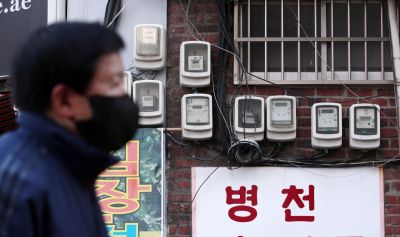 An electric meter of a multi-family house in Seoul on the 30th, as the government is scheduled to announce the electricity and gas rate adjustment plan to be applied in the first quarter of next year. The Ministry of Trade, Industry and Energy will announce the electricity and gas rate adjustment plan for the first quarter of next year on this day. Photo by Kim Hyun-min kimhyun81@
Ruling Party and Government Consider Low-Income Burden... Caution Against Inflation from Public Utility Rate Hikes
The deep deliberation by the ruling party and government over the second quarter energy rate decision is understood to stem from concerns that the increase could exacerbate the economic burden on low-income households. This was confirmed once again by the heating cost shock caused by the gas rate hike this past winter. Increasing public utility rates could potentially lead to inflation. According to Statistics Korea, electricity, gas, and water prices surged 28.3% year-on-year in January, marking the highest level since related statistics began in 2010, driving inflation.
Korea Electric Power Corporation (KEPCO) raised electricity rates by 32.4 KRW per kWh in four increments from the second quarter of last year through the first quarter of this year. If electricity rates, which have risen nearly 30% in one year, are increased further, it could lead to a summer cooling cost shock following the heating cost shock. President Yoon Suk-yeol also indicated freezing public utility rates managed by the central government, such as roads, railways, and postal services, in the first half of the year, and suggested adjusting the magnitude and pace of electricity and gas rate hikes out of concern for the burden on low-income households.
The possibility of a rate hike in the second quarter has not been completely ruled out. The ruling party and government agreed on the financial deterioration of energy public enterprises that could occur if energy rates remain below cost. They also shared the view that continuously suppressing rate hikes could weaken incentives for energy conservation, leading to side effects. After the ruling party-government meeting, Park Dae-chul, the Policy Committee Chair of the People Power Party, said in a briefing, "To comprehensively assess international energy price fluctuations and variables related to rate hikes, we decided to gather more public opinion through expert roundtables and make a decision later," leaving the possibility of a rate increase open.
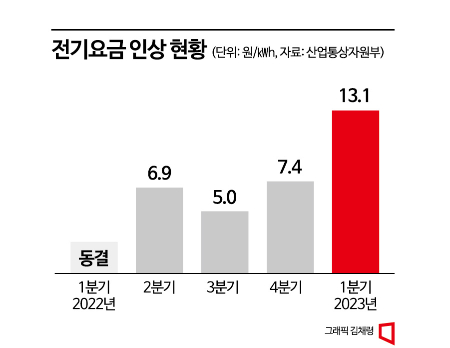
Prolonged Deficits at KEPCO and Korea Gas Corporation Inevitable
The problem is that by temporarily postponing the rate hike decision, the loss burden of energy public enterprises, which reached tens of trillions of won last year, is likely to increase further for the time being. Previously, KEPCO recorded a record deficit of 32.6 trillion KRW last year, and Korea Gas Corporation had unpaid receivables of 8.6 trillion KRW, marking the largest deficits in history. According to the Monthly Electricity Statistics Report, in January this year, KEPCO purchased electricity at 164.2 KRW per kWh but sold it at 147.0 KRW, incurring a loss of 17.2 KRW per kWh. To secure operating funds, KEPCO issued corporate bonds totaling 7.61 trillion KRW by the 24th of this month, already exceeding the amount issued by the end of March last year (6.87 trillion KRW). This means that without a rate hike, deficits are expected to continue this year as well.
It is known that at the ruling party-government meeting on this day, the Ministry of Trade, Industry and Energy emphasized that an electricity rate hike this year is inevitable to resolve KEPCO's record deficit by 2026. Earlier, the ministry estimated that an increase of 51.6 KRW per kWh this year is necessary to eliminate KEPCO's accumulated deficit. Some predict that if the government ultimately freezes the rate hike in the second quarter, discussions in the second half of the year could become even more difficult. This is because the political sphere is expected to enter election mode from the second half, making it necessary to consider political variables. Professor Sung Tae-yoon of Yonsei University's Department of Economics said, "Considering the situation of energy public enterprises suffering record deficits, a phased normalization of rates is necessary," adding, "At the same time, efforts for self-reform should also be strengthened."
© The Asia Business Daily(www.asiae.co.kr). All rights reserved.


















