People Power Party Points Out Greater Charges Against Lee Jae-myung
Democratic Party Explains They Are Different Situations
The arrest motion against Hayoungje, a member of the People Power Party, was passed at the National Assembly plenary session on the 30th, intensifying the confrontation between the ruling and opposition parties. The ruling party strengthened its offensive by calling the Democratic Party, which rejected the arrest motions against Democratic Party leader Lee Jae-myung and Democratic Party lawmaker Noh Woong-rae, "Naeronambul" (a Korean acronym meaning "double standards: what I do is romance, what others do is adultery"). The Democratic Party avoided mentioning the arrest motions and focused on highlighting controversies such as the Korea-Japan summit and the mass resignation of the diplomatic line.
On the morning of the 31st, Joo Ho-young, floor leader of the People Power Party, said at a floor strategy meeting held at the National Assembly, “We reviewed cases of the Democratic Party’s Naeronambul in the February speeches by floor negotiation groups, and this case will also be recorded as a long-standing example of Naeronambul,” adding, “It is even more regrettable because they seem unaware of their shame.”
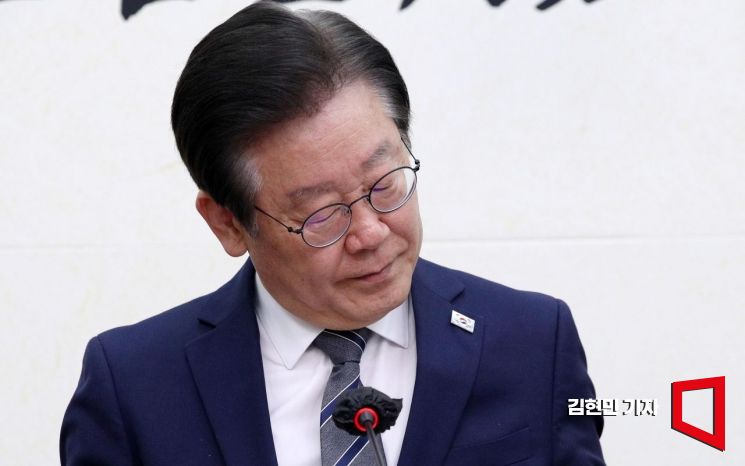 Lee Jae-myung, leader of the Democratic Party of Korea, is attending the Supreme Council meeting held at the National Assembly in Yeouido, Seoul on the 31st. Photo by Hyunmin Kim kimhyun81@
The day before, the arrest motion against Representative Ha was passed in the plenary session with 160 votes in favor, 99 against, and 22 abstentions. The People Power Party considers it a ‘recommendatory party stance’ and, taking into account that it effectively supported the motion, estimates that more than 50 votes came from the Democratic Party. On the day of the plenary session, 103 People Power Party lawmakers attended. Floor leader Joo pointed out, “At least 57 or more votes in favor of the arrest motion came from the Democratic Party,” and added, “If 57 Democratic Party members had voted in favor of the motions against Leader Lee and Representative Noh, both would probably have passed as well.”
He continued, “The charges against Leader Lee were much more serious and heavier compared to those against Representative Ha,” and said, “The foundation of politics is trust, and the basis of trust is principles and fairness.”
In response, the Democratic Party argued that the situations of Representative Ha, Leader Lee, and Representative Noh were different. Jin Seong-jun, senior deputy floor leader of the Democratic Party, appeared on MBC Radio’s ‘Kim Jong-bae’s Focus’ that day and explained, “The privilege against arrest is meant to protect the legislature and lawmakers from political oppression, but it is hard to see the Yoon Seok-yeol government as politically oppressing ruling party lawmakers.” When asked whether there was a politically oppressive nature in Representative Noh’s case, Jin replied, “It seems to have such a nature,” adding, “The bundles of cash found at his home were actually condolence money received at a book launch or a memorial service, but the prosecution took photos of the cash bundles and made them public to prove the charges, which strongly raised suspicions of political oppression.”
However, the Democratic Party leadership made no mention of the arrest motion against Representative Ha and focused their attacks on the Yoon Seok-yeol administration. Leader Lee criticized, “President Yoon reportedly said that although it will take time, he will seek the understanding of the Korean people regarding the Fukushima contaminated water,” adding, “This is interpreted as giving up the lives and safety of our people just to win Japan’s favor.” He also said, “There is an unreasonable series of replacements of key figures in diplomacy and security, who should be coordinating the core agenda of the Korea-US summit,” emphasizing, “Diplomacy is not a matter of ruling or opposition parties but a matter concerning the national interest of all of us. To prevent further diplomatic failures, I hope the ruling party consults with the opposition and gathers bipartisan capabilities to protect the national interest.”
© The Asia Business Daily(www.asiae.co.kr). All rights reserved.
![From Bar Hostess to Organ Seller to High Society... The Grotesque Con of a "Human Counterfeit" [Slate]](https://cwcontent.asiae.co.kr/asiaresize/183/2026021902243444107_1771435474.jpg)
















