Kim Juhyun, Financial Services Commission Chairman, Meets with Five Major Financial Holding Company CEOs
Decision on Full Resumption of Short Selling Based on Market Conditions
Small License and Specialized Banks Are Somewhat Risky, Need Discussion
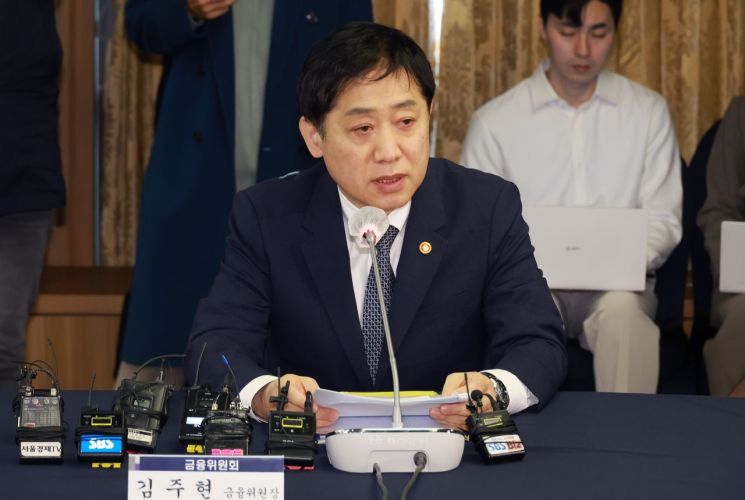
Financial Services Commission Chairman Kim Joo-hyun emphasized to the heads of the five major financial holding companies to "cooperate in absorbing as much as possible the cost factors causing interest rate hikes within the financial sector itself, so that the interest rate increases passed on to borrowers are minimized."
After a meeting with the heads of the five major financial holding companies held on the 31st at the Press Center in Jung-gu, Seoul, Chairman Kim told reporters, "Even in (general) companies, just because there are cost increase factors, they do not reflect 100% of that," adding, "When the Bank of Korea raises interest rates, short-term rates naturally go up, but please pay attention to whether (banks) can keep the loan interest rates a bit lower instead of immediately reflecting the increase."
Regarding short selling, he said the decision on whether to fully resume it will be made while monitoring market conditions. He explained, "Considering the size of our economy and the direction of capital market development, it is somewhat strange that only Korea bans short selling in a way that does not align with international standards," and added, "From the perspective of fostering a capital market that meets global standards and protecting domestic and foreign investors, short selling should naturally be normalized, but due to various uncertainties regarding timing and methods, we are continuing to observe." Earlier, Financial Supervisory Service Governor Lee Bok-hyun also mentioned in a foreign media interview on the 29th that "if financial market instability is resolved within a few months, we will consider lifting the short selling ban within the year."
Regarding the Financial Services Commission's discussion on introducing specialized banks to break the oligopoly of domestic banks following the collapse of Silicon Valley Bank in the U.S., Chairman Kim said, "The issue of insufficient fair competition among banks was raised, and if competition occurs, services will be provided at somewhat lower costs," but added, "However, small licenses or specialized banks carry some risks, so this is an issue that requires discussion."
On internal control and governance issues within banks, he revealed plans to strengthen the 'talent selection, development, and succession program' that involves internal and external competition when appointing CEOs. He stated, "It is not desirable for someone who does not protect consumer interests and manage risks to become CEO, and for a culture where as long as a lot of money is made after causing problems, it is considered a success and leads to promotion," adding, "Is there a system in place where people agree that the person selected is truly qualified to be CEO? We need to check and prevent reappointments when the person selected neither performs well nor is properly checked."
Regarding raising the deposit insurance coverage limit, he said, "Currently, nearly 98% of depositors are protected up to 50 million won, but as national income rises and inflation increases, it is natural to discuss raising the deposit protection limit a bit," adding, "However, if the protection limit increases, deposit insurance premiums will also rise, and questions arise about whether certain phenomena (such as increases in consumer loan interest rates) are justified, so we are internally considering this."
Regarding small emergency living expense loans of up to 1 million won provided twice to vulnerable groups, he said, "We counsel about 1,200 people a day, and about 700 million won is disbursed daily, so with existing resources, this can continue for several months," adding, "In fact, amounts like 500,000 or 1 million won help prevent vulnerable people from turning to private loans in urgent situations, but vulnerable groups need stable cash flow, and 83% of those counseled have been connected to welfare programs."
© The Asia Business Daily(www.asiae.co.kr). All rights reserved.

















