Arrest Warrant for Political Involvement Charges Excluding Treason Plot
Strategic Analysis to Prioritize Detention
The prosecution's decision to request an arrest warrant for former Commander of the Defense Security Command Cho Hyun-cheon, while excluding the core allegation of conspiracy to commit rebellion related to the martial law document, is interpreted as a judgment that it is difficult to prove the crime at this stage. Securing custody is a prerequisite for related investigations, and the prosecution has brought up the charge of 'political involvement' as a breakthrough measure for this.
The Criminal Division 5 of the Seoul Western District Prosecutors' Office (Chief Prosecutor Lee Byung-joo), which is investigating the martial law document allegations, requested an arrest warrant for former Commander Cho on the 31st, citing abuse of authority and political involvement as the charges. The charge of conspiracy to commit rebellion, specified in the arrest warrant issued by the court in September 2018, was not included in this request.
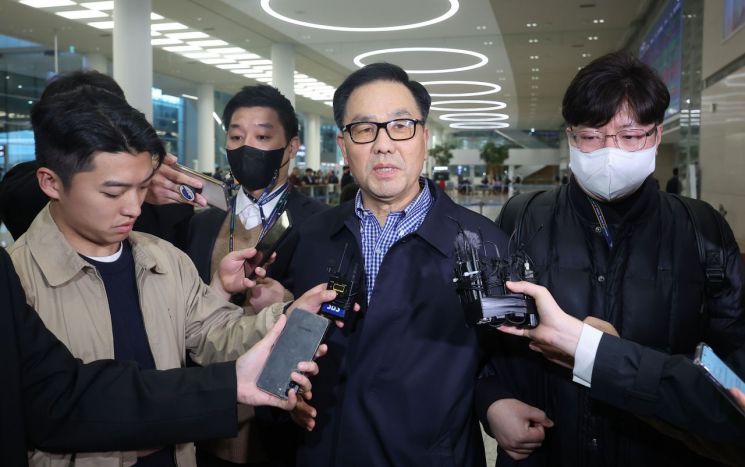 Former Defense Security Command Commander Cho Hyun-cheon, a key figure in the allegations regarding the martial law documents before the impeachment of former President Park Geun-hye, is speaking after being escorted to the Seoul Western District Prosecutors' Office following his arrival through Incheon International Airport Terminal 2 on the morning of the 29th.
 [Photo by Yonhap News]
Abuse of authority, as defined in Article 123 of the Criminal Act, is established when a person abuses their authority to compel another to perform an act they are not obligated to do or obstructs the exercise of rights. The prosecution viewed former Commander Cho's act of ordering subordinates to prepare reports related to the 2016 election of the president of the Federation of Korean Freedom Associations as a violation of this law.
The abuse of authority charge became a key tool for enforcing prosecutorial power across political, judicial, and administrative fields following investigations into the 2017 political scandal and the 2018 judicial scandal. However, as courts have recognized this charge very restrictively in trials related to these scandals, the prosecution has recently been reducing its application.
In this series of developments, it is analyzed that the prosecution judged it difficult to secure custody of former Commander Cho solely on the abuse of authority charge. When reviewing grounds for detention, courts primarily consider whether the crime is proven and its seriousness. Given the court's tendency to interpret abuse of authority narrowly, it is calculated that it would be difficult to have the seriousness of the crime recognized.
Regarding the allegation that former Commander Cho drafted the martial law document and reported it to the then-Chief of Staff to conspire to commit rebellion, it is interpreted that the prosecution found it difficult to prove the crime. In fact, former Commander Cho reportedly claimed during the prosecution investigation that "the martial law document was a simple review document, not an execution plan," arguing that there was no illegality.
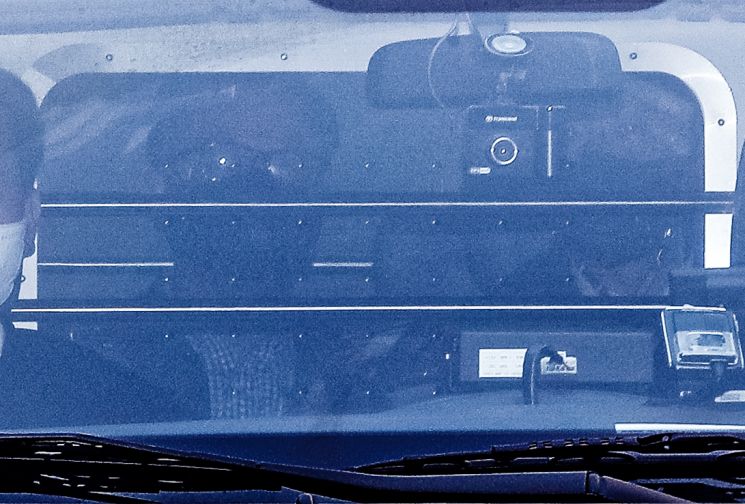 Former Commander of the Defense Security Command (now the Military Security Support Command), Cho Hyun-cheon (center), the key figure in the martial law document controversy, is being escorted to the Seoul Western District Prosecutors' Office in Mapo-gu on the morning of the 29th.
 [Image source=Yonhap News]
Ultimately, the prosecution appears to have chosen the political involvement charge as an alternative to emphasize the seriousness of the crime. The political involvement charge is established when military personnel or military officials illegally join political organizations or engage in political activities. It is a serious crime punishable by up to five years imprisonment and up to five years disqualification. The prosecution judged that former Commander Cho's act of mobilizing Defense Security Command agents in 2016 to hold rallies supporting former President Park and publishing columns and advertisements falls under political involvement under the Military Criminal Act.
The prosecution's decision to bring up the political involvement charge is also interpreted as a step to secure custody of former Commander Cho first and then focus on investigating the conspiracy to commit rebellion charge. The prosecution is reportedly reviewing the possibility of applying conspiracy to commit rebellion by examining the guilty verdict documents of former Chief of Staff So Kang-won, who allegedly received orders to prepare the document from former Commander Cho.
The pre-arrest detention hearing (warrant substantive examination) for former Commander Cho will be held on the morning of the 31st. Since this is a post-arrest warrant case, former Commander Cho can be brought directly before the detention hearing without a separate warrant execution procedure. The decision on whether to detain former Commander Cho is expected to be made as early as late afternoon on the 31st.
© The Asia Business Daily(www.asiae.co.kr). All rights reserved.


















