Bang Gi-seon, First Vice Minister of the Ministry of Economy and Finance, said on the 31st, "Considering the base effect of last March, when the highest export amount in history was recorded, the decline in exports this month is expected to widen compared to February."
Vice Minister Bang made these remarks while presiding over the 20th Emergency Economic Vice Ministers' Meeting at the Gwanghwamun Government Seoul Office in the morning, discussing recent export-import trends and response directions.
Vice Minister Bang said, "Although total industrial production is showing signs of recovering from the slump in the fourth quarter of last year, the recent export downturn has caused a significant decrease in manufacturing production, indicating that uncertainty in the economic flow remains high." He added, "According to the industrial activity trends for February released just now, total industrial production (+0.3%) showed a moderate increase following last month, supported by growth in the service sector (+0.7%) and construction (+6.0%). Domestic demand indicators such as retail sales (+5.3%) and services (+0.7%), which had been somewhat sluggish, generally rebounded, and construction investment (+6.0%) also increased for the second consecutive month."
He continued, "Total industrial production is showing signs of recovering from the slump (-1.5%) in the fourth quarter of last year, but due to the recent export downturn, manufacturing production (-3.2%) has significantly decreased, so uncertainty in the economic flow remains high." He expressed concern, saying, "Looking at export performance from the 1st to the 20th of this month, announced last week, the sluggishness centered on semiconductors and exports to China continued, resulting in a 17.4% decrease compared to the same period last year."
Vice Minister Bang said, "The average daily exports are expected to be similar to those in February, but considering the base effect of last March, when the highest export amount ($63.8 billion) was recorded, the decline in exports this month is likely to widen compared to February." He added, "The government will make all-out efforts in areas such as tax, financial support, and resolving corporate difficulties to ensure that exports can become a momentum for growth rebound as soon as possible."
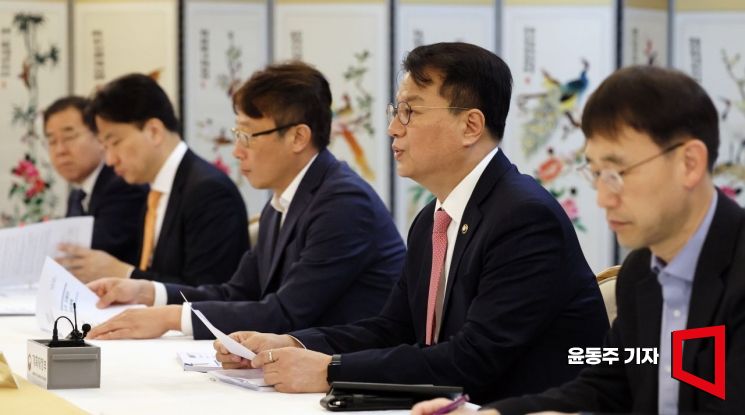 Bang Gi-seon, First Vice Minister of the Ministry of Economy and Finance, is attending the Emergency Economic Vice Ministers' Meeting held at the Government Seoul Office in Jongno-gu, Seoul on the 10th, delivering opening remarks. Photo by Dongju Yoon doso7@
Regarding the consumer price inflation rate, he forecasted that stability would continue. Vice Minister Bang said, "The consumer price inflation rate in February (4.8%) entered the 4% range for the first time in 10 months since April last year, and stability is expected to continue in March." He added, "Prices of agricultural and livestock products such as cabbage and beef are generally stable due to increased production and inventory."
He continued, "However, due to the impact of the previous winter cold wave, prices of some items such as radish, green onions, and chicken continue to rise." He added, "In response, the government is conducting discount events of up to 50% on major agricultural, livestock, and fishery products in collaboration with large supermarkets, and plans to continue discount support worth 17 billion won for items with high consumer burden in the second quarter (April to June)."
He also said, "From May, tariff rates will be reduced on seven items including supply-unstable products such as chicken, green onions, pollock, and radish, as well as production support items for the food industry and farming and fishing households (potatoes for chips, mackerel pike, and hatching eggs of Jeong ducks)." Vice Minister Bang explained, "Going forward, we will induce price stabilization through additional import measures such as expanding tariff quotas for supply-unstable items that are in short supply domestically."
He also promised to strengthen support following the passage of the K-Chips Act (Amendment to the Restriction of Special Taxation Act) in the National Assembly plenary session. Vice Minister Bang said, "We will promptly proceed with the revision procedures of the enforcement decree and enforcement rules to enhance the export competitiveness of our companies through full-scale investment tax support." He added, "As a follow-up measure of the Export Investment Responsibility Meeting, we plan to launch a 2 trillion won 'Export Competitiveness Enhancement Support Fund' from the 1st of next month, offering preferential interest rates up to 0.6 percentage points for small and medium-sized export companies."
He continued, "Following the recent closure of Silicon Valley Bank in the United States, concerns about funding support for small and medium-sized enterprises have increased worldwide." He explained, "The government plans to supply policy finance worth 540 trillion won this year, the largest ever, expanded by 45 trillion won compared to last year." He added, "We are implementing a 80 trillion won financial support plan for small and medium-sized enterprises to support innovative company growth and vulnerable company recovery."
Vice Minister Bang said, "To support investments by small and medium-sized enterprises, we are preparing a new 3 trillion won Innovation Growth Fund and a 1 trillion won 4th Corporate Restructuring Innovation Fund this year, and will additionally raise 2 trillion won on top of the currently operating 30.6 trillion won scale of the Korea Fund of Funds."
© The Asia Business Daily(www.asiae.co.kr). All rights reserved.
![Clutching a Stolen Dior Bag, Saying "I Hate Being Poor but Real"... The Grotesque Con of a "Human Knockoff" [Slate]](https://cwcontent.asiae.co.kr/asiaresize/183/2026021902243444107_1771435474.jpg)










