Even with 'Adverse' Audit Opinion, Delisting Deferred for 1 Year
79 Companies Received Adverse Opinions Over 3 Years Since 2019... 17 Resumed Trading
Guaranteeing Corporate Recovery Opportunities, Positive Effect on Investor Protection... Concerns Over Spread of Insolvency
Listed companies in the domestic stock market that were on the brink of delisting have recently made a series of comebacks. Companies such as Highsonic and DXVX, which previously received 'adverse' audit opinions, have met the listing requirements again through improvement periods, leading the KOSDAQ Market Committee to decide to maintain their listings. While some express concerns that this could produce 'zombie companies,' the fact that companies are successfully turning profitable and resuming trading supports the policy of easing delisting regulations.
Among 79 Companies with Delisting Causes in the Past 3 Years, 17 Resumed Trading
According to the Korea Exchange, from 2019 to 2022, a total of 79 listed companies had delisting causes due to adverse audit opinions (disclaimers, adverse opinions, or qualified opinions). Among these, 34 companies were delisted from the market. Of the remaining 45 companies, 17 resumed trading, while 28 remain suspended.
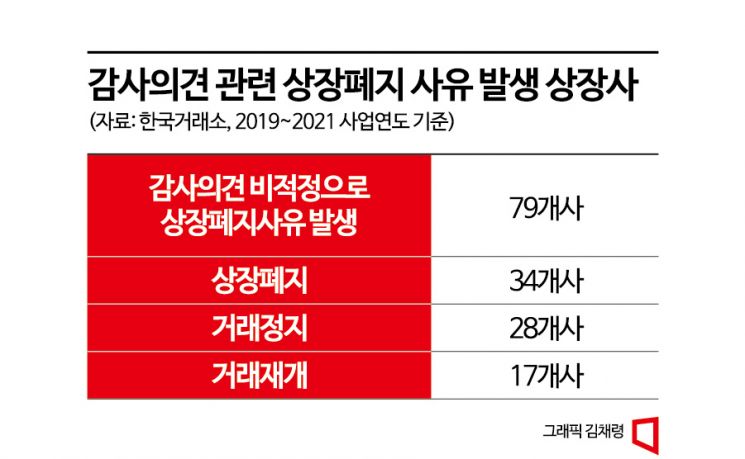
This year, 20 companies received adverse audit opinions. Eight companies that received clean audit opinions in the 2021 fiscal year received adverse opinions in the 2022 fiscal year. Considering that some companies have yet to submit their audit reports, the number of companies with adverse opinions is expected to increase further.
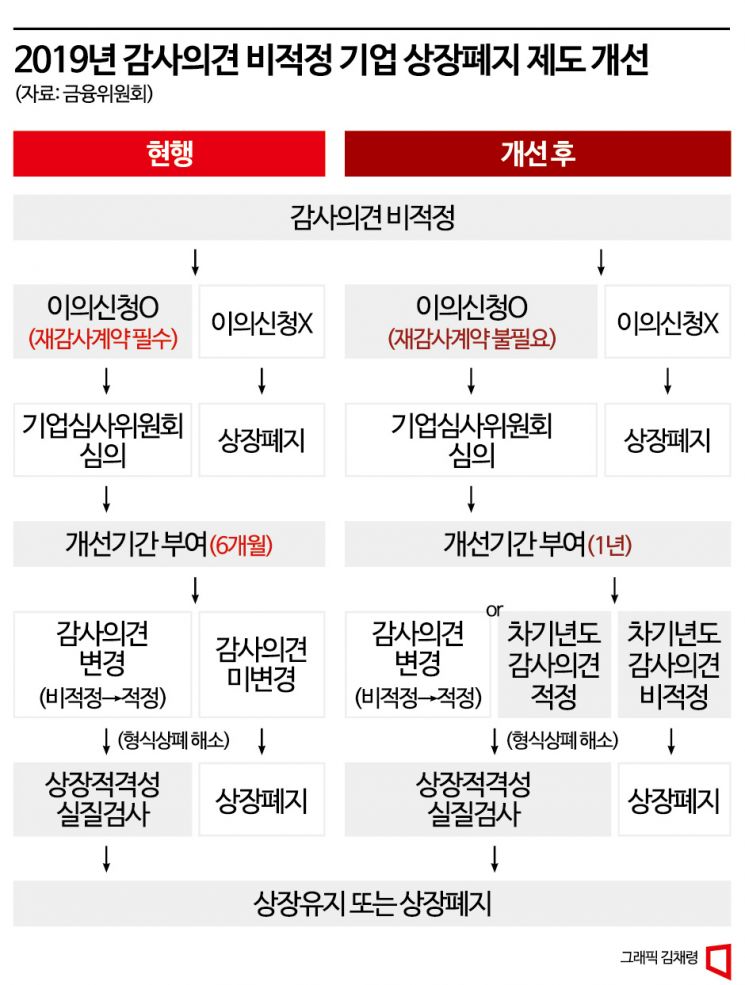
Financial authorities have been granting a one-year grace period for delisting even if companies receive adverse audit opinions since the enforcement of the revised External Audit Act in 2019, which tightened audit standards. This reflects the view that companies should be given a chance to take self-rescue measures. The revised External Audit Act, born out of the 2015 Daewoo Shipbuilding & Marine Engineering accounting fraud case, emphasizes auditor independence and significantly strengthens auditor responsibilities.
Before 2019, if a KOSDAQ-listed company received an adverse audit opinion, delisting was decided without substantive review. If an objection was filed, a six-month improvement period was granted for re-audit. If the adverse opinion persisted after the re-audit, the company was delisted. Even if a clean audit opinion was obtained during the improvement period, a substantive review was conducted to decide whether to maintain the listing. Financial authorities considered mandatory re-audits to be an excessive burden on companies and decided to determine delisting based on the audit opinion of the following year.
Although the number of companies with prolonged trading suspensions has increased, the policy is positively evaluated as it provides companies with opportunities for recovery and is expected to protect investors. President Yoon Suk-yeol promised during his presidential campaign to make delisting decisions more cautiously. The system is being improved to decide delisting by comprehensively reviewing management conditions rather than immediately expelling companies that fail to meet financial listing requirements. Formal delisting criteria are being converted into substantive review reasons, and opportunities for objections are being expanded. The travel and airline industries welcomed the easing of delisting based on formal criteria amid the deteriorated business environment caused by the COVID-19 pandemic.
A Korea Exchange official explained, "The delisting system has been reorganized to reduce corporate burdens and protect investors," adding, "We are revising the application methods for substantive reviews of listing eligibility by converting formal delisting causes into substantive review reasons."
Concerns about side effects are not insignificant. There are criticisms that this could produce zombie companies and undermine market soundness. The burden on the Korea Exchange, which handles delisting operations, has also increased. As the number of companies with prolonged trading suspensions grows, the Korea Exchange is reviewing improvement plans and verifying their implementation. Currently, 47 companies in the KOSDAQ market are suspended due to delisting causes. Kang Sohyun, a research fellow at the Korea Capital Market Institute, said, "Economically, there is a higher possibility that companies that are not reasonable will remain in the market," and added, "If the direction is to ease delisting requirements, investors need to be more cautious."
Some argue that even if formal delisting causes are converted into substantive reviews, the outcome may be the same, raising concerns about administrative waste. Although the decision to maintain listings considers not only quantitative factors but also the company's viability and management transparency, critics point out that if a company has already lost its growth momentum, the chance of revival is slim, potentially causing false hope for investors. Lee Sangho, a research fellow at the Korea Capital Market Institute, said, "Reviewing the reasons for adverse opinions shows the need for governance bodies to prepare self-rescue plans to enhance the completeness of financial statements," and added, "It is also time to consider effective support measures from policy authorities for companies lacking capabilities."
DXVX, S&WR and Others Maintain Listings through Performance Improvement
The KOSDAQ Market Committee of the Korea Exchange recently decided to maintain the listings of DXVX, S&WR, CNT85, Sky Moon Technology, Korea Precision Machinery, and Highsonic.
DXVX submitted an audit report with a 'disclaimer' opinion in March 2019. The external auditor, Anjin Accounting Corporation, pointed out that sufficient audit evidence could not be obtained regarding revenue recognition appropriateness and classification of financial liabilities related to overseas subsidiaries. DXVX filed an objection and was granted a one-year improvement period. The audit report submitted the following year included a 'disclaimer' on internal accounting controls. The Corporate Review Committee granted another eight-month improvement period. In 2021, the Corporate Review Committee again recommended delisting DXVX. However, the KOSDAQ Market Committee, which has the final decision authority, allowed a one-year improvement period. In October 2021, during the prolonged trading suspension, Lim Jong-yoon, eldest son of the late Lim Seong-gi, founder of Hanmi Pharmaceutical, participated in a third-party allotment capital increase of DXVX and became the largest shareholder. Lim Jong-yoon contributed 277,778 shares of Hanmi Science as an in-kind contribution, acquiring a 19.57% stake in DXVX.
After many twists and turns, DXVX recorded sales of 32.2 billion KRW and operating profit of 2.6 billion KRW last year. Sales increased by 330% year-on-year, and operating profit turned positive. The company submitted an audit report with a clean opinion from Anjin Accounting Corporation, and the KOSDAQ Market Committee decided on the 27th to maintain DXVX's listing. Trading resumed on the 28th, more than four years after being suspended on March 21, 2019. On the first day of resumed trading, the stock closed at 6,410 KRW, down 20.86% from the opening price, likely due to investors cashing out after funds were tied up for a long time. Three days after resuming trading, on the 30th, the stock rebounded about 10%, closing at 7,000 KRW.
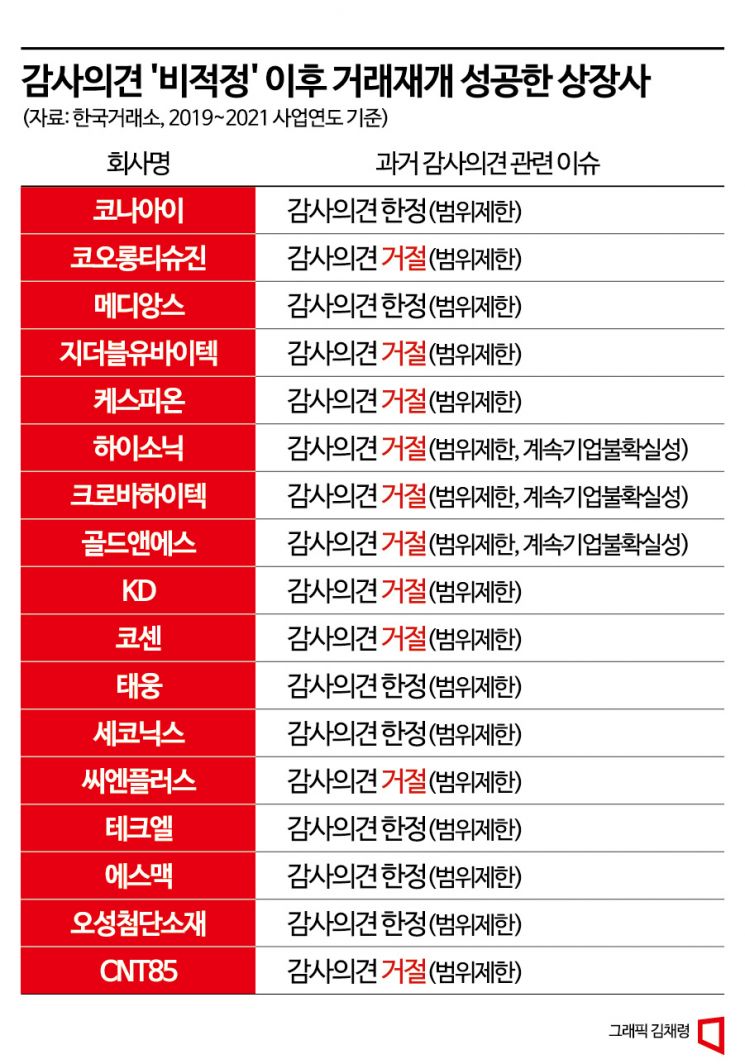
CNT85 also resumed trading on the 30th after being suspended since February 2019. CNT85 operates plant businesses such as air pollution control facilities and wastewater treatment facilities, and supplies filter press equipment for industrial wastewater treatment. Last year, it successfully turned profitable with an operating profit of 1.7 billion KRW. It received a clean audit opinion, and the KOSDAQ Market Committee decided to maintain its listing.
S&WR, a listed company in shipbuilding equipment, succeeded in maintaining its listing as its performance improved after years of losses. S&WR recorded operating losses for five consecutive years, leading to trading suspension since February 2021. Last year, it posted sales of 36 billion KRW and operating profit of 2.5 billion KRW. The company explained that sales increased due to improvements in the shipbuilding, plant, and construction industries, which are its upstream sectors, and increased orders. As sales increased, the burden of fixed costs decreased.
A financial investment industry official said, "Not all companies will recover just because they are given a long improvement period," but added, "While an indefinite improvement period cannot be granted, whether the improvement plan is implemented can help gauge the possibility of recovery."
© The Asia Business Daily(www.asiae.co.kr). All rights reserved.
![Clutching a Stolen Dior Bag, Saying "I Hate Being Poor but Real"... The Grotesque Con of a "Human Knockoff" [Slate]](https://cwcontent.asiae.co.kr/asiaresize/183/2026021902243444107_1771435474.jpg)


















