Pet Medicine Market Growing 20% Annually
Increased Pharmaceutical Interest Including Adding Business Purpose to Articles of Incorporation
Regulatory Tribunal Recommends 'Cross-Production' Approval to Relevant Ministries
 A passenger is moving to check in with a dog at Gimpo Airport in Seoul. Photo by Jinhyung Kang aymsdream@
As the number of pet-owning households increases, the 'pet care' market is rapidly growing, leading to more cases in the pharmaceutical industry pushing animal medicines and related products as new business sectors. The government is also accelerating this trend by improving regulations to enable 'cross-production of human and animal medicines,' significantly reducing initial investment costs.
Recently, the pet market is expected to grow as the number of pet-owning households surges and the care environment improves, resulting in longer lifespans for animals. According to KB Financial Group Management Research Institute on the 31st, the number of pet-owning households nationwide was estimated to reach 6.04 million by the end of 2020. Notably, 19% of dog-owning households have elderly dogs. As animals age, decreased activity and age-related diseases occur, making health management increasingly important. This is also why the domestic pet animal medicine market has shown an annual growth rate of 20%, increasing from 102.8 billion KRW in 2019 to 153.8 billion KRW in 2021.
Accordingly, there has been a surge in pharmaceutical companies eager to enter animal-related businesses. Recently, mid-sized pharmaceutical companies such as Samjin Pharmaceutical, Samil Pharmaceutical, and Hwanin Pharmaceutical added animal-related business purposes to their articles of incorporation at their regular shareholders' meetings. Samjin Pharmaceutical included 'manufacture and wholesale/retail of animal medicines, animal health functional foods, and animal feed,' as well as 'technical testing, inspection, and analysis services.' Samil Pharmaceutical added 'development, manufacture, and wholesale/retail of animal medicines,' and Hwanin Pharmaceutical included 'manufacture and sale of animal medicines' among their business purposes. A representative from Samjin Pharmaceutical explained, "We are preparing to enter the animal-related business to diversify our operations. To properly proceed, we sought understanding from shareholders and specified the business purposes in the articles of incorporation."
Meanwhile, large pharmaceutical companies have actively expanded their businesses by leveraging best-selling human nutritional supplement brands. Daewoong Pharmaceutical’s subsidiary, Daewoong Pet, launched 'Impactamin Pet,' a pet version of the nutritional supplement 'Impactamin.' Kwangdong Pharmaceutical introduced 'Gyeon(ok)go,' a pet version of the traditional herbal supplement 'Gyeongokgo,' and Ildong Pharmaceutical released 'Ildong Pet Biovita,' a pet version of the probiotic 'Biovita.' While adopting the main ingredients of existing supplements, additional development is underway to supplement nutrients tailored to animals' characteristics or to improve feeding convenience by creating formulations in liquid stick form called 'churu.'
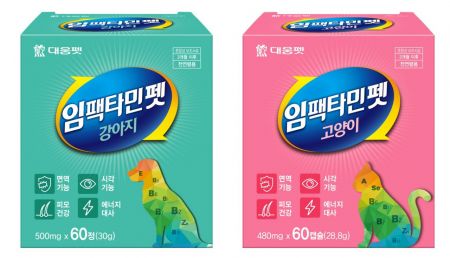
This movement is expected to gain further momentum with the government's regulatory improvements. On the 30th, the Regulatory Review Division of the Office for Government Policy Coordination recommended related ministries improve the system to allow human pharmaceutical manufacturers to produce pet medicines using existing manufacturing facilities. Previously, it was impossible to produce animal medicines in human medicine production facilities. Unless a company had already been producing animal medicines, entering this new industry required investment of tens of billions of KRW in manufacturing facilities. However, since countries like the U.S., Europe, and Japan already permit cross-production of human and animal medicines, there have been calls to allow this in Korea as well, and measures to permit it are being pursued. To protect existing industries, cross-production will only be allowed for pet medicines that are not approved for animal use or contain ingredients that do not significantly impact the current industry.
An industry insider said, "Even when using the same ingredients, companies had to have separate manufacturing facilities, making it difficult to enter the animal medicine market. From the perspective of pet owners, it was sometimes necessary to pay several times more just because the medicine was for animals despite having the same ingredients, so this regulatory improvement is welcome."
In fact, medicines with the same main ingredients are already on the market or under research and development. Dongkook Pharmaceutical converted its steady-selling human gum medicine 'Insadol' into 'Canidol,' a medicine for animal periodontal disease, in 2021. Both medicines share the same main ingredients: corn silk quantitative extract and 75% ethanol extract of Magnolia officinalis. Daewoong Pharmaceutical is developing 'DWP16001,' a diabetes treatment for dogs, together with Daewoong Pet, based on 'Enblo Tab (active ingredient: Inavogliflozin),' a human diabetes treatment approved by the Ministry of Food and Drug Safety and scheduled for release this year. Clinical trials led by researchers confirmed blood sugar control effects when used in combination with insulin for type 1 diabetes in dogs. 'Zedacure,' a treatment for canine cognitive dysfunction syndrome (CDS) developed by GNT Pharma and sold by Yuhan Corporation, is also being developed for humans under the ingredient name 'Crisdesalazine' as a treatment for Alzheimer's disease, Lou Gehrig's disease, and other brain disorders. Phase 1 clinical trials have confirmed its safety in humans.
© The Asia Business Daily(www.asiae.co.kr). All rights reserved.


















