UN General Assembly Adopts Resolution Requesting 'Advisory Opinion' from ICJ
No Binding Force but Possible Obligations... Impact on International Climate Negotiations and Litigation
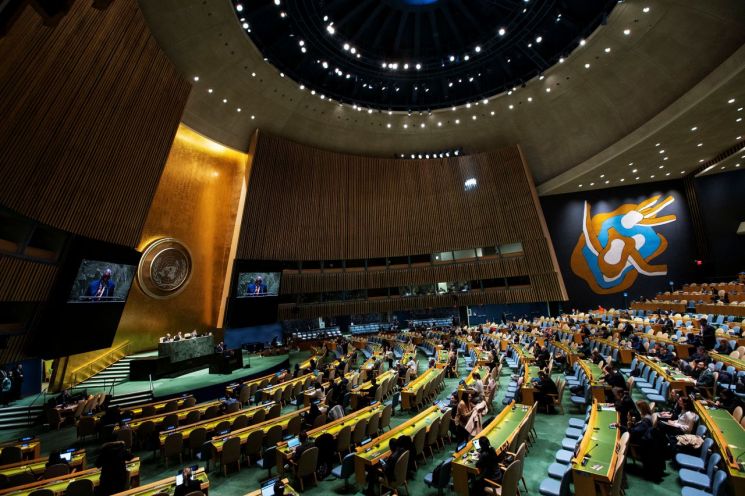 On the 29th (local time), Ismael Kalsakau, Prime Minister of Vanuatu, is delivering a speech at the United Nations General Assembly.
 [Image source=Reuters Yonhap News]
The United Nations has decided to seek an answer from the International Court of Justice (ICJ) on whether countries that fail to properly address the climate crisis or make insufficient efforts to respond can be held judicially accountable.
According to The New York Times (NYT), on the 29th (local time), the UN General Assembly adopted a resolution requesting the ICJ to provide an "advisory opinion" on the obligations of countries to respond to climate change.
The UN explained that through this resolution, it has requested the ICJ to provide an advisory opinion on whether national governments have international legal obligations to address the climate crisis, and whether there is legal responsibility if such obligations are not fulfilled.
The ICJ, located in The Hague, Netherlands, is a judicial body established by the UN in 1945 to resolve disputes between countries under international law. While it typically issues rulings on disputes between states, it can also provide advisory opinions on specific issues upon request from the General Assembly or the Security Council.
Unlike rulings, the ICJ’s advisory opinions do not have legal binding force. However, the advisory opinions provided by the ICJ could transform countries’ climate crisis responses into obligations under international law.
Additionally, they could serve as a basis influencing the judgments of national courts in future climate-related lawsuits. The position of small vulnerable countries in international climate negotiations is also expected to be strengthened.
Ant?nio Guterres, UN Secretary-General, said ahead of the resolution’s adoption, "The ICJ’s advisory opinion will enable us to take the bolder and stronger climate change actions that we urgently need now."
It is expected to take about one and a half years for the ICJ to submit its advisory opinion.
The resolution was led by Vanuatu, a Pacific island nation. Vanuatu, a small country with a population of 300,000, is facing an existential threat due to rising sea levels caused by climate change.
About 130 countries signed as co-sponsors of the resolution. However, the United States and China, the world’s largest emitters of pollutants, are reported not to have joined.
The US representative stated at the General Assembly that they do not agree that this resolution is the best way to achieve common goals. He argued that diplomatic efforts are more effective than judicial procedures to successfully address the climate crisis.
© The Asia Business Daily(www.asiae.co.kr). All rights reserved.

















