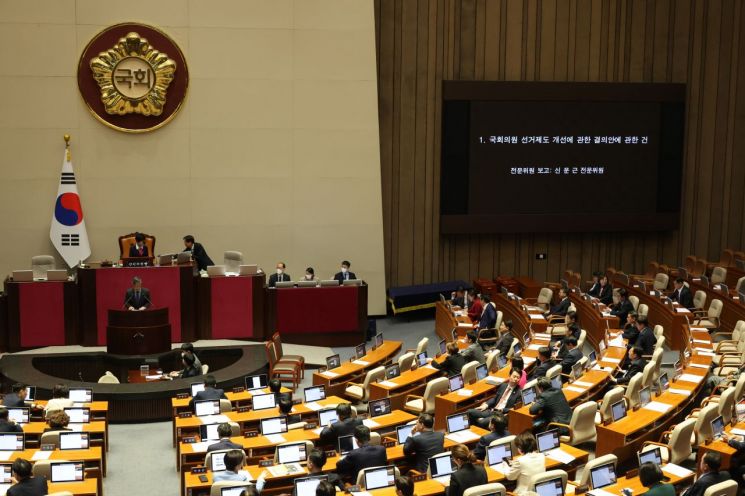
 On the afternoon of the 30th, the first plenary committee meeting for the review of the resolution on the improvement of the National Assembly member election system is being held in the National Assembly plenary chamber.
 [Image source=Yonhap News]
A plenary committee involving all members of the National Assembly was launched on the 30th to reform the electoral system.
On the same day, the ruling and opposition parties submitted the "Resolution on the Improvement of the National Assembly Election System" to be applied in the general election next April during the plenary session, and immediately after the session adjourned, convened the plenary committee.
The plenary committee, consisting of 299 members of the National Assembly, will be held over four days from the 10th to the 13th of next month. On April 10th, discussions will focus on the proportional representation system, on the 11th on the constituency election system, on the 12th on other issues, followed by a comprehensive discussion on the 13th.
Kim Young-joo, Deputy Speaker of the National Assembly and chairperson of the plenary committee according to the National Assembly Act, pointed out, "The electoral system prepared ahead of the 21st general election caused many side effects. Although the semi-proportional representation system was introduced, it failed to prevent the emergence of satellite parties, and hardly any changes were made to the constituency system, failing to overcome the issues of local extinction and regional imbalance."
He added, "The reform of the electoral system, which has been discussed through special committees on political reform in each National Assembly, has repeatedly missed legal deadlines and only finalized the system as the general election approached. It was difficult to create a predictable system, and instead, it caused a winner-takes-all two-party structure and extreme confrontation."
Deputy Speaker Kim said, "If the plenary committee starts by opening understanding and hearts toward each other and reaches a plan and consensus that the majority of the public agrees with, it will be an opportunity to restore public trust in the political sphere."
He emphasized, "I hope a reasonable electoral system agreement that the public feels is sufficient will be derived, and I urge a commitment to show politics of cooperation and hope beyond conflict and discord."
Jeon Jae-soo, opposition party secretary from the Democratic Party of Korea, said, "Our National Assembly members have the authority to decide how the National Assembly is composed, but we have not fully fulfilled the responsibilities that come with that authority. Reforming to a better electoral system is an urgent task that can no longer be postponed."
He continued, "By conducting the plenary committee under the three principles of speed, focus, and deliberation, we expect not only broad agreement on the major framework of electoral system changes but also concrete agreements that integrate the strengths and weaknesses of each system. We will do our best to create an electoral system that advances even by a fingernail."
Kim Sang-hoon, ruling party secretary of the Special Committee on Political Reform from the People Power Party, argued, "At the time of the 21st election, the metropolitan area population ratio was 47%, but as of January this year, the metropolitan population is 50.5%, which means the metropolitan seats increase by seven based on population. On the other hand, among 223 districts nationwide, 113 are classified as depopulated areas, and to comply with the Constitutional Court's 2:1 population standard for electoral districts, there will be constituencies with an area five times larger than Seoul."
Earlier, Speaker Kim Jin-pyo urged during the plenary session, "Whether South Korea fully enters the ranks of advanced countries depends on the success of this political and electoral reform. Let us adopt the principles of deliberation, focus, and speed, engage in deep discussions, and reach a conclusion within April."
The plenary committee will hold four meetings from the 10th to the 13th. On the 10th, the proportional representation system will be discussed; on the 11th, the constituency electoral system; on the 12th, questions and discussions on both proportional and constituency systems will be conducted; and on the 13th, a comprehensive discussion will take place.
© The Asia Business Daily(www.asiae.co.kr). All rights reserved.

















