60 Agenda Items Including the "Jeonse Fraud Prevention Act" Processed
On the 30th, the National Assembly processed a total of 60 agenda items at the plenary session, including the so-called 'K-Chips Act' (Special Tax Treatment Control Act) aimed at fostering the domestic semiconductor industry.
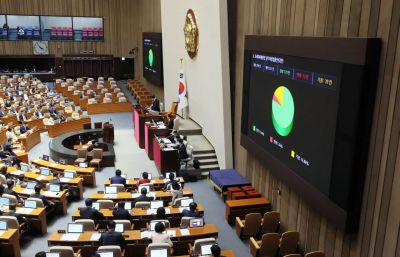
At the plenary session held that afternoon, the following were approved: ▲ the amendment to the Housing Lease Protection Act allowing verification of lease information and landlord's unpaid taxes ▲ the amendment to the Pharmaceutical Affairs Act establishing the designation of 'public late-night pharmacies' and budget support ▲ the amendment to the Special Tax Treatment Control Act expanding tax credits for facility investments in national strategic industries ▲ and the enactment of the Act on Mobility Innovation and Activation Support to foster advanced mobility.
The amendment to the Housing Lease Protection Act centers on requiring landlords to provide tenants with information such as the date of granting a fixed date for the leased housing, rent, deposit, and a tax payment certificate when concluding a lease contract. Additionally, it mandates landlords to consent to tenants receiving information from the fixed date granting agency and viewing the landlord's unpaid national taxes, arrears, and local taxes. Through this amendment, tenants can more easily ascertain whether there are senior priority claims on multi-family housing deposits or if the landlord has tax delinquencies. This is a measure to prevent so-called 'jeonse fraud.'
The amendment also strengthens protection for tenants' claims for deposit returns. Even if the lease registration order is not delivered to the landlord due to reasons such as an uncertain landlord address, it can still be enforced. The lease registration order is a system that allows tenants who have not received their deposit back after the lease contract ends to register independently, thereby guaranteeing freedom of residence relocation.
Alongside this, the amendment to the Pharmaceutical Affairs Act, which establishes the basis for designating public late-night pharmacies and budget support, also passed the plenary session. The amendment provides a legal basis for the designation of public late-night pharmacies, which had previously been operated based on local ordinances and other autonomous regulations. It also includes provisions to introduce a monitoring system for illegal online pharmaceutical transactions.
The amendment to the Special Tax Treatment Control Act, known as the 'K-Chips Act,' was also passed. The approved amendment designates semiconductors, secondary batteries, vaccines, displays, hydrogen, and future mobility as national strategic technology sectors and expands the tax credit rate for facility investments in national strategic industries from the current 8% to 15% for large and medium-sized enterprises, and from 16% to 25% for small and medium-sized enterprises.
Additionally, a special provision was introduced for investments made in the tax year including December 31 of this year, temporarily raising the additional tax credit rate for facilities commercializing national strategic technologies from the current 4% of the amount exceeding the average annual investment or acquisition amount over the previous three years to 10%. Combined, this allows for a maximum tax credit of 25-35%.
The amendment to the 'Special Act on the Construction of Gadeokdo New Airport,' created with the intent to advance the opening date for balanced national development, strengthening national competitiveness, and attracting the 2030 Busan Expo, was also passed that day.
The main content includes allowing the inclusion of detailed tax items for land and other properties incorporated during the establishment of the basic plan for Gadeokdo New Airport construction, and notifying the owners and rights holders of such land and properties. It also stipulates that when the basic plan is established and announced, it shall be deemed as the project approval and announcement under the Act on Acquisition and Compensation of Land for Public Projects. Through this, the construction period for Gadeokdo New Airport is expected to be shortened by at least 12 to over 24 months.
© The Asia Business Daily(www.asiae.co.kr). All rights reserved.
![A Woman Who Jumps Holding a Stolen Dior Bag... The Mind-Shaking, Bizarre Con of a "Human Knockoff" [Slate]](https://cwcontent.asiae.co.kr/asiaresize/183/2026021902243444107_1771435474.jpg)
















