"Japan seafood not imported domestically" even to President's wife
Opposition: "Can buy Japanese sea squirts but not Korean rice?"
The Democratic Party of Korea is intensifying its offensive against the ruling party following Japanese media reports that Japan demanded the lifting of import restrictions on seafood from Fukushima during President Yoon Suk-yeol's visit to Japan and sought South Korea's understanding regarding the discharge of contaminated water from the nuclear power plant into the ocean.
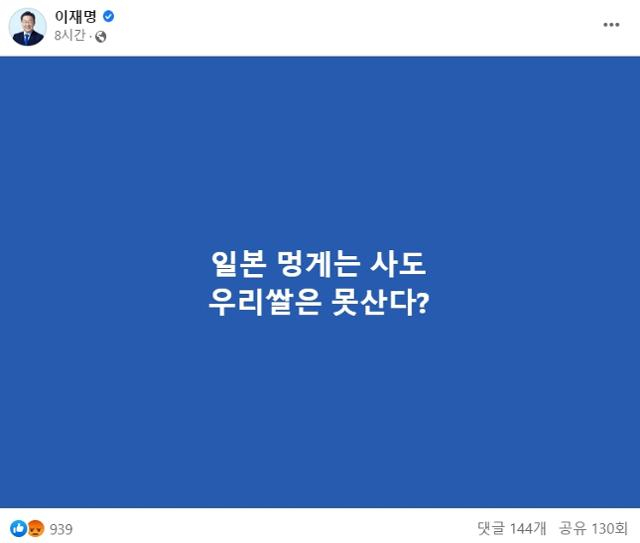
On the 30th, Lee Jae-myung, leader of the Democratic Party, targeted the government in a Facebook post, saying, "Japan can buy sea squirts, but can't buy our rice?"
Earlier, the Mainichi Shimbun reported that Nukaga, chairman of the Japan-Korea Parliamentary League, requested the resumption of imports of Japanese sea squirts to President Yoon Suk-yeol during his visit to Japan on the 17th.
South Korea has completely banned the import of all seafood species caught in Fukushima Prefecture and eight surrounding metropolitan municipalities since the Fukushima nuclear accident caused by the Great East Japan Earthquake in 2011. Additionally, imports of 27 agricultural products from 14 prefectures are also banned.
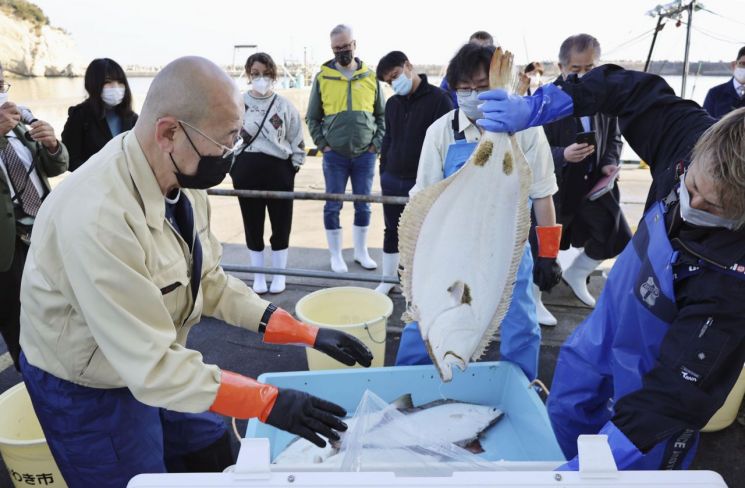 The International Atomic Energy Agency (IAEA) inspection team is observing the transfer of fish samples collected on November 10 last year from the port of Iwaki City, Fukushima Prefecture, as the Japanese government plans to discharge contaminated water from the Fukushima Daiichi Nuclear Power Plant into the sea next spring.
 [Image source=Yonhap News]
In response, a presidential office official denied the reports, stating that "the word 'sea squirt' was never mentioned," but as related Japanese media reports continued to surface, the opposition parties have maintained their offensive.
The "our rice" mentioned alongside "sea squirt" by Lee refers to speculation that President Yoon will exercise his veto power over the amendment to the Grain Management Act. The amendment stipulates that when the surplus production of rice exceeds 3-5% of demand or rice prices fall by 5-8% compared to the previous year, the government will purchase all surplus production. It passed the National Assembly plenary session on the 23rd through a Democratic Party solo vote.
The government and ruling party hold a negative stance toward the Grain Management Act. On the 29th, Prime Minister Han Duck-soo stated in a public address that the amendment is a "forced purchase law for surplus rice" and announced that he would recommend President Yoon exercise his veto power.
In other words, Lee's remark, "Japan can buy sea squirts, but can't buy our rice?" criticizes the government for being willing to accept Japan's request to resume sea squirt imports while reluctant to purchase Korean rice.
As the controversy spread, the presidential office issued a statement on the 30th, asserting that "seafood from Fukushima will never enter the country." They also emphasized that "the government's position remains unchanged that public health and safety are the top priorities regarding the import of Japanese seafood."
However, the presidential office has not expressed any particular stance on the issue of discharging contaminated water from the nuclear power plant into the ocean, so the controversy has not subsided.
On the 29th, Japan's Kyodo News reported that during President Yoon's visit to Japan, he met with former Prime Minister Suga Yoshihide and reportedly said, "Even if it takes time, we will seek the understanding of the Korean people" regarding the discharge of contaminated water from the Fukushima Daiichi nuclear power plant into the ocean.
© The Asia Business Daily(www.asiae.co.kr). All rights reserved.


















