Ahead of next year's general election, the National Assembly has formed a plenary committee to discuss the redistricting of electoral districts. After four days of debate starting from the 10th of next month, a consensus will be reached. Considering the public's strong opposition to increasing the number of National Assembly members, expanding the number of seats will not be easy. Additionally, if the number of proportional representatives is increased to ensure proportionality, the number of constituency seats must be reduced, which is difficult for lawmakers to accept.
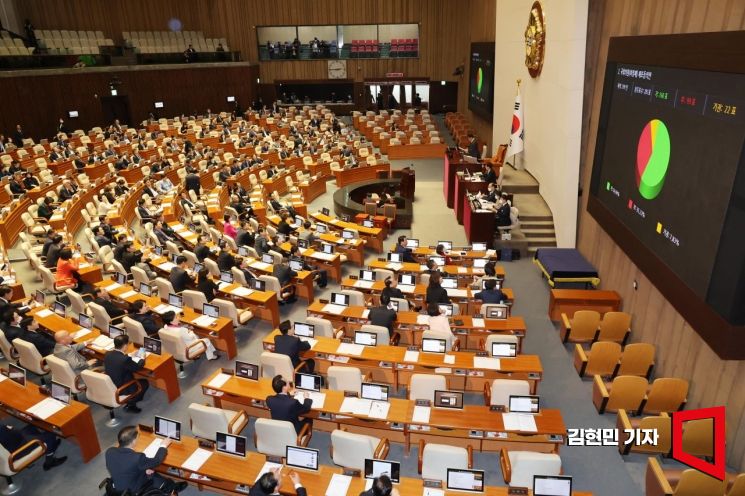 On the 30th, at the 2nd plenary session of the 404th National Assembly (extraordinary session) held at the National Assembly in Yeouido, Seoul, the motion for arrest consent for National Assembly member Ha Young-je was passed. Photo by Kim Hyun-min kimhyun81@
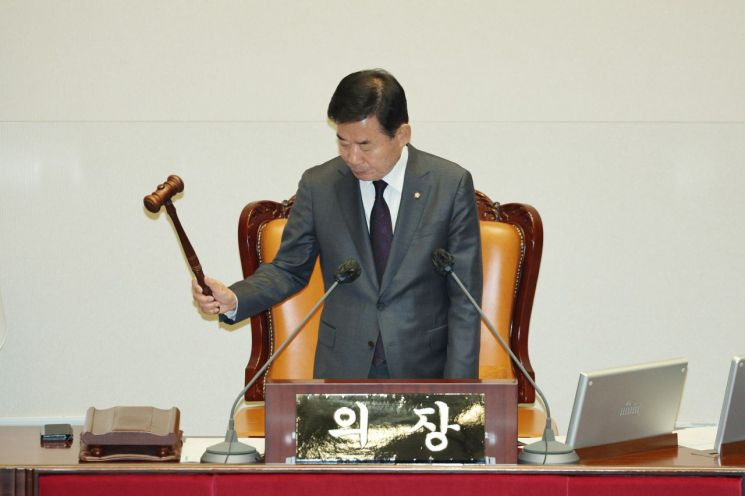
On the 30th, Speaker of the National Assembly Kim Jin-pyo held a plenary session at the National Assembly and explained the background of convening the plenary committee, stating, "this decision will be recorded as a significant historic decision in our constitutional history," and raised his voice saying, "We must first change the distorted electoral system where wasted votes reach 50 percent."
The plenary committee, where all members of the National Assembly engage in in-depth discussions to find a consensus, is being held for the first time in about 20 years since the plenary committee convened in 2003-2004 to discuss the dispatch of troops to Iraq. Speaker Kim said, "Let's institutionalize cooperation so that politics of dialogue and compromise can take root beyond the conflicts and divisions caused by winner-takes-all," and added, "Let's operate under the principles of deliberation, concentration, and speed, conduct focused and deep discussions, and reach a conclusion within April." The chairperson of the plenary committee will be Kim Young-joo, the Deputy Speaker of the National Assembly.
In this plenary committee, discussions on electoral system reform will be based on the resolution passed at the full meeting of the National Assembly's Special Committee on Political Reform (Jeonggae Special Committee). The first proposal is a mixed urban-rural large multi-member district system + regional and parallel proportional representation system; the second proposal is an open-list large multi-member district system + nationwide parallel proportional representation system; and the third proposal is a single-member district system + regional semi-compensatory proportional representation system.
The first proposal's mixed urban-rural large multi-member district system introduces a large multi-member district system in densely populated metropolitan areas, electing 3 to 5 members per district, while maintaining the single-member district system in rural areas. The second proposal's open-list large multi-member district system elects 4 to 7 members in each district for both urban and rural areas, with parties submitting candidate lists without ranking, and voters selecting one party and one candidate. Seats are allocated according to party vote share, and within those seats, winners are determined by vote counts. The third proposal maintains the existing single-member district system but changes the proportional representation system.
However, these three proposals serve only as discussion standards and are not final. The final decision may be modified through negotiations among lawmakers. Although all three proposals fix the number of lawmakers at 300, the possibility of expanding the number of lawmakers can be discussed in principle during the debate. Speaker Kim Jin-pyo previously proposed a compromise plan of 310 seats by reducing 10 constituency seats and increasing 20 proportional seats after opposition arose to increasing the number of lawmakers to 350. The Democratic Party and the Justice Party have also introduced electoral law amendments to expand the number of lawmakers to 330 and 360, respectively.
However, considering the public's opposition to increasing the number of lawmakers, it is expected that even raising the topic will be difficult. Former Democratic Party lawmaker Shin Kyung-min said on the 22nd on National Assembly Broadcasting's 'National Assembly Live 6,' "If you say let's increase even one seat beyond 300, the public will all rush to beat up the lawmakers. If 50 million people hit you, you won't be able to recover your bones," and added, "Even the 310 seats that Speaker Kim talks about will be hard to predict how it will take shape after in-depth discussions."
A survey conducted by Korea Gallup from the 21st to 23rd among 1,001 voters nationwide shows a firm public opposition to expanding the number of lawmakers. 57% said 'it should be reduced,' 30% said 'the current number is appropriate,' and only 9% said 'it can be increased.' The opinion that the number can be increased was somewhat dominant among people in their 40s, Democratic Party supporters, progressive-leaning groups, and those highly interested in politics, but even among them, nearly half answered that the number of lawmakers should be reduced. When asked if it would be acceptable to increase the number of lawmakers while maintaining the current total budget for lawmakers' salaries, 71% answered 'still no.'
There is political consensus that the number of proportional representatives should be increased to enhance proportionality, but if the number of lawmakers is fixed and the number of proportional representatives is increased, the number of constituency seats must be reduced. This is why Speaker Kim mentioned reducing 10 constituency seats in his 310-seat compromise plan. However, even this is not easy. Former lawmaker Shin said, "The moment you say reduce 10 constituency seats, it will be a fierce battle," and added, "When a lawmaker loses even one constituency, there is a huge uproar, so if you say reduce 10, they will not stay quiet."
Attention is also focused on whether the current single-member district system, criticized for encouraging 'winner-takes-all,' can be changed to a large multi-member district or a mega-district system in this electoral reform. Experts predict that escaping the single-member district system will not be easy. Professor Choi Jin-bong of Sungkonghoe University said on the 28th on National Assembly Broadcasting's 'National Assembly Live 1,' "Incumbent lawmakers do not like to drastically change the system they currently have. They have been elected under the current system and believe that continuing with this system will be advantageous to them," and added, "There is public demand for electoral reform and it is a controversial issue, so it cannot be ignored, but there is not much desire to make major changes."
© The Asia Business Daily(www.asiae.co.kr). All rights reserved.


















