Failure to Follow Maintenance Procedures One Year Before Accident
Pilot Made Error in 'Engine Shutdown' Judgment
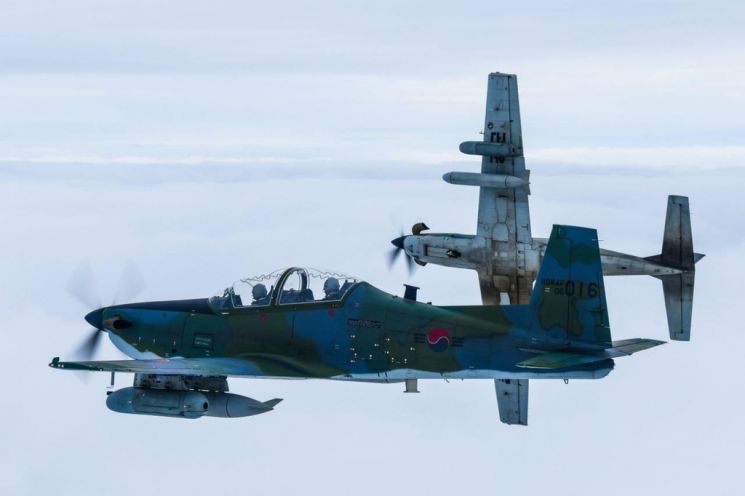
The accident involving the Air Force KA-1 airborne control attack aircraft, which crashed while scrambling for emergency response when a North Korean unmanned aerial vehicle (UAV) intruded into our airspace last December, was found to have occurred due to a combination of maintenance personnel and pilot errors. Since the accident happened during an emergency scramble, concerns have been raised about the military's readiness for actual combat situations.
The Air Force announced the results of a three-month investigation into the accident on the 30th. An Air Force official explained, "The accident was caused by a combination of factors, including engine abnormalities due to non-compliance with overhaul maintenance procedures for the engine fuel control device, and the pilot's inadequate situational judgment and handling operations."
Incorrect Assembly a Year Ago... Created a 'Gap' in Response to North Korean UAV
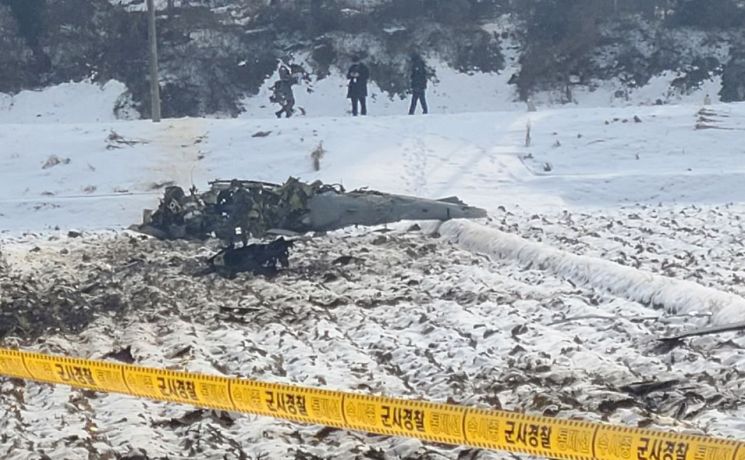
According to the Air Force, the accident aircraft took off from Wonju Base at 11:38 a.m. on December 26 last year. The pilot detected an abnormality in engine output at 11:39:22 a.m., shortly after takeoff, and turned back to the base for an emergency landing. Judging that a safe landing was impossible, the pilot turned the aircraft toward an area without residential houses and ejected at 11:39:39 a.m., and one second later, the aircraft collided with the ground.
The investigation confirmed an abnormality in the fuel control device supplying fuel to the engine. During the overhaul in May 2021, the maintenance technician responsible for the fuel control device failed to properly install a Teflon tube, one of the parts that regulate fuel supply. As a result, the torque gauge, which shows the aircraft's engine output during flight, indicated excessive engine output, and when the pilot attempted to reduce the output, there was no response initially, followed by a sudden drop in output.
An Air Force official said, "Normally, when the output changes within a small range, the feeling of acceleration and deceleration is not significant, but because the output dropped sharply, the deceleration felt different from usual." He added, "This created a situation where the pilot was understandably panicked and felt the need to land quickly." He further explained, "Since this was an emergency scramble for an actual operation, the aircraft was equipped with more armaments than usual, and these conditions seemed to have contributed to the pilot's confusion."
Poor Maintenance and Pilot's Inadequate Judgment... A Complex Issue
However, the engine was operating abnormally but still running at the time of the accident. No warning lights indicating engine abnormalities were lit, and marks on the ground made by the propeller, which continued to rotate after the crash, were also found. Nevertheless, the pilot made the error of judging that the engine had stopped.
In particular, due to hasty maneuvers, the aircraft made a much sharper turn than the predetermined emergency landing trajectory, resulting in a loss of speed. At that time, the descent angle also steepened to 27 degrees, far beyond the normal 5 degrees, causing the aircraft to tilt excessively. Even if the engine output had been alive, recovery at the low altitude of 125 meters would have been difficult.
The Air Force also stated that although the engine was operating abnormally, simulation results indicate that if the pilot had taken proper actions, an emergency landing would have been possible.
The accident aircraft had flown about 260 hours since the overhaul in May 2021, during which no significant issues were reported. Ultimately, poor maintenance, inadequate pilot judgment, and insufficient readiness for actual combat situations combined to cause the 'aircraft crash.'
The Air Force plans to refer some pilots, maintenance personnel, and command officers to a disciplinary committee. Additionally, the investigation results will be used to educate all pilots, emphasizing emergency procedures for engine abnormalities and emergency landing protocols. All fuel control devices on KA-1 and KT-1 basic trainers equipped with the same engine will undergo special inspections, and flights will resume gradually starting with aircraft that have completed inspections.
© The Asia Business Daily(www.asiae.co.kr). All rights reserved.


















