An Important Case of Buddhist Sculptor Succession in the Goheung Region during the Late Joseon Period
Gohung County, Jeollanam-do (Governor Gong Young-min) announced on the 30th that the ‘Gohung Songgwangam Wooden Buddha and Bodhisattva Statues’ have been preliminarily designated as a Tangible Cultural Property of Jeollanam-do.
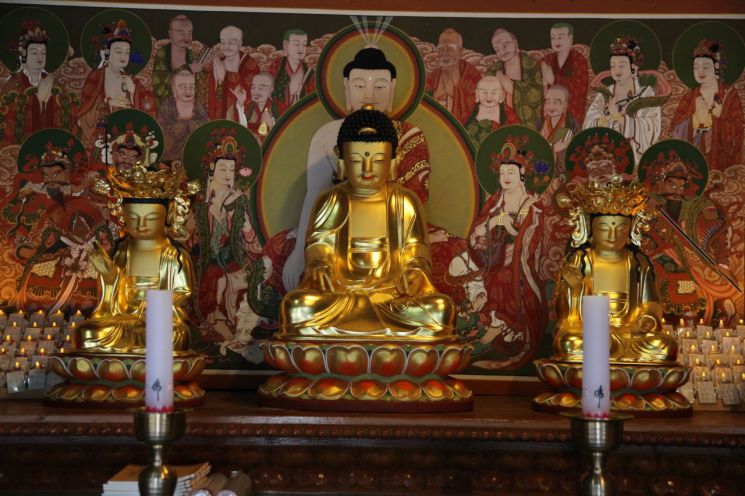
The ‘Gohung Songgwangam Wooden Buddha and Bodhisattva Statues,’ preliminarily designated as a Tangible Cultural Property by Jeollanam-do, are enshrined in the Geungnakjeon Hall of Songgwangam located in Eojeon-ri, Geumsan-myeon, Gohung County.
After the 30-day preliminary announcement period, the statues are scheduled to be officially designated as a ‘Tangible Cultural Property (有形文化財)’ of Jeollanam-do following a review by the Cultural Heritage Committee.
Songgwangam in Geumsan-myeon is said to have been founded by the Buddhist monk Jinul, the National Preceptor during the Goryeo Dynasty.
The wooden triad Buddha statues in Geungnakjeon consist of three wooden statues enshrined in Songgwangam’s representative hall: Amitabha Buddha, Mahasthamaprapta Bodhisattva, and Avalokitesvara Bodhisattva, each created in different periods.
The wooden Amitabha Buddha was carved in 1680 by sculptors Bohae and Seoltan.
It features a small, round face with a smile, and both hands are lowered. The right foot is placed over the left foot in a posture symbolizing good fortune.
The overall proportions resemble the works of sculptor Heejang.
In particular, the wide garment flowing between the crossed legs is very similar to Heejang’s work, indicating a close relationship between the two sculptors.
The wooden Mahasthamaprapta Bodhisattva was created in 1709 by sculptor Saeknan and his ten disciples.
It has a relatively slender face with a faint smile. Although the upper garment is not large, the crown is large and ornate compared to the face, giving a luxurious impression. The shoulders are relatively narrow, but the proportions are well balanced.
This statue, created in the later period of sculptor Saeknan, is not only artistically valuable but also an important academic resource.
The wooden Avalokitesvara Bodhisattva was made in 1726 by sculptors Hacheon, Chijun, and Jonghye.
Hacheon was one of the sculptors in Saeknan’s lineage, and his works closely resemble Saeknan’s statues. Compared to the wooden Mahasthamaprapta Bodhisattva, this statue has a slightly fuller body, a rounder face, and a more solemn expression.
The original enshrinement location was Munsuam Hermitage on Mabuksan Mountain in Podu-myeon, as confirmed through the ritual text found inside the statue.
As such, the statues enshrined in Geungnakjeon Hall of Songgwangam in Gohung were created by different sculptors for the principal Buddha and attendant Bodhisattvas, allowing their characteristics to be observed at a glance. They also demonstrate the continuation of sculptural traditions, making them a highly significant case.
Additionally, since the relics inside the statues remain intact, there were opinions that further designation expansion is necessary through future investigations.
Governor Gong Young-min stated, “The value assessment of Gohung’s cultural heritage is steadily progressing,” and added, “This year, we plan to reexamine undesignated cultural heritage, so continuous interest from the residents is needed.”
Gohung = Asia Economy Honam Reporting Headquarters, Reporter Shim Jeong-woo hss79@asiae.co.kr
© The Asia Business Daily(www.asiae.co.kr). All rights reserved.

















