"Imported Medicines for Pets Replacement... Price Reduction Possible Through Competition"
From now on, pharmaceutical companies (manufacturers of human medicines) will be able to produce pet medicines using their existing manufacturing facilities. Previously, separate manufacturing facilities for veterinary medicines had to be established, costing hundreds of billions of won and causing a burden of redundant investment.
The Regulatory Tribunal of the Prime Minister's Office recommended this decision to the Ministry of Agriculture, Food and Rural Affairs on the 30th.
The Regulatory Tribunal explained the background of the decision by stating, “Most advanced countries such as the United States, the EU, and Japan also allow the production of veterinary medicines in human medicine manufacturing facilities.”
It added, “Strict manufacturing quality control standards are applied to thoroughly manage and operate the manufacturing facilities to ensure there are absolutely no safety issues for humans and animals.”
The Prime Minister's Office expects that this regulatory relaxation will contribute to the growth of the veterinary medicine market.
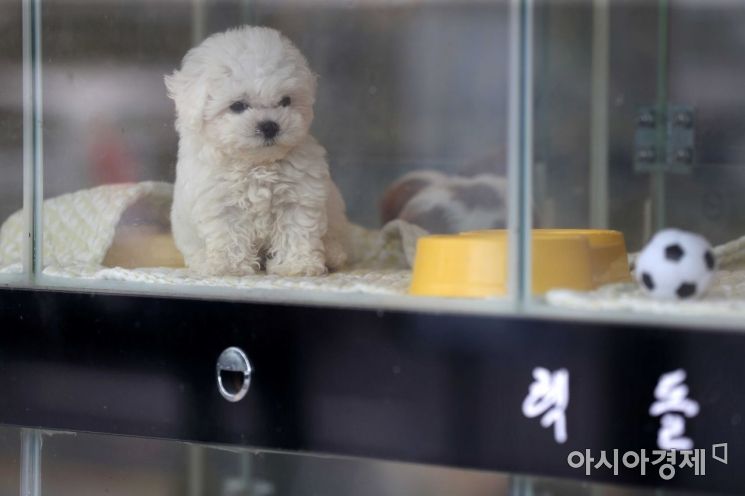 A dog inside a glass partition at a pet shop in Seoul is struggling with the heat. Photo by Mun Ho-nam munonam@
The veterinary medicine market, which was about 62 trillion won this year, is expected to rapidly grow to about 108 trillion won by 2030. The domestic market is also steadily growing by more than 5% annually. This is due to increased interest in pets and the rise of zoonotic infectious diseases (such as COVID-19).
However, the pet medicine industry has been heavily dependent on imports (import ratio: 73.9%).
With this measure, it is expected that high-quality and diverse pet medicines will be supplied, replacing expensive imported medicines. An effect of expanding exports to advanced countries is also anticipated.
The Regulatory Tribunal recommended limiting the target animals to pets and focusing the scope of medicines on high value-added medicines. This is intended to encourage pharmaceutical companies to concentrate on developing high-quality medicines and to promote coexistence with existing industries.
A representative of the Regulatory Tribunal explained, “This measure will enable the production of high value-added medicines such as anticancer drugs and antihypertensive drugs for pets, providing an opportunity for the domestic veterinary medicine industry to emerge as a future growth industry.”
They added, “It is expected that consumer welfare will also increase due to price reductions through competition. Human medicines previously used for animals due to the lack of appropriate veterinary medicines will be improved and supplied to be suitable for animals, contributing to safer animal treatment.”
© The Asia Business Daily(www.asiae.co.kr). All rights reserved.

















