"The body can be thought of as Daedongyeojido and the head as Dongyeodo."
This is the explanation of Professor Kim Ki-hyuk, Emeritus Professor at Pusan National University, regarding the repatriated copy of 'Daedongyeojido' revealed at a press conference held at the Seoul Museum of History on the morning of the 30th. Professor Kim added that this 'Daedongyeojido' is a new form distinctly different from the existing domestic copies.
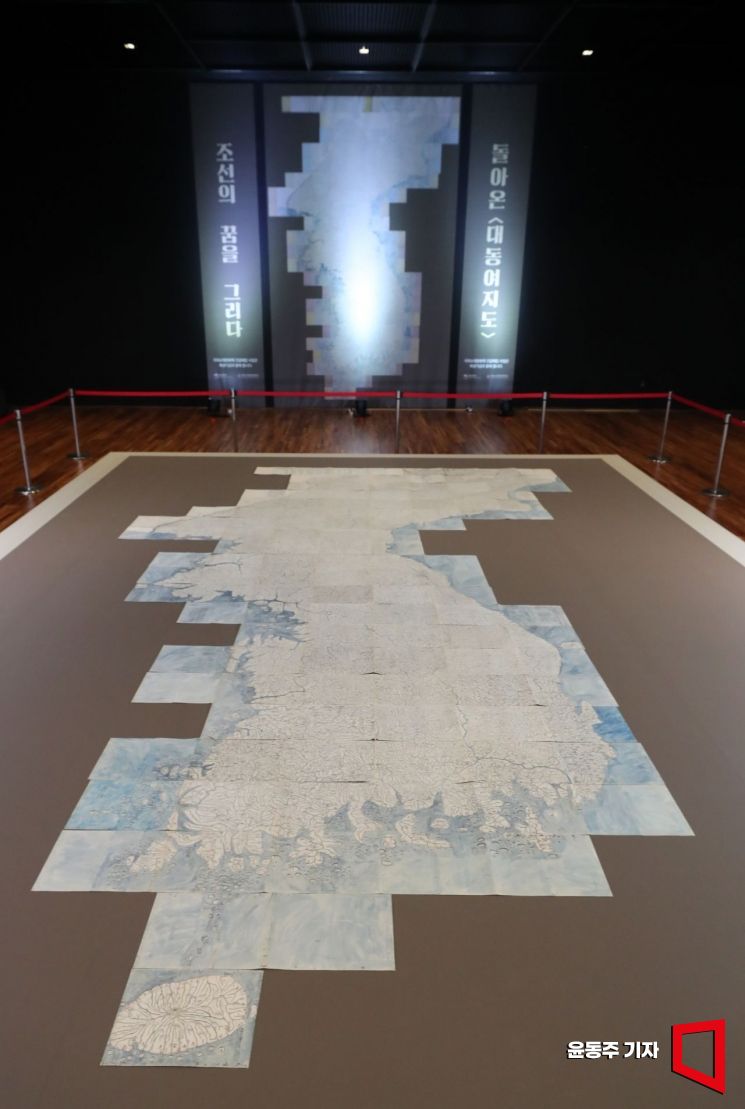 On the 30th, the "Daedongyeojido" repatriated from Japan was unveiled at the National Palace Museum of Korea in Jongno-gu, Seoul. Photo by Dongju Yoon doso7@
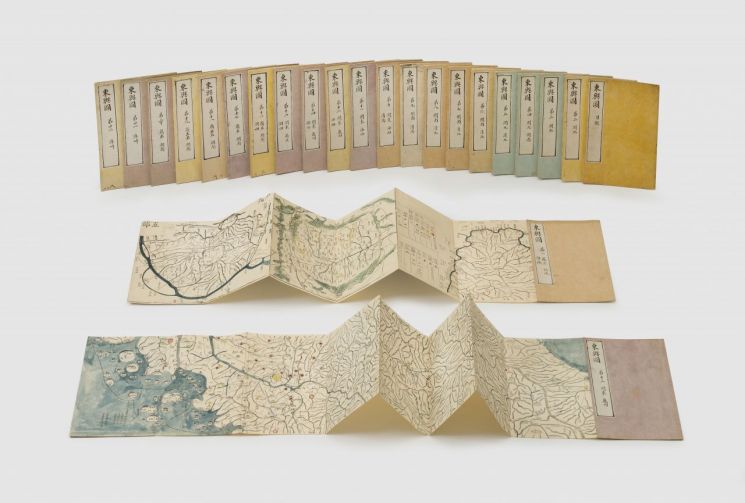
'Daedongyeojido' is a 22-panel folding screen-style nationwide map album created and published by Kim Jeong-ho, a geographer and map publisher of the Joseon Dynasty, in 1861 and reissued in 1864. There were 36 copies worldwide, but recently, two additional copies were discovered among the late Lee Kun-hee's donated items, increasing the total to 38. Including this repatriated copy, purchased from Japan by the Overseas Korean Cultural Heritage Foundation and brought back to Korea, the total is 39 copies.
The repatriated Daedongyeojido contains more detailed information than existing editions. The original 'Daedongyeojido' omitted about 7,000 place names and 'annotations' (information on map production and usage) when transferring the colored manuscript map album 'Dongyeodo,' which served as the base map at the time of production, onto woodblocks. However, the repatriated 'Daedongyeojido' shows many place names and distance information handwritten. Although the creator of 'Dongyeodo,' which served as the basis for 'Daedongyeojido,' is uncertain, academia generally assumes it was made by Kim Jeong-ho.
In fact, the repatriated 'Daedongyeojido' includes handwritten details not found in existing editions, such as the 'Baekdusan Boundary Monument' and distances between military facilities, as well as information like the departure point of boats heading to Ulleungdo. Another difference is that the Gangwon-do Samcheokbu and Ulleungdo areas, previously printed across two panels, are reduced and arranged on one panel. Professor Kim explained, "This is the first case where Dongyeodo was almost entirely transferred to Daedongyeojido," adding, "The additional distance from Baekdusan to Samsugapsan was also carried over from Dongyeodo."
Regarding the absence of Dokdo on the map, Professor Kim said, "Other maps from that time show Dokdo both to the right and left of Ulleungdo," and explained, "It seems it was omitted due to uncertainty about its exact location."
However, it is not certain whether the creator (copyist) of the repatriated copy is Kim Jeong-ho, who made the original 'Daedongyeojido.' Professor Kim stated, "The handwriting of the repatriated copy is not the same as that of 'Daedongjiriji,' known to be Kim Jeong-ho's own writing," and added, "If not Kim Jeong-ho, it is presumed to be an intellectual of the time who had access to 'Dongyeodo.'"
The discovery of this repatriated copy is expected to strengthen research on old maps, as it is the first case where 'Dongyeodo' and 'Daedongyeojido' overlap. Professor Kim said, "Around 2007, when research was conducted to designate old maps as cultural heritage, the designation of 'Daedongyeojido' was postponed due to the need for further research," and added, "I expect this to be an opportunity to restart map research, which had stalled without any special trigger since then."
© The Asia Business Daily(www.asiae.co.kr). All rights reserved.


















