Financial Services Commission Holds 2nd Task Force Meeting on Banking Sector Management, Business Practices, and System Improvements
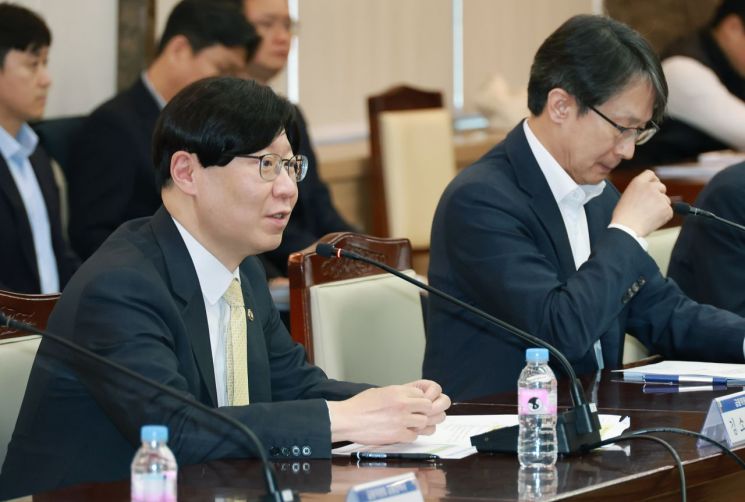
Kim So-young, Vice Chairman of the Financial Services Commission, stated on the 29th regarding the Small License (license segmentation) system proposed as part of measures to promote competition in the banking sector, “It is necessary to comprehensively consider not only the increase in financial consumer benefits and promotion of competition but also financial stability.”
According to the Financial Services Commission on the 30th, Vice Chairman Kim made these remarks at the 2nd Task Force (TF) meeting on improving management, business practices, and systems in the banking sector held the previous day at the Government Seoul Office in Jongno-gu, Seoul. He said, “Based on the advantages and disadvantages of the Small License, its effects on competition, and its effectiveness, it is necessary to listen to and build consensus among the public, the financial sector, and various stakeholders regarding whether and how to introduce it.”
The TF meeting was held as a mid-term review following four working group meetings since its launch in February. During the meeting, the Financial Services Commission shared the results of a research study on “Domestic and international cases and implications of Small Licenses.”
According to the study, the banking Small License system is designed to impose entry regulations proportional to risk by restricting the scope of business, target customers, business scale, and business methods. In Korea, forms of Small Licenses currently include regional banks, internet-only banks, mutual savings banks, and credit cooperatives.
Regarding the domestic introduction of Small Licenses, it was shared that in the case of “payment-specialized banks,” consumer benefits are not significant, but there are concerns about soundness due to difficulties in securing profitability and the potential risk expansion caused by intensified deposit competition.
Additionally, for small and medium-sized enterprise (SME) loan-specialized banks, it was pointed out that the procyclicality of bank assets increases, raising concerns about bank insolvency during economic downturns, and that difficulties in SME credit evaluation may make it challenging to generate profits and maintain soundness.
The TF meeting also shared the welfare improvement effects related to allowing corporate payment services by securities firms and payment services by insurance, card, and fintech companies. Associations from each industry sector stated that permitting payment services to non-bank sectors could provide various consumer benefits along with innovative services.
However, the Bank of Korea expressed concerns, stating that it is difficult to find cases worldwide where non-bank sectors are fully allowed to participate in small payment systems without strict payment risk management. While the effects felt by customers are minimal, there are worries that the safety of the payment system could be significantly compromised due to a sharp increase in bank agency payment amounts or the risk of digital runs.
Furthermore, allowing non-bank sectors to participate in small payment systems effectively introduces a “narrow banking” system specialized in deposits and payment services, which is not subject to the Bank Act, Financial Consumer Protection Act, or Depositor Protection Act, potentially causing regulatory arbitrage.
The Bank of Korea stated, “Allowing non-bank sectors to participate in small payment systems should be comprehensively considered from the perspectives of financial stability and consumer protection, based on a fundamental reform of payment risk management systems similar to those in major countries.” It added, “Especially at this time, when payment risks need to be further strengthened due to incidents such as the Silicon Valley Bank (SVB) case and real estate project financing (PF), it is not desirable to proceed with related discussions.”
Regarding this, Chairman Kim said, “The issue of payment services by non-bank sectors requires sufficient consideration of the trade-off between efficiency and stability,” adding, “It is necessary to judge while examining the essential financial stability levels such as payment risk management from the perspective of same function, same risk, and same regulation, along with sufficient consumer benefit enhancement effects.”
Meanwhile, the meeting also shared the TF’s operational achievements and plans. The Financial Services Commission self-assessed that through the working group’s operations so far, it has prepared measures to promote competition in deposits and loans, such as expanding refinancing loan infrastructure, launching online deposit brokerage services, and improving the disclosure system for deposit-loan interest rate spreads, as well as enhancing banks’ loss absorption capacity through the imposition of countercyclical capital buffers.
Vice Chairman Kim urged, “I ask private experts to take an active interest so that improvement measures can be prepared by the end of June,” and added, “The financial authorities will also actively support the smooth operation of the TF.”
© The Asia Business Daily(www.asiae.co.kr). All rights reserved.

















