Joint Report by Relevant Ministries on 2022 Abnormal Climate
Unseasonal Heat and Cold... Various Damages Also Occurred
Last year was recorded as a year in which 'abnormal climate' occurred comprehensively.
On the 30th, the government, in collaboration with related ministries, announced the '2022 Abnormal Climate Report' containing this information.
One of the abnormal climate phenomena last year was the longest recorded meteorological drought in the southern region.

The meteorological drought, defined as 'a situation where the rainfall over six months is significantly below the average,' lasted for 227.3 days in the southern region, marking the longest period since 1974.
Rainfall was particularly low from December 2021 to February 2022 and in May last year. The drought that began in the southern region in February last year expanded nationwide by the end of May.
Subsequently, heavy rains in the central region alleviated the drought in Seoul, Gyeonggi, and Gangwon from late June, and in Chungbuk and Chungnam by mid-August. However, the drought continues to persist in the southern region.
Among the southern areas, the drought was especially severe in Jeonnam. In June and July last year, damage to crops such as rice, including withering and dying, occurred over an area of 1,442 hectares (ha; 1 hectare equals 10,000 square meters) in Jeonnam alone.
The dry weather also led to wildfires. Last year, the number of wildfires and the affected area were 742 cases and 24,787.5 ha respectively, significantly exceeding the 10-year average (481 cases and 1,087.1 ha).
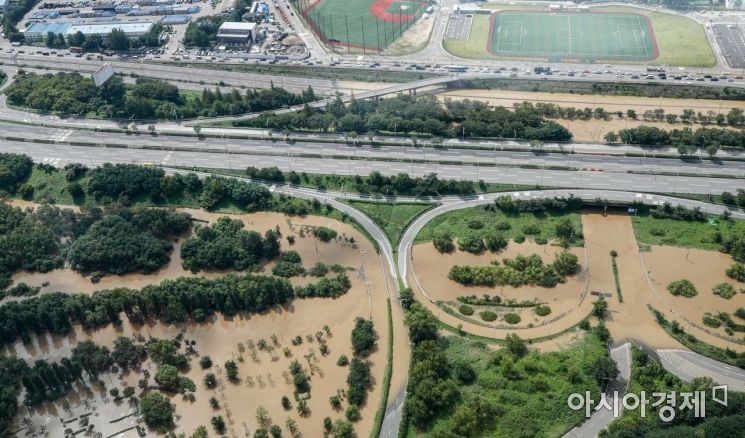 On the 10th, as the heavy rain that swept through the central region subsided, the section of Olympic-daero in Seoul from Dongjak Bridge to Gayang Bridge toward Gimpo is being closed. Photo by Jinhyung Kang aymsdream@
Last summer, there was also a phenomenon where heavy rain fell only in the central region.
From August 8 to 11, after the monsoon season ended, a narrow north-south rain cloud band settled over the central region, causing heavy rain, including over 600 mm in parts of Gyeonggi over four days. On August 8, concentrated heavy rain exceeding 100 mm per hour fell in southern parts of Seoul.
The concentrated heavy rain in the central region in August resulted in 17 deaths and 2 missing persons. Farmland covering 409.7 ha was washed away or buried, and about 33,000 livestock perished. The area affected by landslides was 327.3 ha. Property damage amounted to 315.4 billion KRW.
There was also damage related to rainfall when Typhoon Hinnamnor (the 11th typhoon) made landfall in early September.
When Hinnamnor landed, daily rainfall in Gyeongju and Pohang in Gyeongbuk reached 212.3 mm and 342.4 mm respectively, setting record highs for daily rainfall in September in each area.
Hinnamnor caused 11 deaths and property damage amounting to 243.9 billion KRW.
The reason Hinnamnor was strong was due to warm seas; the East Sea had the highest sea surface temperatures since 1982 in April, May, June, November, and December; the Yellow Sea in January; and the East China Sea in January, March, April, July, August, and December.
In August and September, when Hinnamnor formed and moved northward, the East China Sea's sea surface temperature ranked 1st and 7th highest since 1982. Sea levels were also high last year, with the East Sea recording the highest levels since 1993 in February, September, and November; the Yellow Sea in February, June, September, and November; and the East China Sea in February, June, and September.
Regarding temperatures, abnormal climate phenomena included 'early summer heat from mid to late April,' 'early tropical nights and heatwaves from late June to early July,' 'unseasonably high temperatures in November,' 'late severe cold in mid-February,' 'early cold in mid-October,' and 'severe cold and heavy snow in December.'
In particular, June saw the first-ever 'June tropical night' in Seoul and Suwon, Gyeonggi.
During the summer heatwave, there were 1,564 heat-related illness cases, including 9 deaths, which was 13.7% higher than in 2021.
Yoo Hee-dong, Director of the Korea Meteorological Administration, stated, "Last year was a year that made us realize that the climate crisis has arrived beyond climate change," and added, "We will strengthen the role of the Meteorological Administration as a monitoring, forecasting, and support institution for the climate crisis."
© The Asia Business Daily(www.asiae.co.kr). All rights reserved.

















