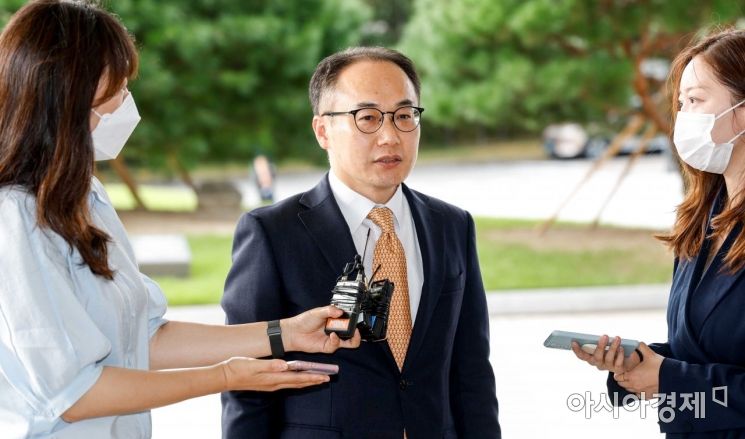
Prosecutor General Wonseok Lee commented on the recent Constitutional Court decision that acknowledged unconstitutionality in the legislative process but maintained the validity of the so-called 'Prosecution Reform' law, stating, "I believe the public will agree with the fundamental principle that legislation should not be enacted in an unconstitutional manner."
At the March monthly meeting held at the Supreme Prosecutors' Office on the morning of March 30, Lee said, "Over the past year, from April last year to recently, the legislative process for the so-called 'Prosecution Reform' bill and the Constitutional Court's decision have caused severe social conflict and confrontation, leading to wasteful debates and a significant loss of national energy."
Lee continued, "The overall intent of the recent Constitutional Court decision appears to be: 'Although unconstitutionality was found in the legislative process and procedures, the Court will respect the National Assembly's autonomy and formative function and will not invalidate the law.' While there are various interpretations of the Constitutional Court's decision, I emphasize that the public will agree with the fundamental principle that important laws directly related to the protection of basic rights should not be enacted in an unconstitutional manner, disregarding proper procedures and processes."
He added, "While natural sciences can conduct tens of thousands of repeated experiments in laboratories, there is no such laboratory for social sciences, and a premature experiment could have unpredictable negative effects on its subjects-people and society. Especially in criminal procedures, which are directly linked to the lives, safety, and property of the public, even minor errors or loopholes must not be tolerated. Changes to criminal laws and systems must reflect public opinion, undergo thorough debate and deliberation, and respect minority voices, so that they are implemented in a flawless and perfect manner."
Previously, on March 23, the Constitutional Court ruled by a 5 (uphold) to 4 (dismiss) vote in a competence dispute case filed by lawmakers Sangbeom Yoo and Juhae Jeon of the People Power Party against the chair of the Legislation and Judiciary Committee and the Speaker of the National Assembly. The Court found that lawmaker Hyungbae Min of the Democratic Party had engaged in a 'fake defection' to be appointed to the agenda coordination committee, and that the then committee chair Kwangon Park's act of submitting and passing the bill in the committee, while condoning this, violated the National Assembly Act and the Constitution, thereby infringing upon the right of Yoo and others to deliberate and vote on the bill.
At that time, four Constitutional Court justices opined that, during the legislative process for the amended Prosecutors' Office Act and the amended Criminal Procedure Act-key parts of the Prosecution Reform-lawmakers of the People Power Party, Justice Minister Donghoon Han, and prosecutors had their powers infringed, and that the act of passing the bill at the National Assembly plenary session was invalid. However, as the required majority of five justices was not reached, this did not become the official decision of the Court.
Notably, controversy arose as four justices classified as progressive-including Chief Justice Namseok Yoo of the Constitutional Court, who previously led the Korean Society for Legal Studies alongside Chief Justice Myungsoo Kim, Justice Kiyoung Kim of the International Human Rights Law Society (also led by Kim), Justice Seoktae Lee, formerly of the Lawyers for a Democratic Society, and Justice Hyungbae Moon-shared the same opinion on all issues.
Meanwhile, Prosecutor General Lee once again emphasized the need for strict responses to corruption and economic crimes.
He stated, "The prosecution has recently conducted strict investigations or indictments regarding economic crimes by major business figures at Korea Tire Group, Daewoo Engineering & Construction, Shinpoong Pharmaceutical, TMON, and others, as well as corruption crimes in the political sphere involving both ruling and opposition lawmakers. While thoroughly responding to crimes affecting people's livelihoods-such as sexual violence, stalking, rental fraud, voice phishing, and child abuse-is a fundamental duty of the prosecution, we must also remember that responding strictly to corruption and economic crimes, which undermine the very foundations and values of our community, is a grave mission entrusted to the prosecution."
Lee further emphasized that "while everyone is outraged by crimes where victims and damage are immediately visible, corruption, economic, public security, and election crimes-which are often concealed and whose direct harm is not immediately apparent-ultimately undermine the foundations of our community. Therefore, we must respond swiftly and thoroughly to such crimes."
Finally, Lee cited the phrase from Han Feizi, "The law does not flatter those of noble status," and urged, "Let there be no exceptions, privileges, or sanctuaries before the law. I ask that the law be applied and enforced strictly and fairly to everyone, according to the same standards and measures."
© The Asia Business Daily(www.asiae.co.kr). All rights reserved.

















