Sharp Decline Due to Weakness in Bonds and Stocks
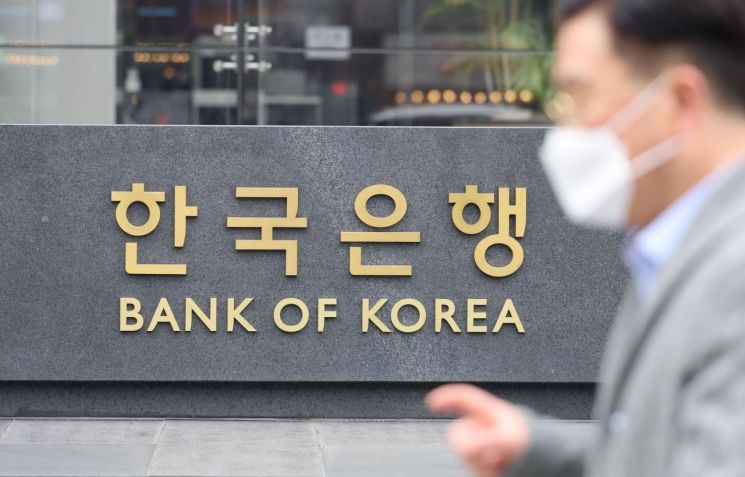
The Bank of Korea's net profit last year was 2.5452 trillion won, nearly 68% down from the previous year's record high. This was due to increased losses from securities trading amid a sluggish stock market caused by heightened global risk aversion, and a sharp rise in interest expenses on monetary stabilization bonds due to rising interest rates.
According to the '2022 Annual Report' released by the Bank of Korea on the 31st, last year's net profit was 2.5452 trillion won, a decrease of 5.3186 trillion won from 2021 (7.8638 trillion won). In 2021, the Bank posted its highest-ever net profit due to a global stock market boom, but last year, the impact of rising interest rates increased interest on monetary stabilization bonds and caused bond prices and stock prices to fall, resulting in a sharp decline.
The Bank explained, "Although total revenue increased due to higher foreign currency asset management interest and foreign exchange trading gains, total expenses, including securities trading losses and interest on monetary stabilization bonds, increased more significantly, leading to a decrease in net profit."
The Bank's total revenue last year was 20.9946 trillion won, and total expenses were 17.6982 trillion won. Total revenue increased by 1.9115 trillion won compared to the previous year, while total expenses surged by 9.3565 trillion won.
The proportion of dollar-denominated assets in the Bank's foreign currency assets (excluding International Monetary Fund positions, gold, and special drawing rights) stood at 72% at the end of last year. This was up 3.7 percentage points from 68.3% at the end of 2021. The dollar share expanded as risk aversion grew and safe-haven demand strengthened, leading to a stronger US dollar. The share of other currencies was 28%, down 3.7 percentage points from 31.7% the previous year.
Among the Bank's foreign currency assets, cash-equivalent assets accounted for 10%, up 4.8 percentage points from 5.2% at the end of the previous year. This was the highest proportion since statistics began in 2007. Direct investment assets accounted for 65.7%, and entrusted assets made up 24.3%.
A Bank of Korea official said, "The proportion of cash-equivalent assets among foreign currency assets had been around 5%, but last year, the dollar index rose to its highest level since 2002, and with increased volatility in the foreign exchange market, the proportion nearly doubled. Cash-equivalent assets serve as an intermediate account that can immediately supply domestic foreign currency liquidity, so it can be seen as maintaining a scale that allows for response." Regarding this year's plans, the official added, "The foreign exchange market is showing a more stable trend than last year. While securing foreign currency liquidity remains important this year, whether to maintain the proportion of cash-equivalent assets will need to be observed."
By product, the share of government bonds was 39.4%, down 5.5 percentage points from the previous year. The share of government agency bonds remained unchanged at 14.1%, while corporate bonds decreased by 1.9 percentage points to 11%. The reduction in government and corporate bond shares was due to bond sales during the process of expanding foreign currency liquidity to stabilize the domestic foreign exchange market. The stock share increased by 1.0 percentage point to 11.4% compared to the previous year.
The Bank set aside 763.6 billion won, 30% of net profit, as a statutory reserve, and 27 billion won as a discretionary reserve for the purpose of contributing to the Farmers and Fishermen Lump-sum Savings Encouragement Fund. The remaining 1.7546 trillion won was paid to the government as revenue.
As of the end of last year, the Bank's total assets stood at 582.8261 trillion won, down 12.8175 trillion won from 595.6437 trillion won at the end of the previous year. This was due to a significant decrease in foreign currency securities despite the rise in the won-dollar exchange rate. Liabilities amounted to 560.9065 trillion won, down 9.8581 trillion won from 570.7646 trillion won at the end of the previous year. While currency issuance increased mainly in the banking sector, the issuance of monetary stabilization bonds decreased due to a reduction in liquidity adjustment scale.
© The Asia Business Daily(www.asiae.co.kr). All rights reserved.
![Clutching a Stolen Dior Bag, Saying "I Hate Being Poor but Real"... The Grotesque Con of a "Human Knockoff" [Slate]](https://cwcontent.asiae.co.kr/asiaresize/183/2026021902243444107_1771435474.jpg)











