Debate Between Ruling and Opposition Parties Over Kim Seong-han's Resignation
Allegations of Blackpink Concert Request Omission and Power Struggle Raised
There are differing interpretations between the ruling and opposition parties regarding the resignation of Kim Seong-han, the head of the presidential security office. While some say the decisive factor for his resignation was the omission of the report on the joint performance request by Blackpink and Lady Gaga, others suggest there is a power struggle within the diplomatic and security line. The ruling party points out the issue of the omitted report and tries to quell rumors of conflict, whereas the opposition party highlights conflicts within the diplomatic and security line surrounding the South Korea-Japan summit as the main reason.
Lee Cheol-gyu, the chief secretary of the People Power Party and a leading pro-Yoon (친윤) faction member, dismissed the "conflict theory" between Kim Seong-han and Kim Tae-hyo, the first deputy director, on the 30th CBS program 'Kim Hyun-jung's News Show,' saying, "Some reports mention conflicts and such, but that is not the case."
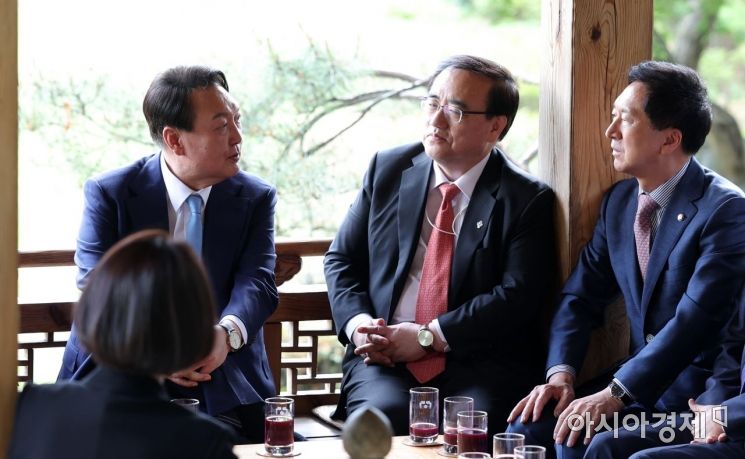 President Yoon Suk-yeol received a report from Kim Ki-hyun, head of the European Union (EU) special envoy delegation, on the 14th at Samcheong-dong, Jongno-gu, Seoul, and had lunch together. All members of the special envoy delegation attended the lunch, including Kim Ki-hyun, Lee Cheol-gyu (deputy head), Im E-ja, Park Soo-young, Bae Hyun-jin, Hong Kyu-duk, professor at Sookmyung Women's University, and Park Sung-hoon, professor at Korea University. From the presidential office, Chief Secretary Kim Dae-gi, Senior Secretary for Economy Choi Sang-mok, National Security Office Chief Kim Sung-han, and First Deputy Kim Tae-hyo were present. Photo by Kim Ki-hyun's Office
Regarding Kim's resignation, which he announced the day before, reports have emerged that the decisive factor was the failure to properly convey the U.S. side's request for a Blackpink performance ahead of President Yoon Seok-yeol's visit to the U.S. next month. Meanwhile, some speculate about a "power struggle."
In response, Secretary Lee said, "When Kim took charge of the Office of Foreign Affairs and Security, he had consistently said that once the government stabilized, and relations with the U.S. and Japan normalized, the Korea-U.S. alliance was restored, and a cooperative system between Korea and the U.S. was established, he would return to academia." He added, "I think he decided to resign after achieving some results," denying the conflict theory.
Kim Byung-min, a Supreme Council member of the People Power Party, on SBS's 'Kim Tae-hyun's Political Show,' pointed out the issue related to the "omission of the joint performance request by Blackpink and Lady Gaga," which is strongly suspected as the background of Kim's resignation. He said, "This is not simply about a performance, but an event commemorating the 70th anniversary of the Korea-U.S. alliance, where the president and his spouse cooperate together, so it is a matter of trust."
He added, "If the issue is mishandled at the working level, trust between the two leaders could be broken," and warned, "As trust at the working level cracks, it could lead to unintended consequences, so we must be very careful and keep this in mind to prevent such incidents in the future."
On the other hand, Woo Sang-ho, a member of the National Assembly's Foreign Affairs and Unification Committee from the Democratic Party of Korea, said on MBC's 'Kim Jong-bae's Focus,' "When someone at the security chief level suddenly resigns, it is usually due to conflict," and criticized, "Replacing a country's security chief because of Blackpink and Lady Gaga? It's a laughingstock worldwide."
This aligns with the Democratic Party's stance that views Kim's resignation as a "power struggle." Kwon Chil-seung, the Democratic Party's chief spokesperson, raised suspicions during a briefing the day before, saying, "There are widespread rumors of clashes between administrative officers from Kim Geon-hee's line and civil servant secretaries, as well as friction between Kim Seong-han and Kim Tae-hyo."
The fact that Lee Moon-hee, the foreign affairs secretary, and Kim Il-beom, the protocol secretary, were replaced before Kim Seong-han is also why Rep. Woo claims internal conflict. He said, "Regarding this issue, especially when replacing such a level of personnel, at least in my view, it is impossible without factional conflict. From what I have heard, this seems to be the aftermath of the South Korea-Japan summit," adding, "Professional diplomats who have long served expressed considerable concern about how the summit was pushed forward."
© The Asia Business Daily(www.asiae.co.kr). All rights reserved.

















