People Power Party Signs to Waive Immunity from Arrest
No Woong-rae and Lee Jae-myung's Arrest Consent Proposals Rejected in Succession
Dilemma Difficult for Both Supporters and Opponents to Choose
The arrest consent motion for Ha Young-je, a member of the People Power Party who has been indicted on charges including violation of the Political Funds Act, will be put to a vote at the plenary session of the National Assembly on the 30th. As the People Power Party officially declared the waiver of immunity from arrest, the Democratic Party of Korea has found itself in a dilemma.
On the same day, the People Power Party will hold a party meeting just before the plenary session to finalize the party stance on the arrest consent motion against Representative Ha. Since more than half of the current People Power Party lawmakers have already signed the waiver of immunity from arrest, there is a possibility that the party stance will be unified in favor of 'approval.' Among the signatories were 58 out of 115 People Power Party members, including Floor Leader Joo Ho-young. A first-term lawmaker from the People Power Party said, "Due to personal relationships, it might be difficult to set a party stance," but added, "Since the party has continuously expressed support for the arrest consent motion, I think most members will likely support it individually."
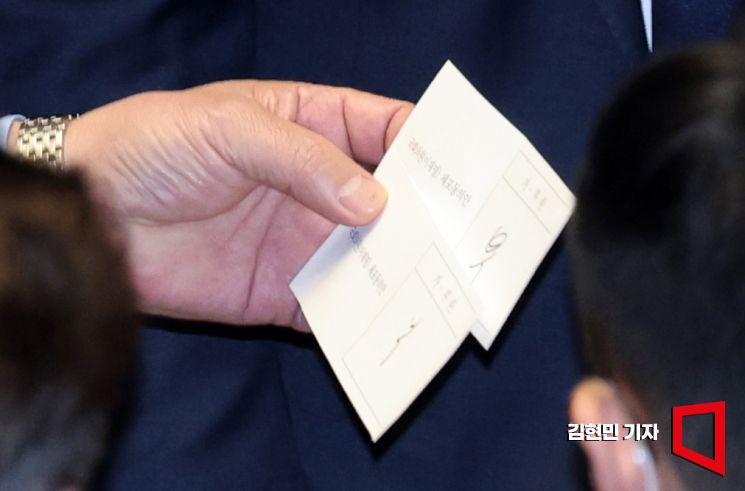 On the 27th, during the vote counting process for the arrest consent bill against National Assembly member Lee Jae-myung at the 8th plenary session of the 403rd National Assembly (extraordinary session) held at the National Assembly in Yeouido, Seoul, the ballot counters are debating the validity of invalid votes. Photo by Kim Hyun-min kimhyun81@
Representative Ha is accused of receiving 70 million won in illegal political funds in exchange for helping nominate preliminary candidates for the Gyeongnam Provincial Council elections ahead of last year's local elections. The prosecution requested an arrest warrant for Representative Ha on the 20th, and the arrest consent motion was reported at the National Assembly plenary session on the 23rd. It is reported that Representative Ha made phone calls to fellow lawmakers urging them to vote against the motion ahead of the vote.
Even if all People Power Party lawmakers vote in favor on the day of the vote, the arrest consent motion for Representative Ha will not pass. Since the motion requires a majority of the total members to be present and a majority of those present to approve, cooperation from the opposition party is essential. For this reason, the Democratic Party, which holds a majority of the seats, appears to be deliberating on the direction of their vote.
If the arrest consent motion for Representative Ha is approved, it will contrast with the rejection of similar motions against Democratic Party lawmaker Roh Woong-rae, who is accused of violating the Political Funds Act and other charges, and Democratic Party leader Lee. Even if the motion is rejected, it may be seen as a preparation for the expected re-submission of the arrest warrant for Leader Lee. The Democratic Party rejected the arrest consent motions for Representative Roh (accused of bribery, solicitation, and violations of the Political Funds Act) and Leader Lee (accused of breach of trust and violations of the Conflict of Interest Prevention Act). Rejecting the arrest consent motion for Representative Ha, who is accused of violating the Political Funds Act, could give the impression of defending 'political offenders.'
In political circles, it is predicted that it will be difficult to anticipate the outcome of the vote since the arrest consent motion will be conducted by secret ballot. Even if both ruling and opposition parties set a party stance, the nature of the secret ballot allows members to cast votes contrary to the party line. In fact, during the vote on the arrest consent motion for Leader Lee Jae-myung, although the Democratic Party leadership declared a consensus to reject, a large number of dissenting votes emerged. A first-term Democratic Party lawmaker said, "At the party meeting, it seems they will just report it as one of the plenary session agenda items and leave the decision to the lawmakers," adding, "Considering that Representative Ha has admitted all charges, it seems worth taking into account."
Meanwhile, at the plenary session on the same day, the so-called 'K-Chips Act' (Amendment to the Restriction of Special Taxation Act) aimed at fostering the domestic semiconductor industry will be passed. The K-Chips Act includes provisions to expand the tax credit rate when companies invest in facilities in national strategic industries such as semiconductors. Also expected to pass are the 'Special Act on the Construction of Gadeokdo New Airport' amendment, which allows advancing the timing of land compensation to expedite the early construction of Gadeokdo New Airport, and the amendment to the Housing Lease Protection Act, which secures tenants' right to review by requiring landlords to provide tenants with information on the date of fixed registration, rent (money paid for the use of leased property), deposit, and tax payment certificates when signing lease contracts to prevent rental fraud.
© The Asia Business Daily(www.asiae.co.kr). All rights reserved.

















