Over 300 Years Since Last Eruption... Possibility of Explosion
Economic Damage Estimated at 24 Trillion Won, Tokyo Expected to Be Paralyzed
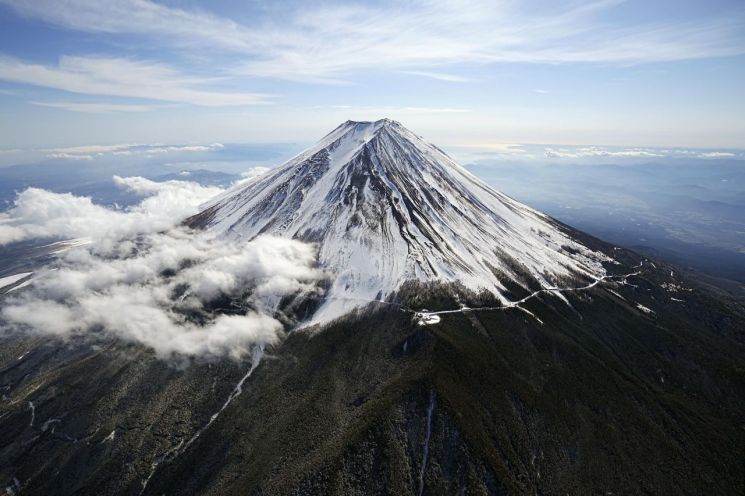
A comprehensive revision has been made to the evacuation plan for residents and tourists in nearby areas in the event of an eruption of Mount Fuji in Japan. Amid prevailing analyses suggesting that an earthquake larger than the Great East Japan Earthquake will occur within the next 30 years, concerns are rising that the risk of a Mount Fuji eruption may also be becoming a reality.
According to the Nihon Keizai Shimbun (Nikkei) on the 30th, the Mount Fuji Volcano Disaster Prevention Council announced a revised draft of the "Basic Evacuation Plan for Mount Fuji Volcano" the day before, which serves as evacuation guidelines in case of an eruption. The council, composed of representatives from the three prefectures bordering Mount Fuji?Yamanashi, Kanagawa, and Shizuoka?and officials from the Japanese government, fully revised the evacuation plan originally announced in 2014.
First, the revision established walking evacuation as the principle. A council official stated, "Because vehicle traffic congestion is expected, walking evacuation was judged to be faster." The council assumed that lava flowing from the crater would descend at a walking pace and set different regional responses based on the distance from Mount Fuji. Additionally, the plan includes various implementation measures such as evacuating tourists, evacuating patients in hospitals and elderly care facilities, and handing over children to guardians at nearby schools.
However, the plan is based on a scenario where signs of an eruption gradually become observable, culminating in an actual eruption. Since there are countless possibilities, such as sudden eruptions or eruptions resuming after a quiet period, local governments will create detailed evacuation plans tailored to their specific characteristics.
Regarding the timing of discussing a Mount Fuji eruption, Nikkei reported that "it is not unusual for an eruption to occur at any time." The last eruption of Mount Fuji occurred in 1707 during the Edo period, but if the timeframe is set back 5,600 years, it has erupted about 180 times to date.
In particular, an earthquake occurred around Mount Fuji four days after the Great East Japan Earthquake in 2011, and scholars believe this likely influenced current magma activity beneath Mount Fuji. Nikkei also reported, "There is a prevailing view that there is a 70-80% probability of a major earthquake with a seismic intensity of 8 to 9 occurring within the next 30 years along the Nankai Trough (Southern Sea Submarine Canyon), and some researchers argue that Mount Fuji could erupt at that time."
According to simulations by the council, if Mount Fuji erupts, social and economic damage is expected to be severe. First, 792,000 residents fall under the evacuation target. The council estimates that 110,000 people could be affected by lava reaching residential areas within three hours or by pyroclastic flows and falling rocks. The Tokyo metropolitan area will also be within the impact zone; for example, in Shinjuku, Tokyo, volcanic ash is expected to accumulate to 10 cm by 15 days after the eruption. The accumulation of volcanic ash could prevent vehicles and trains from operating or cause power outages, raising concerns about disruptions to daily life due to logistics crises.
Economic damage is expected to reach up to 2.5 trillion yen (approximately 24.6 trillion won), and the volume of volcanic ash requiring disposal is estimated at 490 million cubic meters. This amount is ten times the disaster waste generated by the Great East Japan Earthquake.
© The Asia Business Daily(www.asiae.co.kr). All rights reserved.
![Clutching a Stolen Dior Bag, Saying "I Hate Being Poor but Real"... The Grotesque Con of a "Human Knockoff" [Slate]](https://cwcontent.asiae.co.kr/asiaresize/183/2026021902243444107_1771435474.jpg)
















